Turning Your Cloud Native Apps Inside Out With a Service Mesh
Explore cloud native best practices and the benefits of using an Envoy-based Service Mesh to enhance development, improve management, and accelerate migration to modern application patterns.
Resource Requests and Limits Under the Hood - The Journey of a Pod Spec
Explore Kubernetes resource management through fun illustrations, understanding how requests and limits work from Pod spec to Linux kernel, enhancing your ability to optimize cluster performance.
xDS in gRPC for Service Mesh
Explore xDS functionality in gRPC for service mesh, including its benefits, limitations, and current status. Learn about microservices, sidecar proxies, and control plane resources.
Building a Portable Kubernetes Deployment Pipeline with Argo Workflows and Events
Explore building a portable Kubernetes deployment pipeline using Argo Workflows and Events. Learn best practices for multi-cloud environments, platform portability, and managing scalable cluster configurations.
Istio Beyond Kubernetes
Explore Istio's versatility in building service meshes across diverse infrastructures, including Kubernetes, VMs, and bare metal. Learn from real-world examples and understand key tradeoffs.

Creating Chaos in the University with Linkerd and Chaos Mesh
Explore chaos engineering experiments using Linkerd and Chaos Mesh, interpreting data and applying concepts to real-life scenarios in cloud-native environments.
Rapid Experimentation Simplified with Linkerd
Explore how a financial services company used Linkerd for rapid experimentation, enabling resilient services and comparative testing. Learn about local Kubernetes clusters and service mesh representation for efficient microservices development.
Kubernetes and Service Mesh Upgrade Automobile Company’s IT Infrastructure
Explore how an automobile company upgraded its IT infrastructure using Kubernetes and service mesh, improving efficiency and simplifying operations through cloud-native technologies.
How MS3 Supports 10,000+ Transactions Per Second with Kuma Service Mesh Across VMs and Kubernetes
Explore how MS3 uses Kuma service mesh to handle 10,000+ transactions per second, addressing security and observability across VMs and Kubernetes for efficient cloud-native application delivery.
Over the Edge
Explore edge computing insights with industry leaders Craig McLuckie and Matt Trifiro in this KubeCon live session. Gain valuable perspectives on cloud-native technologies and their impact on distributed infrastructure.
Centralized, Distributed or Both? - Architectures for Kubernetes on the Edge
Explore Kubernetes architecture options for edge computing, including centralized and distributed models, and learn about relevant projects like KubeEdge, K3s, and Metal3.
Constructing Building Blocks for Production Grade Cloud Native Deployments - with Crossplane
Discover how Crossplane and composition enable deployment of a highly available Vault with GCS backup, Cloud KMS auto-unsealing, and GCP workload identity, simplifying cloud-native infrastructure assembly.
Kubernetes to Serve a Fraud Detection Model
Explore how Kubernetes powers real-time fraud detection in e-commerce, ensuring reliable and scalable transaction processing with automated deployments and business logic integration.
Integrating Security in the Build Pipeline
Discover how to integrate security into your build pipeline, addressing vulnerabilities early and making deployment decisions based on artifact security status.
The How & Why for Building Crossplane Providers
Explore Crossplane Providers: architecture, development, and use cases. Learn when to create a Provider vs. alternatives like Helm Charts. Includes demo on bootstrapping a new Provider and creating resources.
The SAME Project - A Cloud Native Approach to Reproducible Machine Learning
Explore cloud-native approaches to reproducible machine learning with the SAME Project, focusing on Kubernetes and Kubeflow for efficient scaling and seamless collaboration in ML environments.
Deja Vu - Let's Think About Security Again
Explore cloud-native security transformations, DevSecOps, and Zero Trust in Crossplane. Discuss potential gaps, new tools, and best practices for developers and security experts in cloud infrastructure management.
A First Look at the Security of Serverless Applications
Explore serverless computing security threats, challenges, and mitigation strategies. Learn about attack types, feasibility, and protective measures for this emerging cloud paradigm.
Cloud-Init with Crossplane
Explore leveraging cloud-init with Crossplane for configuring baremetal and VM instances, combining scripts, and managing low-level resources to replicate managed services on bare infrastructure.
Cloud Native Solutions are Fueling a Telecom Revolution
Explore how cloud-native solutions are revolutionizing telecom with microservices and container orchestration, enabling 5G and edge cloud deployments while addressing challenges in QoS, security, and multi-cloud setups.
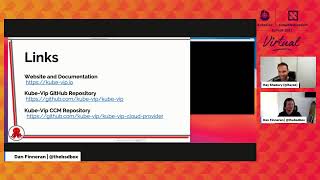
Leveling Up Kubernetes with kube-vip
Explore kube-vip, a tool for enhancing Kubernetes clusters with high availability and load balancing capabilities, improving resilience and performance in cloud-native environments.