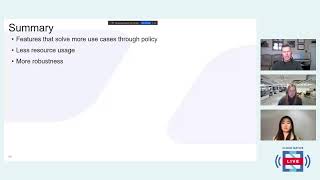
Cloud Native Live: What's New with Kyverno
Explore Kyverno's latest features for cloud-native policy management, including architecture updates, new policy structures, and critical enhancements for improved validation and organizational strategies.
Kubernetes Everywhere: Lessons Learned From Going Multi-Cloud
Insights on deploying Kubernetes across multiple cloud providers, exploring networking differences, scaling challenges, and successful strategies for multi-cloud infrastructure management.

Kubernetes Networking 101
Comprehensive introduction to Kubernetes networking, covering services, DNS, CNI plugins, ingress, load balancing, and service mesh. Hands-on approach with practical examples and scenarios.
Observing Fastly's Network at Scale with Kubernetes and Strimzi
Explore Fastly's Autopilot system for optimizing edge network traffic, focusing on telemetry pipeline, k8s-based platform, and key operators like Strimzi Kafka. Learn about challenges in network-related use cases.
SPIRE: Introduction and Deep Dive Into Windows Support
Explore SPIRE's secure software identification system and its new Windows support. Learn implementation details, platform differences, and user/developer experiences for workload identity management at scale.
PolicyReport CRD - Managing Admission Control, Runtime, and Scan Reports
Explore PolicyReport CRD for standardized Kubernetes policy management. Learn about adapters for various engines and discover Policy Reporter's integration capabilities.
Komrade: An Open-Source Security Chaos Engineering Tool for Kubernetes
Explore Security Chaos Engineering (SCE) and its application in Kubernetes with Komrade, an open-source tool for proactively identifying system vulnerabilities through controlled experiments.
Cluster API Introduction and Deep Dive - Simplifying Kubernetes Cluster Management
Explore Cluster API's role in simplifying Kubernetes cluster management across environments, featuring new capabilities like ClusterClass for efficient cluster deployment and operations.
Scaling Kubernetes Nodes Without Breaking the Bank or Your Sanity
Discover best practices for utilizing spot capacity in Kubernetes clusters, optimizing costs and simplifying VM infrastructure management with tools and techniques for efficient scaling.
From Docker Push to Bytes on Disk - Inside Distribution
Explore the inner workings of container image distribution, from client-side operations to cloud storage, including API interactions, data structures, and garbage collection processes.
Your Manila CephFS Share Backups Belong to S3 - Automating Kubernetes Backup and Restore
Explore CERN's automated backup solution for Kubernetes using Velero, CephFS, Manila, and S3. Learn how to implement this workflow in your clusters for efficient disaster recovery.
Distributed Random Access Merkledags - Exploring Registry Capabilities
Explore innovative uses of OCI registries, drawing parallels with computer architecture concepts to redefine distributed systems and introduce Distributed Random Access Merkledags.
Operating Prometheus in a Serverless World
Explore challenges and solutions for monitoring serverless architectures with Prometheus, including Cloudflare's approach and potential future improvements for better insight into distributed systems.
Tweezering Kubernetes Resources - Operating on Operators
Explore Kubernetes Operators' security risks, threat modeling, and best practices for secure implementation. Learn to assess third-party Operators and conduct effective code reviews for enhanced cluster safety.
Implementing Anti-patterns: Kubernetes Cross-namespace Resource Ownership
Explore cross-namespace resource ownership in Kubernetes, its challenges, and potential solutions. Learn how to implement this anti-pattern while maintaining core services and garbage collection mechanisms.
Tail-Based Sampling in OpenTelemetry Collector - Why, How, and Issues
Explore tail-based sampling in OpenTelemetry Collector: benefits, configuration, implementation in microservices, and current challenges for production deployments.
GitOps to Automate the Setup, Management and Extension of a Kubernetes Cluster
Learn to automate Kubernetes cluster setup and management using GitOps, Terraform, FluxCD, sealed-secrets, and Crossplane. Explore Infrastructure as Code and multi-cloud provisioning techniques.
How to Migrate 700 Kubernetes Clusters to Cluster API with Zero Downtime
Discover how Mercedes-Benz migrated 700 Kubernetes clusters to Cluster API, overcoming challenges and ensuring zero downtime. Learn valuable insights on transferring production systems and extending Cluster API functionality.
Kubernetes IoT Edge Working Group: Edge Device Onboarding and Management
Explore open-source tools for edge device lifecycle management, from secure onboarding to production use. Learn about CNCF, LF Edge, and Eclipse projects extending cloud capabilities to edge devices and I/O.
The Soul of a New Command - Adding Events to kubectl
Explore the development of 'kubectl alpha events' command, its origins, structure, and future potential. Learn about Kubernetes enhancements and helper libraries for fetching and printing objects.
Kubernetes SIG CLI: Introduction and Updates
Explore Kubernetes SIG CLI's recent work, including kubectl and kustomize updates, KRM Functions subproject, and declarative vs. imperative workflows. Learn about contributing and join the open discussion.