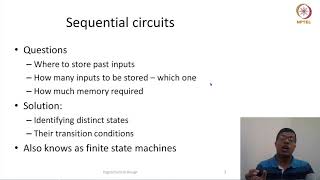
Introduction to Sequential Circuits
Explore synchronous sequential circuits and their building blocks, gaining foundational knowledge for digital system design.
Thermodynamics for Electrical Engineers - Why Did My Board Melt?
Learn to prevent board meltdowns through thermal analysis. Explore heat transfer principles, simulation tools, and practical applications for effective circuit design and component selection.
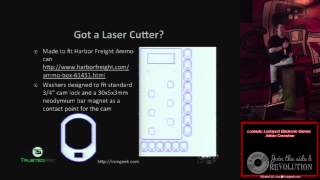
Lockade: Electronic Games for Locksport Training - BSides Cleveland 2014
Explore electronic lockpicking games, from basic lock types to advanced gamification concepts. Learn about schematics, mechanisms, and creative ideas for building your own lockpicking challenges.
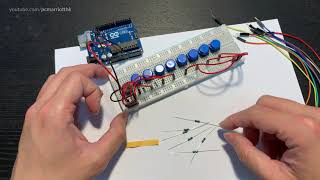
Arduino Piano With 8 Pushbuttons + Passive Buzzer - Coding With mBlock 3 + Extensions
Learn to build an Arduino piano using pushbuttons and a buzzer, with step-by-step guidance on wiring, coding, and programming using mBlock 3 and extensions.

Fault Tolerance of Stabilizer Channels in Quantum Computing
Explore rigorous analysis methods for fault tolerance in stabilizer channels, focusing on surface codes, LDPC codes, and Floquet codes for quantum computing applications.
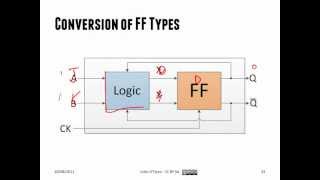
Course Review Lecture Part 3 - Aug 10, 2012
Comprehensive review of digital logic concepts including flip-flops, registers, counters, and finite state machines. Covers design processes and practical applications in digital systems.

Solving Private Set Intersection via Cuckoo Hashing - Benny Pinkas, Bar-Ilan University, Israel
Explore private set intersection protocols, including custom and generic MPC approaches, with a focus on Cuckoo hashing for efficient computation of PSI variants in cryptography and security.
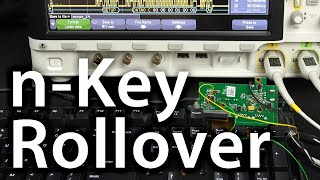
How N-Key Rollover Works in Keyboards
Explore the mechanics of n-key rollover in keyboards, including matrix scanning, ghosting prevention, and implementation techniques for improved typing accuracy and responsiveness.

Build an 8-Bit Decimal Display for 8-Bit Computer
Learn to create a multiplexed decimal display for an 8-bit computer using EEPROM, exploring both unsigned and signed modes, and enhancing your digital electronics skills.
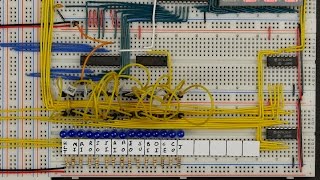
8-Bit CPU Control Signal Overview
Detailed overview of control signals in an 8-bit breadboard computer, covering memory, RAM, instruction register, and program counter operations with practical demonstrations.
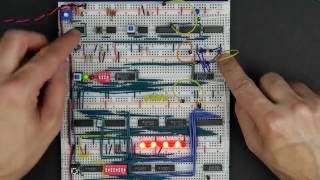
RAM Module Testing and Troubleshooting - Fixing Issues and Modifying Clock Edge Triggering
Learn to test, troubleshoot, and modify a RAM module, focusing on fixing issues and improving clock-triggered writes in digital circuit design.
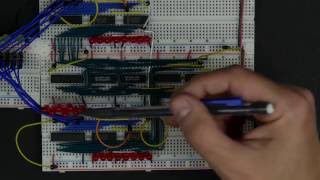
Building the ALU for an 8-Bit Computer
Construct an 8-bit computer's ALU using basic electronic components. Learn about binary addition, logic gates, and digital circuit design principles.

Making Logic Gates from Transistors
Learn how transistors form the building blocks of digital logic, from basic inverters to complex XOR gates, in this hands-on exploration of fundamental computer architecture.
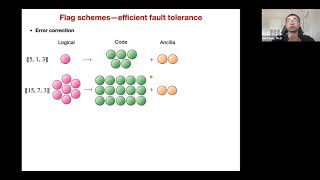
Quantum Fault Tolerance with Flag Qubits - Quantum Colloquium
Explore fault-tolerant quantum computing using flag qubits, a qubit-efficient method for error detection and correction in quantum circuits, with applications and theoretical implications.
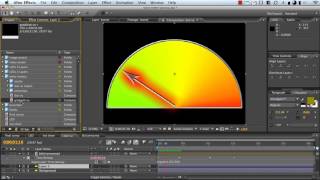
Noise Meter Tutorial - LED Lights and Animation
Create a noise meter with LED lights and Arduino, learning animation techniques and exploring housing options for your project.
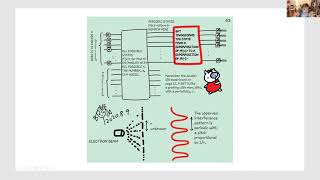
Intro to Quantum Computing - Shor's Algorithm
Explore Shor's Algorithm in quantum computing, focusing on its implementation, components, and applications in factoring large numbers efficiently.

Understanding Photoresistors and Photo Detectors
Learn to use photoresistors with Arduino, exploring their physics and creating a light-sensitive LED project. Gain practical skills in circuit building and programming for real-world applications.

From Small to Tiny: Co-designing ML Models, Computational Precision, and Circuits - Energy-Accuracy Trade-offs
Explore co-designing ML models, computational precision, and circuits for energy-efficient tinyML systems. Learn about cross-layer optimization and cascaded networks for embedded applications.

Arduino Ant Hexapod Robot
Learn to build an Arduino-powered hexapod robot resembling an ant, complete with functional eyes, antennas, and mandibles. Covers 3D modeling, assembly, circuit design, PCB creation, and Arduino programming.
Push Button On-Off Emulator - Cheap Upgrade for Your Arduino Project
Emulate LTC2954 push button on-off functionality for Arduino projects using dual MOSFET circuitry. Learn to implement graceful shutdown requests with simple modifications and interrupt handling.
Fingerprint Readers for Arduino - R307 Plus Adafruit Version
Learn to integrate fingerprint readers with Arduino for enhanced security, including enrollment, verification, and controlling door locks.