
Responsible Microservices
Explore microservices architecture, its benefits, and best practices. Learn about team formation, gradual system replacement, deployment strategies, and the importance of monitoring and reliability engineering.
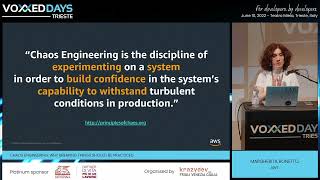
Chaos Engineering - Why Breaking Things Should be Practiced
Explore chaos engineering to build resilient systems by simulating failures. Learn how to uncover hidden issues and improve application performance through controlled disruptions.
Creating Chaos in Containers
Explore chaos engineering in containerized environments, learning about failure layers, testing considerations, and available tools for improving application resilience.

Trace Specifications and Chaos Engineering: Advanced Testing with Snabbkaffe - Code BEAM Europe 2022
Explore advanced testing techniques for distributed Erlang applications using trace specifications and chaos engineering. Learn to verify complex scenarios and improve fault tolerance in production systems.

Reducing Trauma in Production with SLOs and Chaos Engineering
Discover how to enhance system reliability through Service Level Objectives and Chaos Engineering practices, focusing on error budgets, compliance, and resilience to improve customer experience and reduce production issues.

Chaos Engineering in the Fast Lane: Accelerating Resilience with eBPF
Explore chaos engineering with eBPF, enhancing resilience in Kubernetes. Learn advanced techniques, AI integration, and practical experiments for robust system design and security.

Smart Chaos: Leveraging Generative AI for Enhanced Chaos Engineering
Explore leveraging generative AI for chaos engineering in complex enterprises. Learn to enhance testing, analyze dependencies, define steady states, create hypotheses, and design experiments for improved system resilience.

War Games - Prepare for the Unexpected in Chaos Engineering
Explore chaos engineering war games to enhance system resilience. Learn strategies for stakeholder engagement, tabletop exercises, and environment-based simulations to prepare for unexpected scenarios.

Chaos in the Cloud - Exploring AWS Resilience and Fault Injection Simulator
Explore chaos engineering in cloud environments, focusing on AWS resilience strategies, fault injection simulators, and new cross-region and AZ availability scenarios. Gain practical insights and best practices.

Mastering the Maze: Navigating Complexity in Distributed Systems
Explore distributed systems complexities, challenges, and strategies. Learn about architecture, consistency, availability, and SRE principles for navigating complex systems effectively.
Chaos Engineering for SQL Server
Explore Chaos Engineering concepts and methodologies to identify potential weaknesses in SQL Server, enhancing system resilience and reliability.
From Chaos to Quality: Elevating LitmusChaos with CI/CD and Pull Requests
Explore how LitmusChaos integrated CI/CD practices and pull requests to enhance code quality in chaos engineering. Learn strategies for improving development workflows and applying these principles to your projects.

Resilience Testing of PostgreSQL Operators in Kubernetes
Explore PostgreSQL operator resilience through chaos testing. Observe recovery and downtime impact by subjecting operators to extreme conditions in Kubernetes environments.

Monkey Business for Serious Systems: Why Chaos Engineering Isn't Crazy
Explore chaos engineering's role in uncovering system vulnerabilities and enhancing resilience. Learn to simulate real-world failures, identify weaknesses, and build robust infrastructures.

Chaos Mesh: Introducing Chaos in Kubernetes
Explore fault simulation in Kubernetes with Chaos Mesh, orchestrating scenarios to uncover potential system issues across development, testing, and production.

Build Multi-Region Resilient Applications Emphasizing Chaos Engineering
Explore resiliency and chaos engineering techniques for multi-region applications using AWS components. Learn failover strategies, Route 53 best practices, and CloudWatch Alarm integration for enhanced resilience.

Build Reliable Systems with Chaos Engineering - MLOps Podcast #237
Explore chaos engineering to build reliable systems under unpredictable conditions. Learn benefits, trends, and integration with ML systems for improved resilience and observability.

Simplifying Cloud Native Chaos Engineering: A Deep Dive into Chaos Mesh
Explore Chaos Mesh for cloud native chaos engineering, enhancing application reliability and resilience. Learn key features, best practices, and real-world examples to improve system stability.
Enhancing Cyber Resilience Through Zero Trust Chaos Experiments in Cloud Native Environments
Explore Zero Trust Chaos Experiments to uncover vulnerabilities and enhance cyber resilience in cloud-native environments. Learn strategies to detect and mitigate cyber threats through simulated disruptions.

Fail-Aware Events Processing on AWS - Implementing Resilient Consumers
Explore resilient event processing on AWS, focusing on failure scenarios, chaos engineering, observability, and best practices for implementing reliable consumers using SQS and Kinesis.

Embrace Chaos to Achieve Stability
Explore chaos engineering principles to enhance system resilience. Learn how to prepare for unexpected scenarios and test your infrastructure's ability to withstand disruptions, ensuring stability in critical situations.