Bootstrap in Matrix Models and Lattice - Luis Kruczenski, Vladimir Kazakov
Explore bootstrap techniques in matrix models and lattice Yang-Mills theory, discussing loop equations, positive constraints, and applications to gauge theories and confinement.
G-2M from Lattice QCD and Experiments - Zoltan Fodor
Explore the latest findings on (g-2)m from lattice QCD and experiments, including the 4.2 sigma discrepancy, experimental results, and theoretical contributions in this comprehensive physics talk.
The Flux Tube Spectrum and the World-Sheet Axion - Andreas Athinodorou
Explores flux tube spectrum and world-sheet axion in color confinement, combining lattice simulations, string theory, and gauge/gravity duality to study non-perturbative phenomena in non-Abelian gauge theories.

Quantum Field Theory - What Is a Particle?
Explore the concept of particles as excitations of relativistic quantum fields, from simple harmonic motion to quantum mechanics and field theory, in this accessible introduction to fundamental physics.

Second Order Harmonic Oscillator, Characteristic Equation, Ode45 in MATLAB
Explore second-order harmonic oscillators, characteristic equations, and ode45 in MATLAB through practical examples and hands-on coding for engineering mathematics applications.
Earth Science - Lift and Instability
Explore atmospheric lift mechanisms and stability types, understanding their impact on weather patterns and daily forecasting.
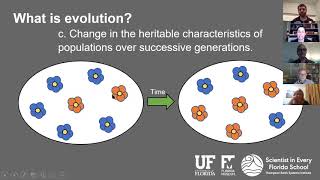
SEFS Webinar - Dr. Durkin - Nature of Science
Explore the nature of science through Dr. Durkin's PhD research, covering evolution, experimental design, and artificial selection in parasitic mites and their attachment to flies.
Deriving Classical from Quantum Physics - Ehrenfest's Theorem
Brian Greene explores Ehrenfest's Theorem, revealing how classical physics emerges from quantum mechanics through mathematical derivation, bridging two fundamental descriptions of reality.
Integrability in Planar AdS/CFT - Yangian Symmetry and Applications - Lecture 1
Explore Yangian symmetry in AdS/CFT correspondence, focusing on N=4 supersymmetric Yang-Mills theory and its applications to scattering amplitudes, correlation functions, and Wilson loops.
Baryons, Determinants and Integrability at Large N - Lecture 1
Explore baryonic and determinant operators in large N gauge theories, their relation to D-branes, and new approaches for computing correlation functions using emergent semi-classical descriptions and integrability.
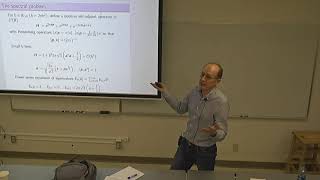
On the Spectral Problem of a Three Term Difference Operator
Explore the spectral problem of quantum mechanical operators in complex Planck's constant scenarios, focusing on toric Calabi-Yau threefolds and their implications.

TIG Welding Tips and Arc Length
Mastering TIG welding techniques for various joints and metals, emphasizing the importance of maintaining a tight arc length for optimal results across different materials and joint types.
Randomized Methods for Quantum Many-Body Problems - A Mathematical Primer
Explore randomized methods for quantum many-body problems, focusing on Monte Carlo techniques to approximate ground and excited states in large systems. Learn about VMC and FCIQMC algorithms.

Systematically Improvable Models from Alchemical Perturbations - IPAM UCLA
Explore systematic improvements in quantum models using alchemical perturbations, connecting chemical spaces and simplifying material design through novel approaches and fundamental constraints.
Exact Degeneracies and Screening vs. Confinement in 2D Models for QCD - Silviu Pufu (Princeton)
Explores exact degeneracies, screening, and confinement in 2D models for QCD, offering insights into color confinement, flux tubes, and non-perturbative phenomena in gauge theories.
Flux Tubes and Exotic Particles - Jon Rosner
Explore color confinement, flux tubes, and exotic particles in non-Abelian gauge theories. Discover insights from lattice simulations and gauge/gravity duality in this advanced physics talk.
Lattice Determination of Confining String Contributions in the - Michele Caselle
Explores lattice simulations of confining strings in SU(2) gauge theory, examining flux tube formation and its role in color confinement using large N methods and gauge/gravity duality.
Mean String Field Theory and the Lower Critical Dimension - John McGreevy
Explores mean string field theory and lower critical dimension in color confinement, focusing on non-Abelian gauge theories, flux tubes, and large N methods in fundamental physics.
Infrared Dynamics of QCD Theories - Jaume Gomis
Explores color confinement, flux tubes, and large N gauge theories in QCD. Combines perspectives from string theory, lattice gauge theory, and gauge/gravity duality to study this fundamental phenomenon.
Non-stationary Quantum Many-body Dynamics - Lecture 1
Explore non-stationary quantum many-body dynamics in this lecture, covering advanced concepts in periodically and quasi-periodically driven complex systems.
Non-stationary Quantum Many-body Dynamics - Lecture 2
Explore non-stationary quantum many-body dynamics in this advanced physics lecture, delving into complex systems and their behavior under periodic and quasi-periodic driving forces.