Functional Data Structures in C++
Explore functional programming concepts and data structures in C++, enhancing code efficiency and reusability through immutability and persistent data structures.
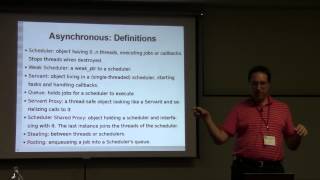
Asynchronous Programming Using the Boost.MetaStateMachine and the Upcoming Asynchronous Library
Explore asynchronous programming techniques using Boost.MetaStateMachine and the upcoming asynchronous library, enhancing C++ development skills for efficient and scalable applications.
Lifetime and Usage of Global, Thread-local, and Static Data
Explore the intricacies of global, thread-local, and static data in C++, focusing on their lifetimes, usage patterns, and best practices for efficient and safe programming.
Intro to Functional Programming in C++
Explore functional programming concepts in C++, including pure values, lists, algebraic data types, and inheritance, to enhance code quality and problem-solving skills.
Create Your Own Refactoring Tool in Clang
Learn to develop a custom refactoring tool using Clang, enhancing your C++ code manipulation capabilities and improving software maintenance efficiency.
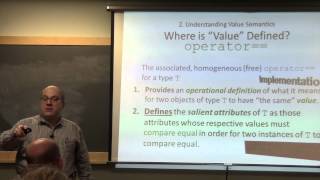
Value Semantics - It Ain't About the Syntax!
Explore the concept of value semantics in C++, focusing on its significance beyond syntax. Gain insights into efficient programming practices and design principles.
My Thoughts on Large Code Base Change Ripple Management in C++
Strategies for managing code changes in large C++ projects, focusing on minimizing ripple effects and maintaining stability during updates and refactoring.
The Future of Accelerator Programming in C++
Explore the evolving landscape of accelerator programming in C++, covering hardware models, vendor approaches, memory management, and advanced techniques for optimizing parallel computations.
Generic Programming with Concepts
Generic programming principles using Concepts Lite in C++: enhancing template constraints for more robust and efficient library design.
Numerical Weather Prediction - Facing the Future with C++
Explore numerical weather prediction's future with C++, addressing challenges in data processing, scalability, and power efficiency for complex atmospheric modeling and forecasting.
Biicode - A C - C++ Dependency Manager with a Hosting Service
Hands-on workshop exploring biicode, a C/C++ dependency manager. Learn to develop, publish, and reuse packages while managing dependencies, versions, and conflicts in C++ projects.
Constexpr - C++ At Compile Time
Explore constexpr's capabilities in C++11/14, including compile-time parsing, floating-point computations, containers, and potential workarounds for limitations. Discover powerful compile-time programming techniques.
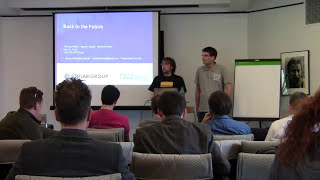
Back to the Future
Exploring advanced C++ abstractions for multi-core and parallel computing, focusing on a heterogeneous, extensible future implementation that outperforms existing models like OpenMP and MPI.
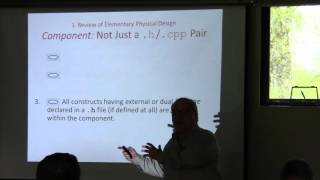
Large-Scale C++ - Advanced Levelization Techniques, Part I
Explore advanced levelization and insulation techniques for large-scale C++ systems. Learn to avoid inappropriate dependencies and optimize physical design for complex software projects.
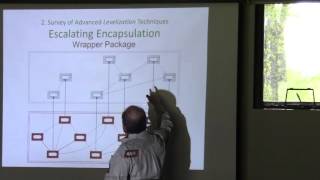
Large-Scale C++ - Advanced Levelization Techniques, Part II
Advanced techniques for managing dependencies in large-scale C++ projects, focusing on levelization and insulation methods to improve software architecture and maintainability. Practical examples demonstrate effective use of C++ language features.
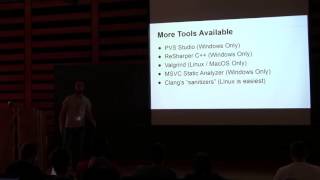
Thinking Portable - How and Why to Make Your C++ Cross Platform
Learn strategies for creating portable C++ code, exploring benefits like standards compliance, future-proofing, and wider tool availability while addressing challenges and providing practical guidelines.
SwitchAny - A Practical Exercise in Template Metaprogramming
Explore practical template metaprogramming in C++ with switchAny, a tool for type-based dispatching in Boost.Any. Learn advanced TMP techniques applicable to real-world scenarios.
Why in Heaven Is There No Dependency Management for C++
Explore the lack of dependency management in C++ and its implications, analyzing existing solutions and potential challenges for the language's future.
Boost.Compute - A Library for GPU - Parallel Computing
Explore Boost.Compute, a high-level API for GPU/parallel computing. Learn to write efficient C++ applications for GPUs, FPGAs, and multi-core CPUs using this portable, STL-like library.
Ranges for the Standard Library
Explore the future of C++ with Eric Niebler's keynote on Ranges, concept checking, and potential STL 2.0 features. Gain insights into new idioms and the evolving standard library.
Modern Generic Programming Using the Tick and Fit Libraries
Explore modern C++ generic programming using Tick and Fit libraries for improved type requirements, clearer compile errors, and enhanced function overloading techniques.