Blueprint vs. C++ - Knowing the Difference and When to Apply It
Explore key differences between Blueprint scripting and coding in game development, debunking optimization myths and learning when to use each method for optimal results.

Six Impossible Things in Software Development - Lecture 1
Explore six impossible concepts in software development, from integer representation to task estimation, and learn to work within these limits to create effective solutions.
Contemporary C++ in Action
Explore modern C++ techniques through live coding, debunking myths and showcasing practical applications for everyday developers using modules, coroutines, and C++23 features.
Belle Views on C++ Ranges, Their Details and the Devil - Keynote Meeting C++ 2022
Entdecken Sie C++ Ranges: Möglichkeiten, Vorteile und Herausforderungen. Tauchen Sie ein in fortgeschrittene Konzepte wie Templates, Threads und atomare Referenzen.
Source Instrumentation for Monitoring C++ in Production
Explore portable source instrumentation techniques for C++ monitoring, including logging, tracing, and metrics. Learn to balance information detail with performance overhead for effective production troubleshooting.
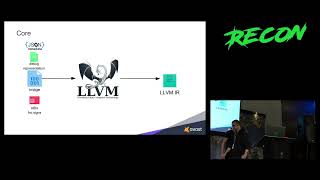
An Open-Source Machine-Code Decompiler
Explore RetDec, an open-source machine-code decompiler for analyzing binary applications. Learn about its components, applications in reverse engineering, and real-world examples demonstrated by Avast developers.
Sanitize, Fuzz, and Harden Your C++ Code
Explore dynamic testing tools for C/C++, including Sanitizers and libFuzzer, to find and prevent various bugs. Learn about security hardening techniques like Control Flow Integrity and Safe Stack.
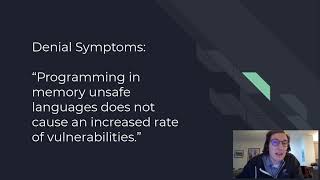
Quantifying Memory Unsafety and Reactions to It
Explore memory unsafety in C/C++, its prevalence in major projects, and developer reactions. Learn strategies for addressing this critical issue in modern secure development.
A Few Effective GCC - Clang Optimizations for Embedded Systems
Explore effective gcc/clang optimizations for embedded systems, focusing on code size reduction, performance enhancement, and compiler-friendly coding practices for Linux-based platforms.
Develop ML Interactive GPU-Workflows with Visual Studio Code, Docker and Dockerhub
Learn to streamline GPU-enabled ML workflows using Visual Studio Code, Docker, and Dockerhub. Overcome CUDA errors and version conflicts while developing in containers with seamless GPU integration.

Embedded Linux Size Reduction Techniques
Techniques for minimizing Linux kernel and filesystem size in embedded systems, covering compiler optimizations, configuration options, and user space tools for faster boot times and resource efficiency.
Flow - An Introduction
Explore Flow, an actor-based C++ language for I/O-heavy concurrent software. Learn to write actors, understand underlying code, and avoid common pitfalls in this FoundationDB-specific language.

Unicode - Going Down the Rabbit Hole
Explore Unicode's complexities, from ancient scripts to modern emojis, and learn how text encoding impacts computer systems and programming languages like C++.
QProperty - QML Property Binding in C++
Explore QProperty in Qt6 for C++ property binding, comparing it with QML binding. Learn implementation details, evaluation methods, and migration options from Qt5 to Qt6.
Rust for C++ Developers - What You Need to Know to Get Rolling With Crates
Explore Rust's advantages over C++ for safe, concurrent programming. Learn about ownership, enums, traits, and using external packages to write elegant code.
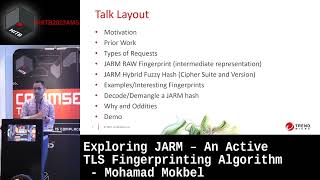
Exploring JARM – An Active TLS Fingerprinting Algorithm
Exploring JARM: An active TLS fingerprinting algorithm for clustering servers, identifying default settings, and detecting malicious servers. Includes C++ implementation, technical analysis, and improvements to enhance fingerprint confidence.
What Swift Devs Can Learn from C++
Explore C++ features Swift developers might envy, including performance optimizations, hardware customization, and mature community practices, presented by an iOS developer working on Photoshop for iPad.
Enforce Inform Ignore Assume - Gradual Adoption of Contracts in Production Code
Explore gradual adoption of contract checking in C++ production code, covering semantics, workflow, and implementation strategies for improved code quality and performance.
C++ Insights - How Stuff Works, Lambdas and More
Explore C++ intricacies through compiler's perspective, covering implicit conversions, in-class initializers, lambdas, and variadic templates using C++ Insights tool.
Hello World from Scratch
Demystifying C++ compilation: from source code to execution. Explore stages of compilation, linking, libraries, object file loading, and OS interaction. Gain insights into the inner workings of C++ tools and processes.
Safe and Sane C++ Types
Explore guidelines for creating safe C++ classes, understanding special member functions, and navigating complex language features to write more robust and maintainable code.