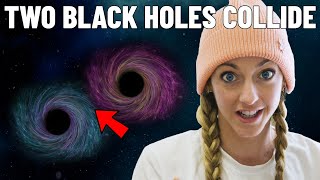
What Happens When Black Holes Collide - Expert Answers on Gravitational Waves
Explore the fascinating world of gravitational waves, black hole collisions, and the stretching of spacetime. Gain insights into cutting-edge physics research and its implications for our understanding of the universe.

Black Holes - Seeing the Unseeable
Explore groundbreaking observations of black holes with Brian Greene and Shep Doeleman, discussing the Event Horizon Telescope's achievements and the first image of our galaxy's supermassive black hole.
Illuminating Black Holes - Understanding Spacetime and Quantum Information Theory
Explore spacetime, black holes, and quantum information theory with physicist Veronika Hubeny. Delve into gauge/gravity duality to uncover the fundamental nature of our universe.
Entanglement, Black Holes, and Wormholes - An Informal Discussion
Explore groundbreaking advances in black hole physics, quantum entanglement, and wormholes with renowned physicist Brian Greene in this engaging year-end science discussion.

Gravitational Waves and Particle Physics: From Detection to Future Prospects - Lecture
Explore gravitational waves and particle physics with Nobel Laureate Barry Barish and Brian Greene, discussing LIGO, detections, future prospects, and the intersection of these cutting-edge fields.
The Monster at the Heart of Our Galaxy - Master Class
Nobel Laureate Andrea Ghez explores the supermassive black hole at the Milky Way's center, discussing its role in galaxy formation and evolution in this captivating astrophysics lecture.
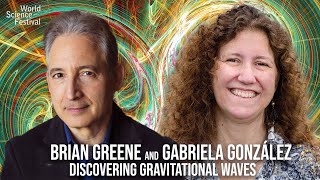
Discovering Gravitational Waves - LIGO's Latest Massive Source
Explore the latest gravitational wave discoveries with physicists Brian Greene and Gabriela González, discussing LIGO's groundbreaking findings and their implications for our understanding of the cosmos.

Black Holes - Why Time Slows Down Near Them - Your Daily Equation 31
Explore black holes and their mathematical foundations with Brian Greene, delving into Einstein's general relativity and the strange phenomena of time dilation near these cosmic enigmas.
Darkness Visible - Shedding New Light on Black Holes
Explore cutting-edge techniques to observe and understand black holes, including radio telescope arrays and mathematical models. Learn how these methods reveal fundamental truths about the universe and bridge general relativity with quantum mechanics.
CFT, Spin's Statistics, and All That - David Simmons Duffin
Explore modern conformal field theory, including insights from the conformal bootstrap program, and its applications to holography and quantum gravity foundations in this advanced theoretical physics talk.
An Eye for the Bulk - Simon Caron Huot
Explore modern conformal field theory insights and their impact on holography and quantum gravity. Discover connections between CFT consistency and string/M-theory in this cutting-edge physics lecture.
Missing Physics III - Discussion on Binary Systems and Circumbinary Gas
Explore circumbinary gas evolution, observational signatures, and numerical modeling techniques in stellar and black hole binary systems with experts Roger Blandford and Sean McWilliams.
Discussion: Populations II - Binary Systems in Astrophysics
Explore binary systems in astrophysics, from stellar to supermassive black holes. Discuss gas evolution, observational signatures, and numerical modeling techniques across varied scales.
Large N Partition Functions, Holography, and Black Holes - Nikolay Bobev
Explore large N partition functions, holography, and black holes in conformal field theory. Discover modern insights connecting quantum gravity and CFT consistency conditions.
Bounds on Spin-Two KK Masses - Alessandro Tomasiello
Exploring bounds on spin-two Kaluza-Klein masses in the context of holography and quantum gravity, with insights from conformal field theory and modern field theory methods.
Finite-N Holography - Supersymmetry and Modularity in Gravity
Explore finite-N holography, focusing on supersymmetry and modularity in gravity. Gain insights into modern field theory methods and their applications to holography and quantum gravity.
Crossing Symmetry in Matter Chern Simons Theories at Finite N and K - Shiraz Minwalla
Explore crossing symmetry in Matter Chern-Simons theories at finite N and k. Delve into advanced concepts in conformal field theory and their applications to holography and quantum gravity.
Holographic Tensor Networks in 2d CFT - Thomas Hartman (Cornell)
Explore holographic tensor networks in 2D conformal field theory, examining their role in understanding quantum gravity and holography through modern field theory methods.
Comments on Symmetry Breaking and Weak Gravity - Clay Córdova
Explores symmetry breaking, weak gravity, and quantum gravity conjectures in conformal field theory and holography. Discusses higher symmetries, screening, and magnetic weak gravity, offering insights for theoretical physics research.
Non-Relativistic Physics in AdS and Its CFT Dual - Henry Maxfield (Stanford)
Explore non-relativistic physics in Anti-de Sitter space and its Conformal Field Theory dual, examining holographic principles and their implications for quantum gravity and string theory.
Matrix Models for ETH and Random CFT - Julian Sonner
Explores matrix models in relation to the Eigenstate Thermalization Hypothesis and random Conformal Field Theory, advancing understanding of quantum chaos and holography.