
When Lightning Strikes Thrice - Breaking Thunderbolt 3 Security
Explore Thunderspy attacks that compromise Thunderbolt security, revealing vulnerabilities in device authentication and DMA protection across Thunderbolt 1, 2, and 3 interfaces.

NoJITsu - Locking Down JavaScript Engines
Explore data-only attacks on JavaScript engines and learn defensive strategies to secure JIT compilers against modern threats in web browsers and interactive applications.
Building a Vulnerability Disclosure Program That Works for Election Vendors and Hackers
Explore the creation of effective vulnerability disclosure programs for election vendors, balancing security needs with researcher collaboration to enhance voting system integrity.

Uncommon Sense - Detecting Exploits with Novel Hardware Performance Counters and ML Magic
Explore novel hardware performance counters and machine learning techniques to detect advanced exploits like speculative execution, Rowhammer, and ROP, enhancing cybersecurity defenses against evolving threats.

Policy Implications of Faulty Cyber Risk Models and How to Fix Them
Explore data-driven analysis of cyber incidents, their economic impact, and policy implications. Learn to improve risk models for better security governance and third-party risk management.

Room for Escape - Scribbling Outside the Lines of Template Security
Explore vulnerabilities in Content Management Systems, focusing on template security issues and potential exploits in collaboration platforms. Learn about safe mode attacks and object data validation.

Breaking Brains, Solving Problems - Lessons Learned from 2 Years of Setting Puzzles for InfoSec Pros
Explore problem-solving strategies, cognitive biases, and improvement techniques for InfoSec professionals, drawing insights from puzzle-setting experiences and real-world applications.

Exploiting Excel Online
Explore Excel Online vulnerabilities, focusing on integer overflow in fnConcatenate formula. Learn about chaining formulas for remote code execution and potential security implications.

Dive into Apple IO80211FamilyV2
Explore Apple's IO80211FamilyV2 Wi-Fi architecture, its features, and potential vulnerabilities. Learn about reverse engineering, attack surfaces, and the latest security concerns in macOS Catalina.
Reversing the Root - Identifying the Exploited Vulnerability in 0-Days Used In-The-Wild
Explore techniques for identifying root cause vulnerabilities in exploited 0-days, including binary patch diffing, exploit minimization, and reverse engineering, to enhance cybersecurity analysis and threat mitigation.

Experimenting with Real-Time Event Feeds
Explore innovative approaches to real-time event feeds in cybersecurity, challenging traditional SIEM methods and addressing high-volume data management for improved threat detection.

Fooling Windows Through Superfetch
Explore Windows Superfetch service's privacy implications, forensic potential, and methods to manipulate its predictive behavior for enhanced system security and user privacy.

Hacking the Voter - Lessons from a Decade of Russian Military Operations
Explore Russian military's decade-long election interference strategies, examining GRU tactics and the role of information in shaping international relations and outmaneuvering tactical defenses.
Superman Powered by Kryptonite - Turn the Adversarial Attack into Your Defense Weapon
Explore how AI-powered attacks on security mechanisms can be turned into defensive strategies, focusing on adversarial examples and innovative countermeasures in cybersecurity.

Kr00k - Serious Vulnerability Affected Encryption of Billion+ Wi-Fi Devices
Explore the Kr00k vulnerability affecting Wi-Fi encryption on billions of devices. Learn about its impact, technical details, and see a live demonstration of exploiting this security flaw in popular Wi-Fi chips.

A Little Less Speculation, a Little More Action - A Deep Dive into Fuchsia's Mitigations for Specific CPU Side-Channel Attacks
Explore Fuchsia's approach to mitigating CPU side-channel attacks, including enumeration, implementation, and testing of protective measures across x86 and ARM processors.

Exploiting Kernel Races through Taming Thread Interleaving
Explore advanced techniques for exploiting kernel race conditions by manipulating thread interleaving, overcoming limitations of conventional brute-force methods and addressing challenging vulnerabilities.
The Next Gen PlugX - ShadowPad - A Dive into the Emerging China-Nexus Modular Trojan, Pangolin8RAT
Explore the emerging Pangolin8RAT trojan, its potential as a successor to PlugX and ShadowPad in Chinese cyber operations, and its attack timeline from 2020 to 2021.

From Coordinated Disclosure to Cooperative Vulnerability Research When Dealing with Critical Software Stacks
Explore evolving approaches to vulnerability disclosure in critical software, emphasizing early cooperation between researchers and vendors for improved security outcomes.
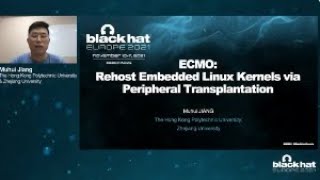
ECMO - Rehost Embedded Linux Kernels via Peripheral Transplantation
Innovative technique for rehosting embedded Linux kernels in QEMU using peripheral transplantation, enabling dynamic analysis of firmware images from diverse embedded devices.

A Universal Way to Exploit Android PendingIntents in High-profile and System Apps
Explore Android PendingIntent vulnerabilities in high-profile apps, learn exploitation techniques, and discover security implications for developers and system integrity.