Pushing the Limits of Human Mobility
Explore biomechanics and cutting-edge technology for enhancing human movement. Learn how computer simulations and smart sensors are revolutionizing mobility and athletic performance.
Of Corals and the Cosmos - A Story of Hyperbolic Space
Explore hyperbolic geometry in nature, from corals to cactuses, and its historical significance. Discover how these forms challenge traditional Euclidean concepts and their prevalence in the natural world.
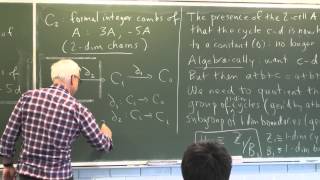
Introduction to Homology in Algebraic Topology - Part 2
Explores cycles, boundaries, and homology in algebraic topology, focusing on graph modifications and using commutative group theory to analyze formal combinations of geometric elements.
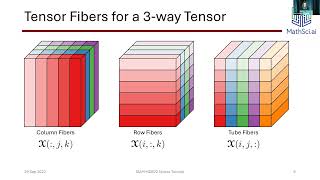
Tensor Decompositions - A Quick Tour of Illustrative Applications
Explore tensor decompositions for data analysis and dimensionality reduction. Learn fundamentals, applications in various fields, and hands-on examples using real-world datasets.
Understanding Tumour Responses to Radiotherapy Using Mathematical Models - Lecture 2
Explores mathematical modeling of tumor responses to radiotherapy, focusing on theoretical approaches to understand and predict treatment outcomes in cancer progression.
Mathematical and Computational Modelling to Explore Various Potential Cancer Treatments
Explore mathematical and computational modeling approaches for cancer research, covering topics from age-structured populations to machine learning techniques for understanding disease progression and treatment.
Conquering Movement - How Math Can Help Us Become Musicians
Exploring the intersection of music and mathematics to revolutionize musician education and health through innovative analysis of physical motion and performance patterns.

Interview with Noga Alon - Mathematician with 600 Publications
Interview with mathematician Noga Alon discussing his prolific career, interdisciplinary research, and notable contributions to mathematics, including necklace splitting and applications of the Borsuk-Ulam Theorem.
Using Topology - Fundamental Forces and Nonequilibrium Potentials by Massimiliano Esposito
Explore fundamental forces and nonequilibrium potentials in topology, uncovering insights into energy flows, constraints, and limits in cellular processes and bioenergetics.

Fitting High-dimensional Data and Model Selection - Lecture
Explore techniques for fitting high-dimensional data and selecting appropriate models in biological evolution, focusing on polygenic adaptation and phenotypic variation.
Structural and Stochastic Modeling to Study the Dynamics of Tumor-Immune Interactions
Explore structural and stochastic modeling techniques to analyze tumor-immune interactions, enhancing understanding of cancer dynamics and potential treatment strategies.
Using Mathematical Approaches to Describe and Understand Cancer
Explore mathematical modeling in cancer research, covering population dynamics, systems biology, and machine learning to enhance understanding and treatment of this complex disease.
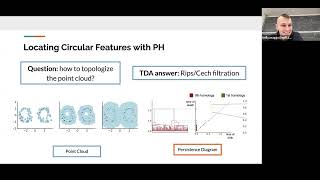
Cohomology Classes in the RNA Transcriptome
Explore how cohomology classes in single-cell sequencing data can model transient biological processes, using persistent cohomology and differential forms to infer gene expression dynamics.
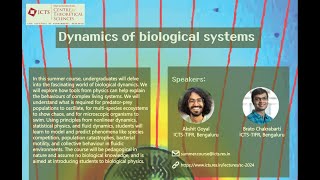
Dynamics of Biological Systems - Lecture 5
Explore biological dynamics using physics tools to model and predict complex living systems, from predator-prey oscillations to bacterial motility and collective behavior in fluids.
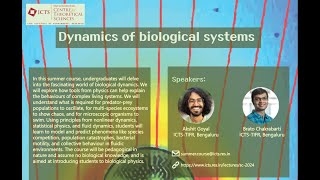
Dynamics of Biological Systems - Lecture 8
Explore biological dynamics using physics tools to model and predict complex living systems, from predator-prey oscillations to bacterial motility and collective behavior in fluids.
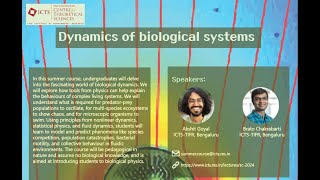
Dynamics of Biological Systems - Lecture 7
Explore biological dynamics using physics principles. Learn to model predator-prey oscillations, ecosystem chaos, and microbial swimming. Gain insights into species competition, population changes, and collective behavior in fluids.
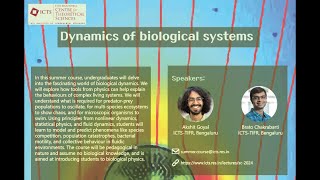
Dynamics of Biological Systems - Lecture 6
Explore biological dynamics using physics tools to model and predict complex living systems, from predator-prey oscillations to bacterial motility and collective behavior in fluids.
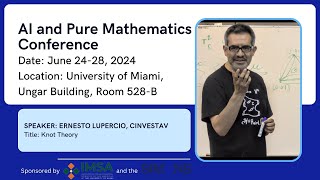
Knot Theory in Mathematics and AI Applications
Explore the fascinating world of knot theory and its connections to mathematics and AI in this engaging talk by Ernesto Lupercio from CINVESTAV.
Vectors and How Climate May Impact Them
Explore how climate change affects disease vectors, their ecology, and transmission dynamics. Gain insights into vector-borne diseases and their potential future impacts on ecosystems and public health.
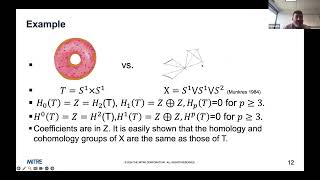
Steenrod Squares and Data Science - Exploring Connections in Algebraic Topology
Explore the potential link between advanced algebraic topology concepts and data science classification, examining how increasing algebraic complexity may solve harder geometric problems.
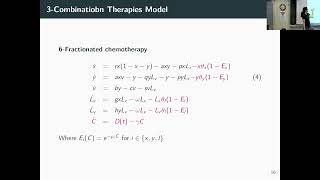
Comparing Combination Therapies with Oncolytic Viruses in a Simple Mathematical Framework
Explore mathematical models for comparing combination cancer therapies using oncolytic viruses, examining their effectiveness and potential outcomes in treatment strategies.