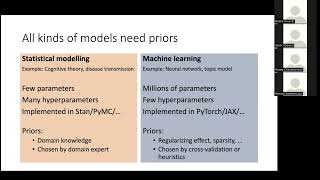
Better Priors for Everyone - Choosing Prior Distributions in Bayesian Modeling
Explore techniques for choosing effective prior distributions in Bayesian modeling, including prior elicitation and automatic selection methods for improved statistical inference.

Parameter Estimation and Interpretability in Bayesian Mixture Models
Explore posterior contraction in Bayesian mixture modeling, examining parameter estimation and model interpretability under correct and misspecified conditions. Gain insights into tradeoffs between expressiveness and interpretability.
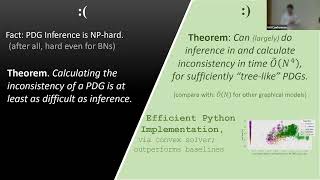
UAI 2023 Poster Spotlights - Advanced Topics in Uncertainty and AI
Explore cutting-edge research in uncertainty and AI, covering topics from point processes and GNN spatial convolutions to variational inference and Bayesian approaches in reinforcement learning.

Comparing Probability Distributions with Conditional Transport
Explore conditional transport as a new divergence for comparing probability distributions, with applications in generative modeling and resistance to mode collapse.
Integrating Inference with Stochastic Process Algebra Models - Jane Hillston, Edinburgh
Explore probabilistic programming for continuous-time systems using ProPPA, an extension of Bio-PEPA. Learn parameter inference methods and applications in biology, ecology, and urban transport.
Statistical Physics and Statistical Inference - Lecture 2
Explore statistical physics and inference, covering Bayesian methods, error correction, spin glasses, and advanced algorithms like belief propagation. Gain insights into phase transitions and applications in machine learning.
Gravitational Wave Parameter Estimation with Compressed Likelihood Evaluations
Explore advanced techniques for efficient gravitational wave parameter estimation, focusing on Reduced Order Quadratures (ROQs) to accelerate likelihood evaluations and improve Bayesian inference in GW astronomy.
Bayesian Field-Level Inference with Weak Lensing Data by Supranta Boruah
Explore Bayesian field-level inference techniques for weak lensing data analysis in cosmology. Learn advanced methods to extract valuable information from large-scale structure surveys.
Artificial Intelligence in Medical Imaging for Precision Medicine by Vaanathi Sundaresan
Explore AI applications in medical imaging for precision medicine, covering deep learning techniques, image analysis, and their impact on diagnosis and treatment planning.
Challenge of Characterising High-Mass Compact Mergers - The Case of GW190521
Explores challenges in analyzing gravitational waves from massive binary mergers, focusing on GW190521. Discusses Bayesian inference, prior choices, and alternative interpretations like eccentric mergers or exotic objects.

Decision Making and Learning in the Life Sciences - Lecture 2
Explore decision-making and learning in life sciences, focusing on advanced concepts and their applications in biological systems and research.
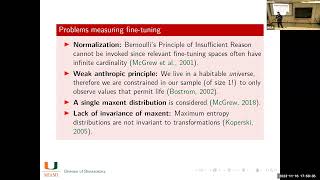
On Some Aspects of Cosmological Fine-Tuning
Explore fine-tuning in cosmology through Bayesian and maximum entropy frameworks. Examine probabilistic measurements, distribution families, and the learnability of fine-tuning concepts.
Learning Battery Physics from Images
Explore advanced techniques for extracting battery physics from synchrotron imaging data, combining electrochemical models with PDE-constrained optimization and Bayesian inference to uncover hidden information.
Genomic Medicine XV: Population Screening - Welcome and Keynotes - Session 1
Explore the current state, barriers, and opportunities of population genomic screening in the U.S., discussing its impact on clinical practice, technologies, costs, and future research directions.
Using Historical Information to Improve Seismic Data Processing Methods I
Explore innovative seismic data processing techniques, including Bayesian methods, machine learning, and waveform cross-correlation, to enhance earthquake monitoring and location accuracy.
Lung Disease and AI Applications - From Cough Sounds to CT Scan by Anurag Agrawal
Explore AI applications in lung disease diagnosis, from analyzing cough sounds to interpreting CT scans. Learn how machine learning enhances detection and treatment of respiratory conditions.
Cause of Obesity, Diabetes & CVD Epidemic by Ponnusamy Saravanan
Explores the role of Gestational Diabetes Mellitus in obesity, diabetes, and cardiovascular disease epidemics, discussing its causes, impacts, and potential interventions.
The Healthy Life Trajectories Initiative - Implementation, Challenges and Future
Exploring the Healthy Life Trajectories Initiative's implementation, challenges, and future prospects, focusing on improving health outcomes through data-driven approaches and collaborative research.
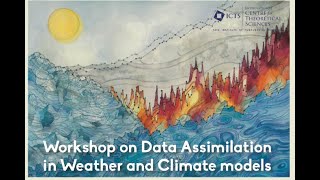
Application of Particle Filters on Data Assimilation
Explore particle filters in data assimilation, a powerful technique for integrating observations and forecasts to estimate atmospheric states and uncertainties in weather and climate modeling.
ABC Phylodynamics
Explore ABC phylodynamics with Samuel Alizon, delving into advanced techniques for analyzing evolutionary dynamics of pathogens using phylogenetic data.

Statistical Methods for Data Analysis in Particle Physics - Lecture 3
Explore advanced statistical techniques for analyzing particle physics data, focusing on hypothesis testing, confidence intervals, and likelihood methods in experimental research.