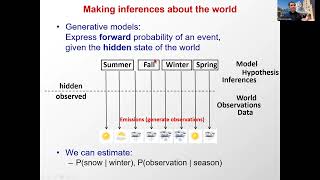
Expression Analysis, Clustering, and Classification in Machine Learning - Lecture 2
Comprehensive exploration of machine learning concepts, from basic principles to advanced techniques, with applications in gene expression analysis and text clustering.
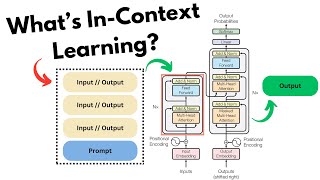
In-Context Learning in Deep Learning - How It Works in Large and Small Language Models
Explore in-context learning in LLMs: definition, significance, Bayesian framework, and implementation. Gain insights into this surprising capability of language models and its implications for AI.
Probabilistic Programming in Python - Conf42 Python 2024
Explore Bayesian statistics, probabilistic modeling, and MCMC in Python. Learn key concepts and practical applications through demonstrations and workflow explanations.
Detecting Discriminatory Risk through Data Annotation Based on Bayesian Inferences
Explore Bayesian inference techniques for detecting discriminatory risk in data annotation, enhancing fairness and accountability in machine learning systems.
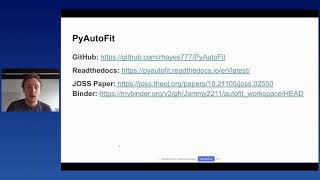
PyAutoFit - A Classy Probabilistic Programming Language For Data Science
Explore Bayesian inference with PyAutoFit, a probabilistic programming language for data science. Learn core features, model composition, and advanced tools for big data analysis and parallel computing.
Free Energy Minimisation for Perception as Inference
Explores predictive processing theory and free energy principle in perception, comparing Helmholtz machine and message passing approaches to neural inference and consciousness.

What Do Babies Think?
Explore the sophisticated intelligence of babies and young children through play, revealing their advanced cognitive abilities and decision-making processes.
An Introduction to Forecasting Using Orbit
Explore Orbit, a probabilistic forecasting tool developed by Uber, and learn its application in demand forecasting for technical support teams through a practical case study.
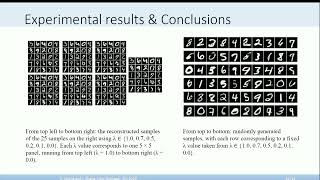
Deformed Evidence Lower Bound (λ-ELBO) Using Rényi and Tsallis Divergence
Explore advanced variational inference techniques using Rényi and Tsallis divergences to optimize the Deformed Evidence Lower Bound (λ-ELBO) for improved probabilistic modeling.
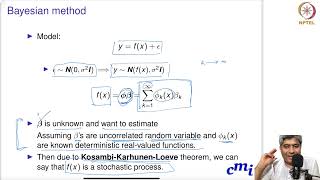
Gaussian Process Regression
Explore non-linear regression techniques, focusing on Gaussian Process Regression, basis functions, and systems. Gain insights into GP priors for advanced statistical modeling.

Combined Stochastic Models for Cancer Patient Trajectories
Integrating diverse clinical data into a unified stochastic model for cancer patient trajectories, combining tumor growth, metastasis, and survival data using Julia for simulation and Bayesian inference.
A Deep Computational Phenomenology of MPE as Metacognitive Free Energy Optimization
Explore the computational modeling of minimal phenomenal experience through Bayesian mechanics and free energy principles, examining belief dynamics and metacognitive processes.
Machine-Brain Intelligence in Brain-Computer Interfaces - Understanding Neural Networks and Human Learning
Explore the symbiotic relationship between neural networks and brain-computer interfaces, discovering how machine and human learning combine to extend neural control to external devices.
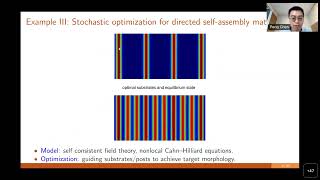
Derivative-Informed Neural Operators for Solving PDE-Governed Optimization Problems
Explore novel machine learning for solving optimization problems with PDEs, featuring derivative-informed neural operators for efficient, scalable solutions in high-dimensional parameter spaces.
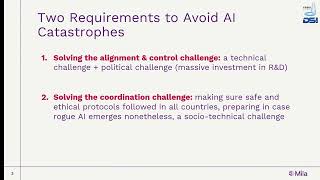
How Could We Design Aligned and Provably Safe AI?
Explore AI safety with Dr. Yoshua Bengio, focusing on run-time risk evaluation and Bayesian approaches to mitigate potential harm from advanced AI systems.
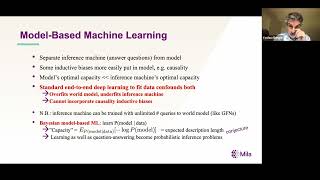
Large Neural Nets for Amortized Probabilistic Inference in Highly Multimodal Distributions
Explore amortized probabilistic inference using large neural networks for complex distributions. Learn about GFlowNets and their potential to improve AI systems with Bayesian and causal understanding.
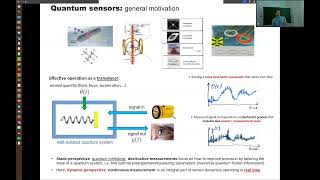
Quantum Sensors Operated in Real Time
Explore quantum sensors' real-time applications, from gravitational-wave detection to brain magnetic field tracking. Learn about enhancing sensitivity through non-classical correlations and measurement-based feedback techniques.
Fast and Accurate Probabilistic Time Series Classification
Explore fast and accurate probabilistic time series classification using MINIROCKET technology, achieving near-state-of-the-art performance with significantly reduced computational costs compared to existing methods.
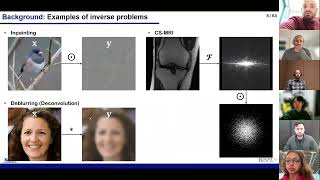
Diffusion Models for Inverse Problems
Explore advanced techniques for solving inverse problems using diffusion models, focusing on posterior sampling and manifold constraints.
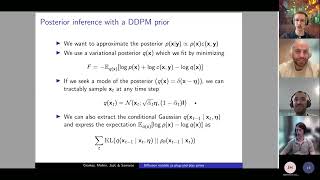
Diffusion Models as Plug-and-Play Priors
Explore diffusion models as versatile priors for various tasks, enhancing image processing and generation capabilities.
Variational Inference and Optimization - Lecture 3
Explore advanced variational inference and optimization techniques for probabilistic AI, focusing on cutting-edge methods and practical applications.