
WarpPINN: Cine-MR Image Registration with Physics-Informed Neural Networks
Explore WarpPINN, a physics-informed neural network for cardiac image registration. Learn how it quantifies local heart deformations, improving heart failure diagnosis through advanced strain estimation techniques.

Deep Dive: Gradients in Ivy - Tutorial 20
Explore gradients in Ivy, mastering advanced techniques for deep learning and neural network optimization.

Swift for TensorFlow - TF World '19
Explore Swift for TensorFlow, a cutting-edge ML platform integrating deep neural networks with AI algorithms and software development, enhancing research efficiency and speed.
Fast Deep Learning with Categories
Explore GPU-accelerated deep learning using Haskell, ConCat, and Accelerate for high-performance industrial applications.
Decision Awareness in Reinforcement Learning - End-to-End Optimization Approaches
Explore decision awareness in reinforcement learning, covering control-oriented models, neural ODEs, and computational challenges. Gain insights into advanced techniques for optimal decision-making.

Molly.jl - Molecular Dynamics in Julia
Explore Molly.jl for molecular dynamics simulations in Julia. Learn about its features, advantages, and applications in research, including differentiable molecular simulation and force field improvement.
AI Hardware and Real-world AI - JuliaCon 2024
Explore AI's computational impact, from theoretical understanding to efficient hardware design. Gain insights on optimizing AI models for real-world applications across various computational scales.
LLVM in HPC: Enabling Performance Portability, Interoperability, and Novel Features - Part 2
Explore recent LLVM efforts for HPC: portable CUDA, debugging at scale, GPU execution of legacy codes, automatic differentiation, ML in compilers, and static information impact.
FastIce.jl: A Massively Parallel Ice Flow Model Running on GPUs
Explore FastIce.jl, a Julia-based ice flow model for GPUs. Learn about its modular architecture, performance on supercomputers, and applications in efficient large-scale ice sheet modeling.
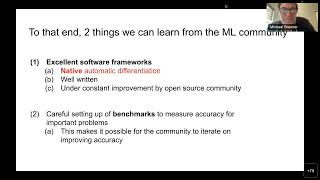
Scientific Uses of Automatic Differentiation - DDPS
Explore automatic differentiation's scientific applications beyond machine learning. Discover innovative approaches in PDEs, self-assembly, fluid dynamics, and protein modeling using large-scale optimization.
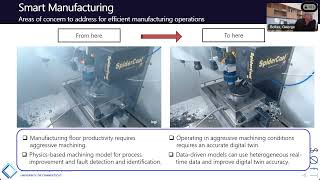
Physics Informed Machine Learning through Symbolic Regression
Explore symbolic regression for identifying PDE models from scarce, noisy data. Compare with Physics-Informed Neural Networks and discuss applications in fault detection and system health prognostics.
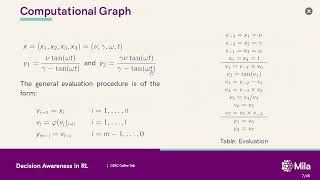
Decision Awareness in Reinforcement Learning
Explore decision awareness in reinforcement learning, focusing on control-oriented transition models and neural ODEs for nonlinear trajectory optimization. Discuss computational challenges and scaling solutions.
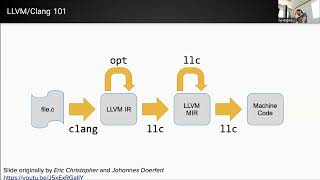
LLVM in HPC - Enabling Performance Portability, Interoperability, and Novel Features - Part 1
Explore LLVM's impact on HPC, covering portable CUDA, debugging at scale, GPU execution of legacy code, and ML in compilers. Learn about efforts to enhance performance, tooling, and development in HPC.
PyTorch Tutorial for Deep Learning
Explore PyTorch for deep learning: implement neural networks, leverage GPU acceleration, and train convolutional models for digit recognition using efficient coding practices.