Intensity, Loudness, and Timbre
Explore sound power, intensity, loudness, and timbre, covering key concepts like amplitude envelope, harmonic content, and modulation. Gain insights into audio signal processing for machine learning.
Mel-Frequency Cepstral Coefficients Explained Easily
Explore Mel-Frequency Cepstral Coefficients (MFCCs) in audio processing, covering their history, computation, visualization, and applications in speech and music analysis.
How to Extract the Fourier Transform with Python
Extract and visualize Fourier Transform from audio using Python and Numpy. Compare magnitude spectra of the same note on different instruments, with practical code examples provided.
Discrete Fourier Transform Explained Easily
Explore the Discrete Fourier Transform's adaptation for digital signals, its visual interpretation, and practical hacks for time and frequency domains in audio signal processing.
Defining the Fourier Transform with Complex Numbers
Explore complex numbers in Fourier transform, including coefficients, visual interpretation, and inverse transform. Gain insights into elegant mathematical representations for audio signal processing.
Demystifying the Fourier Transform - The Intuition
Gain intuitive understanding of the Fourier Transform for audio signal processing through visual explanations, avoiding complex math while focusing on practical applications in frequency domain analysis.
How to Extract Root-Mean Square Energy and Zero-Crossing Rate from Audio
Explore audio feature extraction using Python: learn to calculate Root-Mean Square Energy and Zero-Crossing Rate, and analyze their variations across music genres and audio sources.
How to Extract Audio Features
Explore acoustic feature extraction from audio signals, covering time and frequency domains, spectral leakage, windowing, frames, and hop length for enhanced audio processing understanding.
Extracting Mel Spectrograms with Pytorch and Torchaudio
Master Mel Spectrogram extraction using PyTorch and torchaudio. Learn key audio transformations, resampling techniques, and practical implementation for audio processing tasks.

Automatic Song Remixes With Audio Signal Processing and Simple Machine Learning
Explore Python-based Infinite Remixer for automatic song remixes using beat tracking and Nearest Neighbours search. Learn system design, usage, experiments, and potential improvements for innovative music creation.
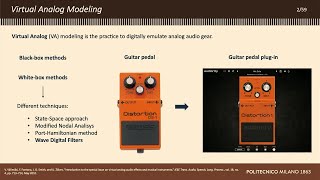
Recent Trends in Virtual Analog Modeling Based on Nonlinear Wave Digital Filters
Explore recent advancements in virtual analog modeling using nonlinear Wave Digital Filters. Gain insights into emulating complex audio circuits with multiple nonlinearities for improved stability, accuracy, and efficiency.
A Comparison of Virtual Analog Modelling Techniques - Part 2
Explore virtual analog modeling techniques, from traditional methods to neural networks and grey-box approaches, using the Boss DS-1 guitar pedal as an example. Compare generalization and problem-solving across different circuit types.
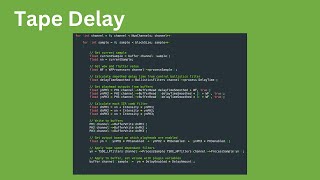
Digital Modelling of the Roland RE-201 - ADC23
Explore digital modelling of the Roland RE-201, analyzing subsystems and challenges in achieving perceptual accuracy in software simulations. Compare various modelling methods for this iconic device.
High-Level Programming of FPGAs for Audio Real-Time Signal Processing Applications
Explore high-level FPGA programming for audio processing using SyFaLa toolchain and Faust language. Learn advantages, applications, and potential in spatial audio and room acoustics control.
Point to Point Modeling: An Automatic Circuit Solving Library
Explore an automatic circuit solving library for simulating analog audio circuits. Learn to implement and analyze component-level circuits for real-time plugins and mobile apps.
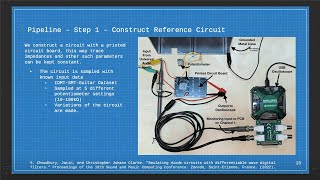
Pipeline for VA Modelling with Physics-Informed Machine Learning
Explore a VA modelling pipeline using Differentiable Wave Digital Filters and neural networks for accurate, real-time circuit modelling, demonstrated with a diode clipper circuit.
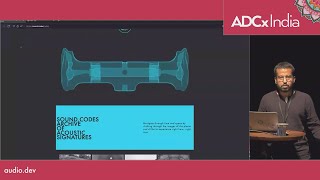
Using Convolution for Archeo-Acoustic Conservation
Explore computational techniques for preserving unique acoustic properties of historical spaces, enhancing heritage conservation through audio technology.
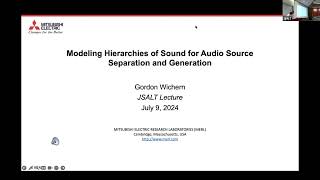
Modeling Hierarchies of Sound for Audio Source Separation and Generation - 2024 JSALT
Explore hierarchical sound modeling for audio source separation and generation. Learn about extracting components, controlling models, detecting data memorization, and building interpretable controls.

Complex Numbers for Audio Signal Processing
Explore complex numbers visually for audio signal processing, covering Cartesian and polar representations, Euler's formula, and their application in Fourier transforms.
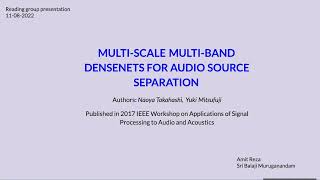
Multi-Scale Multi-Band DenseNets for Audio Source Separation
Explore multi-scale multi-band DenseNets for audio source separation, featuring innovative architecture with up-sampling, block skip connection, and band-dedicated dense blocks to improve performance and efficiency.
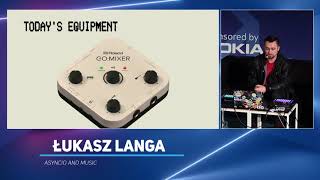
AsyncIO and Music
Explore AsyncIO's potential in music production through MIDI processing, covering signal transformations, generative music, and audio processing challenges.