Groq Tutorial - Part 5
Explore Groq's innovative AI hardware and software solutions for accelerating machine learning workloads and enhancing computational efficiency.
GenSLM - Infrastructure and Downstream Utilization - Tutorial 3
Explore GenSLM infrastructure and downstream applications for advanced language modeling techniques in this comprehensive tutorial.
Foundation Models for Materials Discovery
Explore foundation models for materials discovery, focusing on their applications and potential in advancing scientific research and innovation.
Foundation Models for a Sustainable Planet
Explore how foundation models can address sustainability challenges and drive positive environmental impact through AI-powered solutions.
Example Memorization in Learning: Batch and Streaming - Differential Privacy for ML
Explore example memorization in machine learning, covering batch and streaming scenarios, space requirements, and implications for natural models and future research directions.
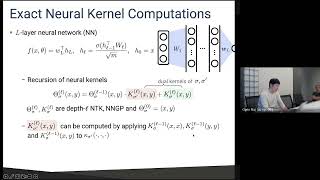
Fast Neural Kernel Embeddings for General Activations
Explore fast sketching methods for approximating multi-layered NNGP and NTK matrices with various activation functions, overcoming limitations of prior works and achieving significant speedups.
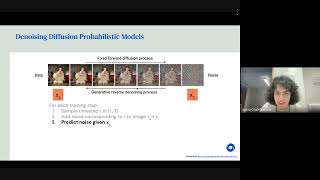
Differentially Private Diffusion Models Generate Useful Synthetic Images
Explore privacy-preserving synthetic image generation using diffusion models. Learn techniques for fine-tuning pre-trained models to achieve state-of-the-art results on CIFAR-10 and Camelyon17 datasets.
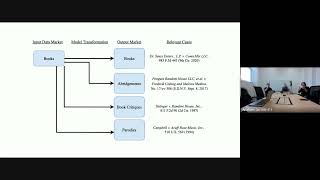
Foundation Models and Fair Use - Legal and Ethical Implications
Explore legal and ethical implications of training foundation models on copyrighted material. Analyze fair use doctrine, potential risks, and technical mitigations for model development and deployment.
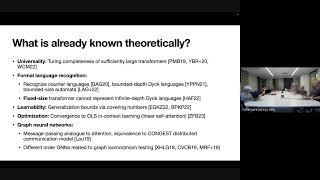
Representational Strengths and Limitations of Transformers
Explore the mathematical analysis of attention layers in transformers, comparing their representation power to other architectures and examining complexity parameters in various tasks.
High-Dimensional Prediction for Sequential Decision Making
Explore efficient algorithms for online high-dimensional predictions, enabling no-regret guarantees, fairness, and uncertainty quantification in multiclass settings for improved decision-making.
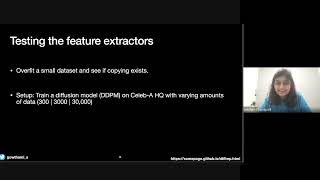
Understanding and Mitigating Copying in Diffusion Models
Explore frameworks for detecting replication in diffusion models, identify memorization factors, and learn techniques to reduce data replication during training and inference.
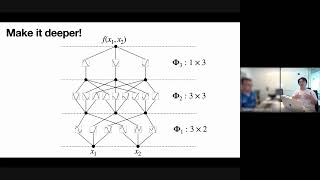
Kolmogorov-Arnold Networks - Alternatives to Multi-Layer Perceptrons
Explore Kolmogorov-Arnold Networks as alternatives to MLPs, offering improved accuracy and interpretability in data fitting and PDE solving. Discover their potential for scientific collaboration and law discovery.

Privacy Preserving Machine Learning with Fully Homomorphic Encryption
Explore Fully Homomorphic Encryption's role in advancing secure, privacy-preserving machine learning applications, focusing on Concrete ML and its integration with other technologies.
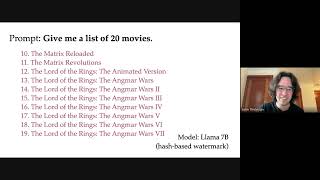
Robust Distortion-free Watermarks for Language Models
Explore robust watermarking techniques for language models, focusing on edit-resistant methods that preserve text distribution. Learn about key-based protocols and their applications.
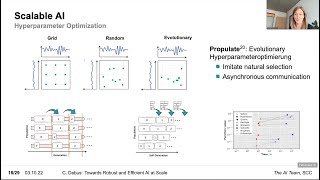
Towards Robust and Efficient AI at Scale
Explore robust, efficient AI for scientific time series forecasting. Learn scalable transformer architectures, energy optimization, and balancing performance with sustainability in large-scale AI applications.
Processing Very Large Image Volumes with the Adaptive Particle Representation
Explore advanced techniques for processing massive image datasets using adaptive particle representation, enabling efficient visualization and analysis of terabyte-scale biomedical data.
Mixing Precisions in Numerical Algorithms - HPC Perspective with Modern Hardware Context
Explore mixed precision algorithms in HPC, focusing on convergence properties and performance considerations for modern hardware implementations of floating-point arithmetic.
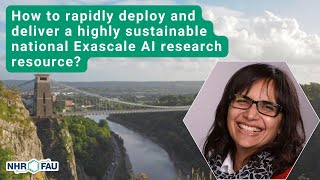
Rapidly Deploying and Delivering a Sustainable National Exascale AI Research Resource - Isambard-AI Case Study
Explore the rapid deployment and sustainability of Isambard-AI, a national Exascale AI research resource in the UK, including its architecture, applications, and impact on AI research.
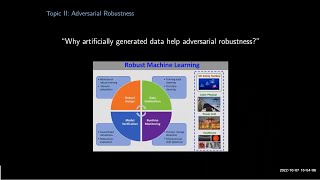
A Statistical Journey through Trustworthy AI
Explore statistical perspectives on privacy, robustness, and fairness in AI, focusing on machine un-learning, adversarial robustness, and fair Bayes-optimal classifiers.

Continuous-in-time Limit for Bandits
Explore the connection between Hamilton-Jacobi-Bellman equations and multi-armed bandit problems, and discover an efficient algorithm for solving MAB challenges.
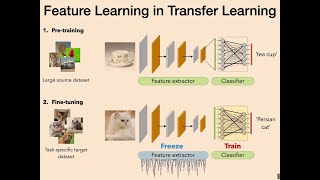
Foundations for Feature Learning via Gradient Descent
Explore the theoretical foundations of feature learning in modern machine learning models, focusing on gradient descent's role in extracting useful features and representations from data.