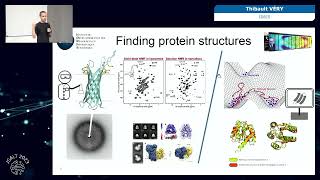
Deep Learning for Protein Structure Discovery
Explore deep learning techniques for uncovering protein structures, revolutionizing molecular biology and drug discovery.
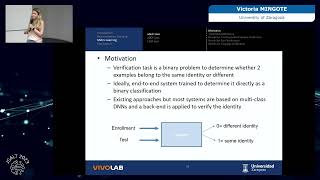
Representation and Metric Learning Advances for Face and Speaker Biometric Systems
Explore advances in representation and metric learning for face and speaker biometric systems, enhancing accuracy and efficiency in identity verification.
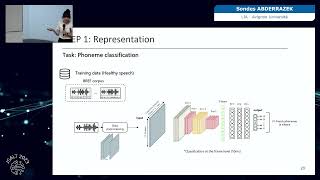
Deep Learning Interpretability and Explainability of Speech in a Clinical Context
Explore deep learning interpretability and explainability of speech in clinical settings, focusing on advanced techniques and their practical applications.
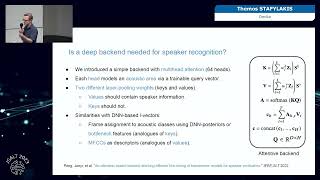
Extracting Speaker and Emotion Information from Self-Supervised Speech Models
Explore techniques for extracting speaker and emotion data from self-supervised speech models, enhancing speech recognition and analysis capabilities.
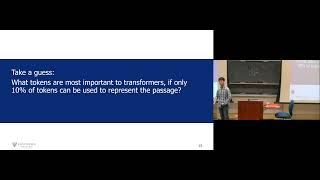
Nugget: Neural Agglomerative Embeddings of Text
Explore dynamic text embedding with Nugget, a novel approach for encoding language into meaningful units, enhancing semantic comparison and expanding contextual windows in language models.
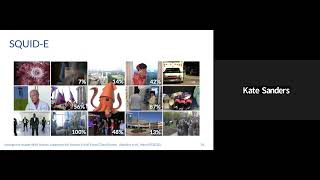
Visual Semantics Events
Explore ambiguous image classification and multilingual video-text alignment for robust event understanding. Enhance visual models' performance on uncertain data and leverage diverse news sources.
Foundation Models and the Transfer of Embodied Autonomy
Explore challenges in developing foundation models for sequential decision-making, including transfer learning, and discuss future research directions in embodied autonomy.
Neurosymbolic AI: Combining Large Language Models with Symbolic Methods
Explore neurosymbolic AI's potential in story generation and D&D gameplay. Discover how combining neural networks with symbolic methods enhances AI robustness and improves accessible communication.
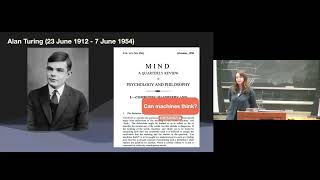
A Universe To Be Decided: Towards Specialized Foundation Models for Advancing Astronomy
Explore specialized foundation models in astronomy, including AstroLLaMa-1 and AstroLLaVA, to enhance scientific inquiry and democratize access to astronomical knowledge.
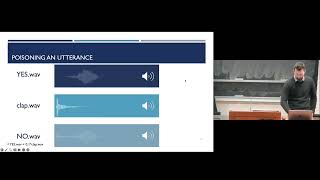
Adversarial and Poisoning Attacks Against Speech Systems - Where to Find Them
Explore vulnerabilities in machine learning systems, focusing on poisoning and adversarial attacks. Learn strategies, defense mechanisms, and implications for AI security.
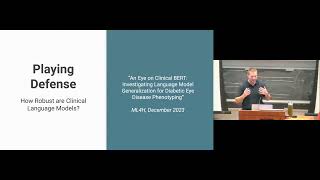
Fighting Bias from Bias: Robust Natural Language Techniques to Promote Health Equity
Explore AI's role in addressing health disparities, examining clinical phenotyping, language model robustness, and efforts to identify stigmatizing language in medical records.
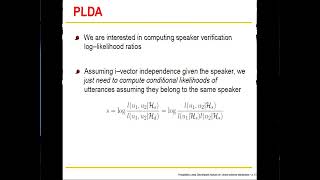
Probabilistic Linear Discriminant Analysis of i-Vector Posterior Distributions
Explore probabilistic linear discriminant analysis for i-vector posterior distributions in speaker recognition, enhancing understanding of advanced speech processing techniques.
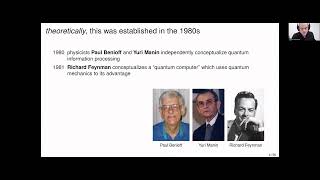
Quantum Computing for AI - Hype or Hope?
Explore quantum computing's potential impact on AI, examining promises, limitations, and realistic applications in machine learning and Bayesian network inference.
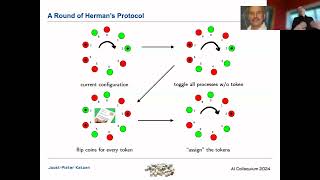
Facing Uncertainty in AI - From Verification to Synthesis
Explore techniques for verifying and synthesizing AI systems under uncertainty, focusing on model-based approaches and automation to ensure safety and dependability in various AI applications.
Aligning AI to Everyone via Reinforcement Learning
Explore reinforcement learning techniques for aligning AI with human values, fostering cooperation and trust in intelligent decision-making systems.
RLHF: How to Learn from Human Feedback with Reinforcement Learning
Explore reinforcement learning techniques for incorporating human feedback in AI systems, enhancing multi-agent and human-AI interactions in social contexts.
Concordia Contest 2024 - Basic Agent Development Tutorial
Develop cooperative AI agents for text-based environments using the Concordia framework. Advance language model intelligence in open-ended worlds similar to tabletop RPGs.
Computational Social Choice and AI Value Learning
Explore computational social choice and AI value learning, focusing on misspecification in RLHF, model interpretability, and foundation model capability evaluations.
Self-Play in Artificial Intelligence - Lecture by Noam Brown
Explore advanced AI techniques in imperfect-information games, focusing on self-play algorithms and their applications in poker and beyond.
Unsupervised Environment Design
Explore automatic generation of environments for training RL agents, from GenIE to Unsupervised Environment Design, bridging classical decision theory and deep learning.
Data Fabrics and Knowledge Graphs for the AI Enterprise
Explore data fabrics and knowledge graphs as essential tools for integrating enterprise knowledge, enhancing AI capabilities, and democratizing data access across organizations.