Learning to Predict Requires Integrated Information
Exploring how Integrated Information Theory quantifies consciousness in neural networks and its relationship with embodied intelligence and predictive learning in AI agents.
Insights from the Conscious Turing Machine - A Machine Model for Consciousness
Explores puzzling phenomena of consciousness using the Conscious Turing Machine model, including pain's impact on sleep, experiences vs. simulations, illusions, dreams, and free will.
Brainish - Formalizing a Multimodal Language for Intelligence and Consciousness
Explores Brainish, a multimodal language for AI consciousness, building on the Conscious Turing Machine. Discusses its syntax, semantics, and implementation for advancing machine intelligence and consciousness models.
On the Link Between Conscious Function and General Intelligence in Humans and Machines
Exploring the connection between consciousness and intelligence in humans and AI, examining theories and proposing a unified model for developing more advanced artificial agents.
Consciousness Meets AI for a New Paradigm
Exploring connections between consciousness and AI, combining theories like Global Workspace Theory with deep learning to develop a new paradigm for general-purpose intelligence and brain-to-brain communication.
Towards an NP-Hard Model of Consciousness
Exploring computational complexity of consciousness, analyzing arguments for non-computability, and proposing conditions for implementable conscious systems in artificial intelligence.
Cortex-Like Systems via Range-Dependent Networks of K-Dimensional Clocks
Explore a novel model of human cortex using range-dependent networks of phase-resetting clocks, offering insights into consciousness and cognitive processing with simplified simulations.
To What Extent Are Machines Conscious?
Exploring machine consciousness: challenges, theories, and implications. Analyzes information, computation, and phenomenal experience in AI, discussing strong vs. weak machine consciousness and their achievability.
The Creativity Code - AI - Friend or Foe?
Explore the intersection of AI, creativity, and consciousness with Oxford professor Marcus du Sautoy. Delve into the potential of machines to think, create, and impact our future in this thought-provoking talk.
Consciousness as a Coherence-Inducing Operator
Exploring consciousness as an operator that induces coherence in biological information processing, examining its properties, function, and potential for computational simulation.
Does a Computer Think If No One Is Around to See It?
Explores the ambiguity of computer thoughts, arguing that multiple interpretations of computations exist simultaneously, contrasting with the unambiguous nature of human cognition.
Understanding Weak and Strong Artificial Consciousness
Explores the distinction between simulating and instantiating consciousness, using the free energy principle to analyze the difference between weak and strong artificial consciousness.
Consciousness and Free Will - A Physical Hypothesis for Distinguishing Humans from AI
Exploring a physical hypothesis for free will and consciousness based on quantum processes in the brain, distinguishing human cognition from AI through perception of parallel worlds.
Simulation and Indexical Function Individuation - Why the Diagonal Argument Does Not Establish the Impossibility of Machine Consciousness
Explores diagonal arguments against algorithmic consciousness, challenging Penrose's conclusions on machine consciousness and simulation of human mathematicians through question-answering systems and indexical function individuation.
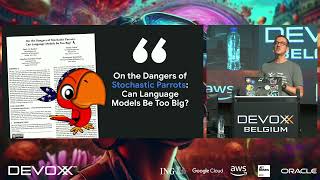
Generative AI in Practice - Concrete LLM Use Cases in Java, with the PaLM API
Explore practical applications of generative AI using Java and the PaLM API, with concrete examples and use cases demonstrated by Guillaume Laforge.
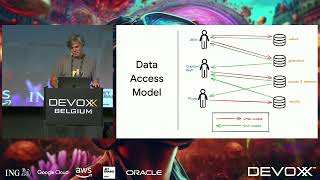
Lessons Learned Building a GenAI Powered App
Explore insights and practical tips for developing GenAI-powered applications, drawing from real-world experiences and best practices in the field of artificial intelligence.
Using AI to Improve the UI of Business Applications
Explore AI-driven UI enhancements for business applications, focusing on innovative techniques to optimize user experience and streamline workflows.
AI Unbounded - Multiplying the Collective Intelligence of Humanity
Explore the potential of AI to amplify human intelligence and revolutionize problem-solving across various domains, enhancing our collective capabilities.
JetBrains AI - A Deep Dive
Explore JetBrains AI's capabilities, features, and potential applications in software development with insights from Vladislav Tankov's comprehensive analysis.
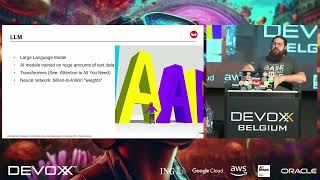
Challenges and Benefits of Coding with Generative AI
Explore the impact of generative AI on coding practices, examining both the advantages and potential hurdles developers face when integrating these tools into their workflows.
Java Meets AI - A Hands On Guide to Building LLM Powered Applications with LangChain4j
Hands-on guide to integrating AI and Large Language Models into Java applications using LangChain4j, enabling developers to create powerful AI-driven solutions.