
Unlocking the Power of ML for Your JavaScript Applications with TensorFlow.js
Explore TensorFlow.js for ML in JavaScript: learn to integrate, retrain models, and leverage ML beyond browsers. Includes demos of virtual makeup try-on and radiology diagnostics.

Intelligent Internet of Things - Start Analyzing Your Global Device Data for Real-Time
Explore Google Cloud IoT's capabilities for managing global devices, extracting real-time insights, and leveraging AI and machine learning for enhanced IoT data analysis and decision-making.

Challenges of Using V4L2 to Capture and Process Video Sensor Images
Explore challenges in capturing and processing video sensor images using V4L2, covering BAYER arrays, white balance, and color adjustment techniques.

Group Fairness - Independence Revisited
Explore the concept of group fairness and independence in algorithmic decision-making, examining its implications, limitations, and potential improvements for ethical AI systems.

Responsible AI in Industry - Lessons Learned in Practice
Explore practical lessons on implementing responsible AI in industry, covering explainability, fairness, and challenges faced by major tech companies.
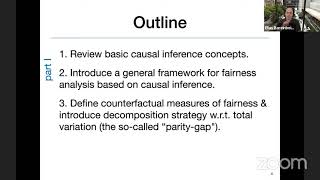
Translation Tutorial - Causal Fairness Analysis
Explore causal fairness analysis in AI, covering structural causal models, causal diagrams, and demographic disparities. Learn why causality matters and how to address fairness challenges in artificial intelligence.

Implications Tutorial - AI on the Ground Approach
Explore the real-world impact of AI through case studies, examining challenges, harms, and social implications. Learn strategies for studying AI's effects on communities and society.

Image Representations Learned With Unsupervised Pre-Training Contain Human-like Biases
Explore how unsupervised pre-training in image representations can lead to human-like biases, examining methods, results, and implications for AI fairness and ethics.

You Can't Sit With Us - Exclusionary Pedagogy in AI Ethics Education
Explores exclusionary practices in AI ethics education, highlighting methodological dogmatism, lack of co-creation, and siloed citations. Proposes ideas for more collaborative and inclusive pedagogical approaches.

Fairness Through Robustness - Investigating Robustness Disparity in Deep Learning
Explore robustness disparity in deep learning, its impact on fairness, and potential mitigation strategies for more equitable AI systems.

What Does Fairness Mean in Data Protection Law
Explore legal concepts of fairness in data protection, examining justice, equality, and AI ethics through practical scenarios and GDPR implications.

The Meaning and Measurement of Bias - Lessons from NLP
Explore the complexities of bias in NLP, covering measurement processes, construct validity, and fairness evaluation. Gain insights into representational harms and practical examples in word embeddings.

Learning Algorithms
Exploration of fairness in machine learning algorithms, focusing on disparity assessment, classification with fairness constraints, and comparative studies of fairness-enhancing interventions.

Fairness, Rankings, and Behavioral Biases
Exploring fairness in ranking systems, behavioral biases, and interventions to improve diversity and equity in selection processes through mathematical modeling and analysis.
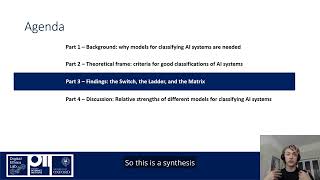
Models for Classifying AI Systems - The Switch, the Ladder, and the Matrix
Explore three models for classifying AI systems: the Switch, the Ladder, and the Matrix. Gain insights into AI governance and evaluation criteria for effective classification frameworks.

One Label, One Billion Faces - Usage and Consistency of Racial Categories in Computer Vision
Explores racial categorization in computer vision, examining usage, consistency, and implications for fairness in AI systems. Highlights challenges and potential biases in facial recognition technology.

Impossible Explanations? Beyond Explainable AI in the GDPR from a COVID-19 Use Case Scenario
Exploring AI explainability challenges in GDPR compliance using COVID-19 scenarios, emphasizing justifiability over technical explanations in legal and ethical contexts.
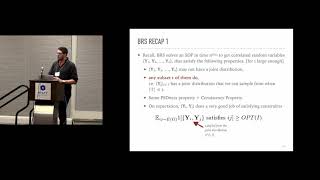
Approximating Constraint Satisfaction Problems on High Dimensional Expanders
Explore high-dimensional expanders and their role in approximating constraint satisfaction problems, with insights on natural collections and general expanders.
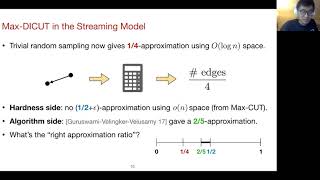
Optimal Streaming Approximations for All Boolean Max 2-CSPs and Max k-SAT
Explore streaming approximations for Boolean Max 2-CSPs and Max k-SAT, covering algorithms, lower bounds, and communication complexity in constraint satisfaction problems.
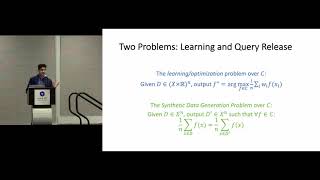
How to Use Heuristics for Differential Privacy
Learn about differential privacy heuristics, their properties, and applications in machine learning. Explore modular design, universal identification, and privacy analysis techniques.

Emerging Tech Trends for 2020
Futurist Amy Webb explores crucial tech trends for 2020, including AI algorithms, synthetic media, and their implications. Scenarios for 2035 range from dystopian to optimistic futures.