Generative Models of Molecular Structures - Day 3
Explore generative models for molecular structures, focusing on applications in drug discovery and computational chemistry.
Machine Learning in Structure-Based Drug Discovery - Day 2
Explore machine learning applications in structure-based drug discovery, focusing on innovative techniques and their impact on pharmaceutical research.
Diffusion Forcing: Next-token Prediction Meets Full-Sequence Diffusion
Explore Diffusion Forcing, a novel training paradigm combining next-token prediction and full-sequence diffusion for enhanced sequence generation and decision-making in AI applications.
Geometric Deep Learning for Protein Understanding
Explore geometric deep learning techniques for protein analysis and understanding, focusing on advanced computational methods in molecular biology.
Polaris - Industry-Led Initiative to Critically Assess ML for Real-World Drug Discovery
Explore an industry-led initiative critically assessing machine learning's impact on real-world drug discovery through the Polaris project.
Metric Flow Matching for Smooth Interpolations on the Data Manifold
Explore Metric Flow Matching for smooth interpolations on data manifolds. Learn about conditional paths, Riemannian metrics, and geodesic interpolants. Discover applications in LiDAR navigation and cellular dynamics modeling.
Approximately Piecewise E(3) Equivariant Point Networks
Explore APEN: a framework for approximate piecewise-E(3) equivariant point networks, improving generalization in part-based symmetry tasks like room scene analysis and human motion recognition.
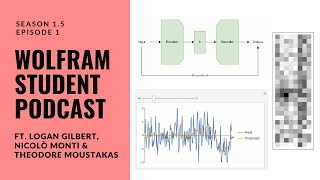
Accelerating Simulations of Particle Systems Using Machine Learning
Explore machine learning techniques for accelerating particle system simulations using transformer-based architectures and Mathematica.
New Additions to Wolfram Neural Net Repository - Overview and Applications
Explore the latest pre-trained models in Wolfram's Neural Net Repository, covering NLP, computer vision, and audio analysis, with insights on their applications and integration.
The Wolfram Prompt Repository: Creation, Components, and Submission Process
Explore the Wolfram Prompt Repository, learn about prompt types, their functionality in notebooks, and how to create and submit your own prompts.
AI-Based Environmentally Sustainable Cardiovascular Disease Diagnostic
Explore an LSTM-based diagnostic tool for CVDs, reducing misdiagnoses and medical waste while achieving high accuracy in disease detection.

What's New in Wolfram Image and Audio Processing - Recent Developments and Applications
Explore cutting-edge AI advancements in image and signal processing, including segmentation, OCR, and speech technologies, with powerful neural network applications.
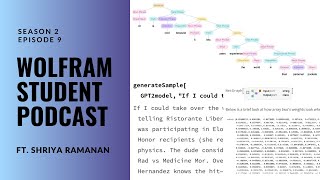
Analyzing GPT-2's Brain Development
Explore GPT-2's inner workings through token manipulation, node analysis, and temperature adjustments to gain insights into its structure and functioning.
Get Started with AI - A Beginner's Guide to Automated Classification, Predictions and Computer Vision
Apply modern data science techniques for predictions, categorization, and relationship discovery using numeric, textual, and image data. Learn practical AI applications for beginners.
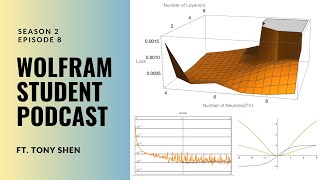
Evaluating Complexity for Neural Nets in Learning Math Functions
Explore neural net complexity's impact on learning math functions through criteria analysis and optimization techniques.

Injecting Reliability into Generative AI
Explore Wolfram's vision for enhancing LLM reliability through computational intelligence. Learn to inject facts, utilize private data, and combine LLM capabilities with Wolfram Language to solve complex problems.
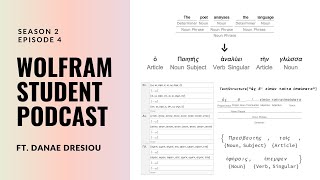
Analyzing Ancient Greek Syntax
Explore ancient Greek syntax analysis through computational methods, developing functions for parts of speech, verb endings, and noun categories.
XAI: A Model to Explain StyleGANs
Explore an innovative explanation model for StyleGANs using active shape and appearance models in this computational essay.
AI and the Future of Scientific Publishing
Explore AI's impact on scientific publishing with experts discussing new tools, methods, and workflows for arXiv, bioRxiv, medRxiv, and ScienceCast.
Computational Thinking, LLMs and the Future of Education
Explore computational thinking, large language models, and their impact on education's future in this thought-provoking workshop by Wolfram.
Machine Learning for Real-Time Hydrate Risk in LNG Facilities
Explore advanced neural networks in Wolfram Language for real-time hydrate risk monitoring in LNG facilities using simulation-based data.