Automated and Explainable Deep Learning for Clinical Language Understanding
Explore advanced deep learning techniques for clinical NLP, including automated model training, explainable AI, and scalable architectures to extract critical healthcare insights from unstructured medical notes.
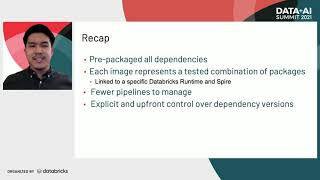
Using Docker Images in Production - Databricks Case Study
Learn how Condé Nast evolved Spire, their user segmentation service, from notebooks to Docker images on Databricks clusters. Explore the streamlined deployment workflow, challenges faced, and solutions implemented.
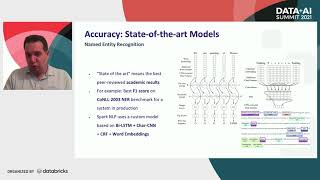
Advanced Natural Language Processing with Apache Spark NLP
Explore advanced NLP tasks using Apache Spark NLP, covering classification, named entity recognition, sentiment analysis, and more through hands-on Python notebooks and deep learning techniques.
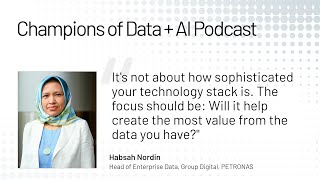
Why AI Starts with Effective Data Management
Explore effective data management strategies for AI success with insights from PETRONAS' Head of Enterprise Data on building a data-driven organization and empowering citizen analytics.
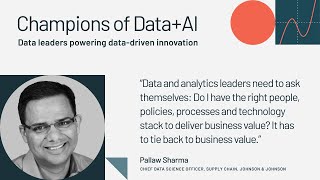
The Role of Data Platforms in Transforming Business - Champions of Data and AI Episode 6
Explore how Johnson & Johnson leverages a comprehensive data platform for business transformation, featuring insights on data curation, AI applications, and strategic decision-making.
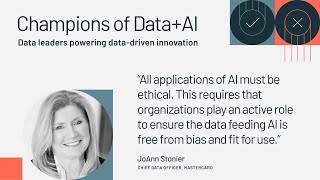
Ethical Use of Data for AI - Episode 5
JoAnn Stonier discusses ethical data use in AI, addressing bias, GDPR, global responsibility, and societal impact. She offers insights on eliminating bias and advice for data leaders.
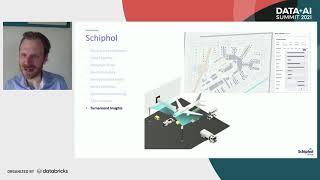
Consolidating MLOps at Schiphol Airport Using MLFlow
Explore how Schiphol Airport leverages MLFlow for rapid iteration, deployment, and monitoring of mission-critical machine learning models, enabling multiple weekly releases and efficient adaptation to changing dynamics.

Interpretable Machine Learning - Data Brew Season 2 Episode 7
Explore interpretable machine learning with Ameet Talwalkar, discussing its relation to data privacy, fairness, and practical applications in this insightful interview on cutting-edge ML research.
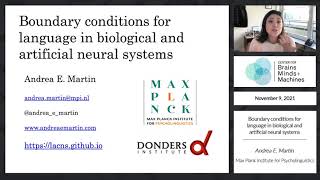
Boundary Conditions for Language in Biological and Artificial Neural Systems
Explore computational requirements for language processing in neural systems, focusing on hierarchical structures, neural oscillations, and integrating linguistic insights with neural computation principles.
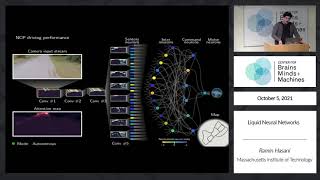
Liquid Neural Networks
Explore Liquid Time-Constant Networks, a novel continuous-time neural network model with superior expressivity and improved performance in time-series prediction tasks.
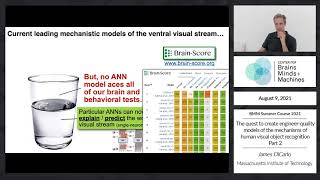
The Quest to Create Engineer-Quality Models of the Mechanisms of Human Visual Object Recognition - Part 2
Explore cutting-edge models of human visual object recognition, their implications for AI, and strategies for future research in neuroscience and machine learning.
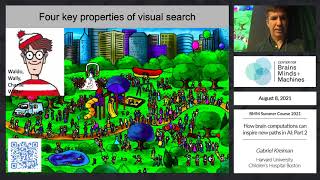
How Brain Computations Can Inspire New Paths in AI - Part 2
Explore brain-inspired AI advancements, focusing on object recognition, contextual reasoning, and model performance. Gain insights into cutting-edge computational approaches and their applications.
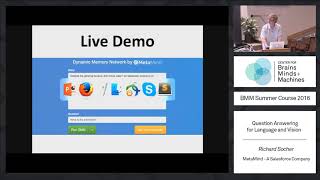
Question Answering for Language and Vision
Explore advanced techniques in question answering for language and vision, including joint models, multitask learning, and neural networks with Richard Socher from MetaMind.
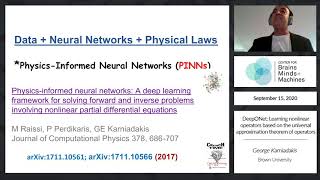
DeepOnet - Learning Nonlinear Operators Based on the Universal Approximation Theorem of Operators
Learn to approximate nonlinear operators using DeepONet, a neural network architecture based on the universal approximation theorem. Explore applications in differential equations, fluid mechanics, and multiphysics problems.
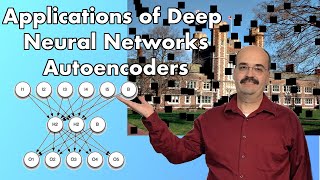
Deep Neural Network Autoencoders in TensorFlow and Keras - Part 1
Learn to create and implement autoencoders in Keras and TensorFlow, including denoising autoencoders, for deep neural network applications in image processing and function approximation.
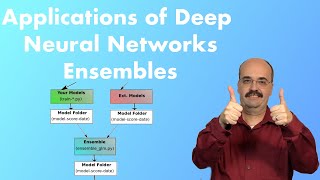
Neural Networks with Ensembles for TensorFlow and Keras
Learn to create and evaluate ensemble models using random forests and deep neural networks with TensorFlow, Keras, and scikit-learn. Explore feature importance and perturbation ranking techniques.
Early Stopping and Encoding a Feature Vector for Deep Neural Networks
Learn to implement early stopping, encode feature vectors, and use validation sets in Keras neural networks for improved deep learning model performance and efficiency.
Introduction to TensorFlow and Keras with Anaconda Python
Learn to build neural networks using TensorFlow and Keras for classification and regression tasks. Covers key concepts, data handling, model creation, training, and evaluation.
Deep Neural Network Basics for Keras and TensorFlow
Explore deep neural network fundamentals including activation functions, bias neurons, and output calculation for Keras and TensorFlow implementation.
Detecting Cancer with RBF Networks Trained by Genetic Algorithms
Explore machine learning techniques for cancer detection using RBF networks and genetic algorithms, with practical insights on implementation and advanced concepts.
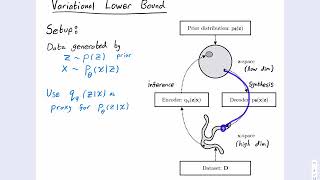
Variational Autoencoders
Explore generative models, autoencoders, and variational techniques in deep learning. Learn about architecture, optimization, and practical applications of variational autoencoders.