Neur2SP- Neural Two-Stage Stochastic Programming - IPAM at UCLA
Explore Neur2SP, a novel approach to two-stage stochastic programming using neural networks. Learn how this method efficiently solves complex decision-making problems under uncertainty.
Reasoning Algorithmically- From Toy Experiments to AGI Modules
Explore neural networks' potential in algorithmic computation, from toy experiments to groundbreaking applications in mathematics and AI reasoning, with insights on their transformative impact on machine learning and computer science.
Prediction + Optimisation - Without and With Decision-Focused Learning
Explore AI-enhanced combinatorial optimization, including preference learning, decision-focused learning, and explanation generation. Discover CPMpy, a modern constraint programming language integrating multiple solving paradigms with machine learning.
AI-Guided Nonlinear Optimization for Real-World Problems - IPAM at UCLA
Explore AI-guided optimization techniques for complex real-world problems, focusing on nonconvex objectives and slow-to-evaluate functions in applications like embedding table sharding and antenna design.
AlphaTensor - Discover Faster Matrix Multiplication Algorithms with RL - IPAM at UCLA
Discover how DeepMind's AlphaTensor uses reinforcement learning to find efficient matrix multiplication algorithms, outperforming human-designed methods and improving on Strassen's algorithm after 50 years.
Machine Learning for MIP Solving - IPAM at UCLA
Explore machine learning techniques for solving Mixed Integer Programming problems, enhancing optimization algorithms in discrete mathematics and artificial intelligence applications.
From A to B via a Synthesis of Rare-Event Sampling and Machine Learning
Explore machine learning and rare-event sampling techniques for analyzing molecular transitions and generating pathways between energy basins, with applications in materials science and biomolecules.
Explainable Structured Machine Learning in Similarity, Graph and Transformer Models
Explores techniques for explaining complex machine learning models, focusing on similarity, graph, and transformer structures. Discusses applications in knowledge evolution, gender bias, and task-solving.
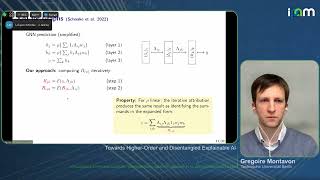
Towards Higher-Order and Disentangled Explainable AI
Explore advanced techniques in Explainable AI, including higher-order explanations and disentangled components, to enhance the interpretability of complex machine learning models.
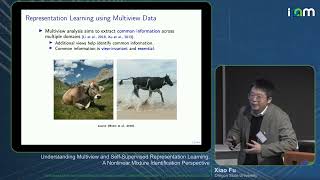
Multiview and Self-Supervised Representation Learning - Nonlinear Mixture Identification
Explore nonlinear mixture identification in multiview and self-supervised representation learning. Gain insights into extracting essential information from high-dimensional data for improved AI applications.
From Network Dissection to Policy Dissection - Emergent Concepts in Deep Representations
Explore emergent concepts in deep neural networks, from image classification to reinforcement learning, revealing inner workings and enabling meaningful human-AI interactions for content creation and robotics control.
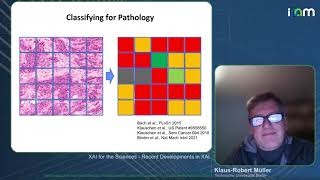
AI for the Sciences - Recent Developments for XAI - IPAM at UCLA
Explore recent advancements in Explainable AI for scientific applications, focusing on novel insights and developments presented by Klaus-Robert Müller at IPAM's workshop.
New Approaches in Simulation of Transition Paths - IPAM at UCLA
Explores tensor methods for simulating chemical transition processes, focusing on compressing high-dimensional PDE functions and introducing a novel tensor-network generative modeling approach without optimization.
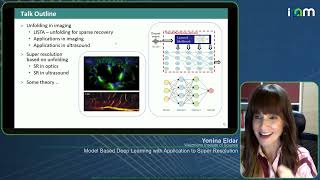
Model Based Deep Learning with Application to Super Resolution - IPAM at UCLA
Explore model-based deep learning for super-resolution microscopy, merging parametric models with optimization tools to create efficient, interpretable networks from limited training data.
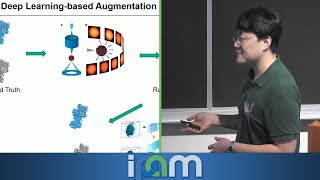
Neural Network-Assisted Atomic Electron Tomography - IPAM at UCLA
Neural network-assisted atomic electron tomography for 3D atomic structure measurement of nanoparticles, enabling precise surface characterization and functional property analysis at single-atom level.
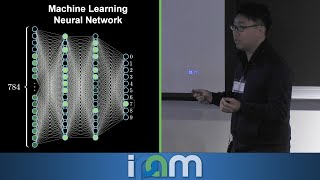
AI Inroads in Imaging Sciences for Materials Research - IPAM at UCLA
Explore deep learning applications in materials research, focusing on convolutional neural networks for transmission electron microscopy and tomographic imaging advancements.
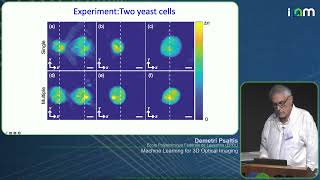
Machine Learning for 3D Optical Imaging - IPAM at UCLA
Explore machine learning techniques for enhancing 3D optical diffraction tomography, including digital phantom-based training and physics-constrained neural networks for improved image reconstruction.
3D Phase Imaging with Scattering Samples - IPAM at UCLA
Innovative microscopy techniques for 3D phase imaging in thick, scattering samples using computational algorithms and neural networks to reconstruct refractive index maps from angle-coded illumination.
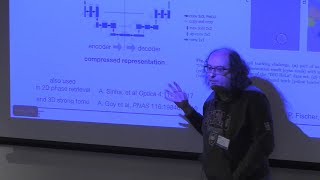
On the Use of Machine Learning for Computational Imaging
Exploring machine learning applications in computational imaging, focusing on inverse problems, regularization, and challenges in phase retrieval, 3D structure reconstruction, and surface analysis.
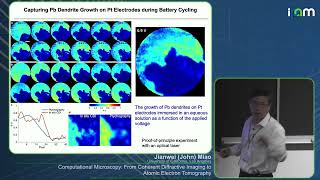
Computational Microscopy: Coherent Diffractive Imaging to Electron Tomography
Explore computational microscopy techniques from coherent diffractive imaging to atomic electron tomography with UCLA expert Jianwei Miao in this insightful presentation on cutting-edge imaging methods.
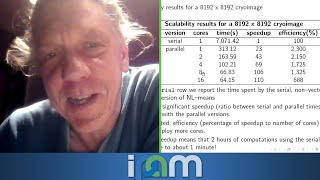
Algorithms for Non-Local Filtering - Application Cryo-Electron and Biological Microscopy
Efficient algorithms for non-local filtering in microscopy, focusing on fast implementations of Non-Local Means Denoising and feature detection in biological images for improved image processing and analysis.