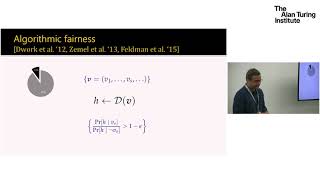
Fairness and Robustness in Machine Learning – A Formal Methods Perspective - Aditya Nori, Microsoft
Explore fairness in machine learning through formal methods. Learn techniques for verifying probabilistic properties and certifying fairness in decision-making programs using FairSquare.

Turing Lecture - AI Through the Looking Glass
AI's societal impact: opportunities, challenges, and ethical considerations. Explores job automation, socio-technical approaches, and UK's positioning in AI evolution. Emphasizes unexpected outcomes and the need for diverse perspectives.
Ground Truth - The Uses and Abuses of Human Annotation in Text Analysis - Professor Kenneth Benoit
Explores the concept of "ground truth" in text analysis, discussing annotation methods, intercoder agreement, and comparing expert vs. crowd-sourced coding for social science research.

Computational Semantics Evaluation - The Origins of Senseval and Evolution of SemEval
Explore the evolution of computational semantics evaluation, from Senseval's origins in word sense disambiguation to SemEval's diverse tasks. Learn about key challenges, benefits, and future considerations in semantic analysis.
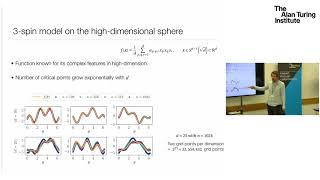
Neural Networks as Interacting Particle Systems
Explore neural networks as interacting particle systems, examining their mathematical foundations and applications in complex systems modeling across various scientific disciplines.
Using AI in the Exploration of Urban Modelling Scenarios - Richard Milton & Flora Roumpani
Explore urban modeling scenarios using AI, focusing on smart cities, deep learning for mobility data, and building resilient systems for future urban challenges.

A Function Space View of Overparameterized Neural Networks - Rebecca Willet, University of Chicago
Explore function spaces of overparameterized neural networks, focusing on weight-bounded networks and their approximation capabilities. Insights from Radon transform analysis reveal novel perspectives on learning with ReLU networks.
Unsupervised Doodling and Painting with Generative Agents
Explore unsupervised learning in generative art, reinforcement learning agents as image creators, and the potential of AI in artistic tools and creative processes.
An Unethical Optimisation Principle
Explore the ethical implications of AI optimization strategies and their potential for unintended consequences in financial markets and AI regulation.
Turing Lecture - Algorithmic Accountability - Professor Ben Shneiderman, University of Maryland
Exploring algorithmic accountability and human-centered oversight for safer AI systems. Emphasizes comprehensible, predictable, and controllable designs to prevent failures and improve safety in critical services.
Turing Lecture - Chief Scientific Advisor for the Department of Transport, Phil Blythe
Explore evolving transport techniques, from aging infrastructure to autonomous vehicles, and their impact on future travel with insights from the Department of Transport's Chief Scientific Advisor.

The Truck Backer-Upper
Explore neural network applications in vehicle control, focusing on the Truck Backer-Upper problem. Learn about state transitions, training strategies, and Bayesian neural networks.

ConvNets in Practice
Explore practical applications of ConvNets in object detection, face recognition, and semantic segmentation. Learn about network architectures, performance comparisons, and real-world implementations in robotics and image processing.

Parameter Sharing - Recurrent and Convolutional Nets
Explore parameter sharing in recurrent and convolutional neural networks, covering hypernetworks, RNNs, LSTMs, attention mechanisms, and ConvNets, with insights on architecture, training, and biological inspiration.

Gradient Descent and the Backpropagation Algorithm
Explore gradient descent and backpropagation algorithms, covering supervised learning, parametrized models, loss functions, and neural network architectures with PyTorch implementation.

Graph Convolutional Networks - GCNs
Explore Graph Convolutional Networks (GCNs), their connection to CNNs, and implementation using PyTorch and DGL. Learn about tensors on vertices and edges, residual gated GCNs, and domain sparsity.

Self-Supervised Learning in Computer Vision
Explore advanced self-supervised learning techniques in computer vision, including PIRL, SwAV, AVID+CMA, and Barlow Twins, to enhance your understanding of representation learning and model training.

Speech Recognition and Graph Transformer Networks
Explore modern speech recognition techniques, including connectionist temporal classification, beam search decoding, and Graph Transformer Networks, with expert insights and practical applications.
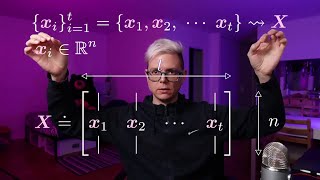
Self - Cross, Hard - Soft Attention and the Transformer
Explore attention mechanisms and Transformer architecture, covering self/cross and hard/soft attention, key-value stores, and practical implementation in PyTorch for advanced deep learning applications.

AE, DAE, and VAE with PyTorch - Generative Adversarial Networks and Code
Explore autoencoders, VAEs, and GANs with PyTorch. Learn implementation, visualization, and comparison of generative models through hands-on coding and insightful analogies.

From LV-EBM to Target Prop to Autoencoder
Explore various autoencoder types, from target propagation to variational autoencoders, understanding their mechanisms, applications, and differences in deep learning and neural network architectures.