Self-Training With Noisy Student Improves ImageNet Classification
Explore advanced image classification techniques using self-training and noisy student methods, improving accuracy and robustness in deep learning models.

Algorithmic Decision Making and the Cost of Fairness
Explore algorithmic decision-making in pre-trial settings, examining bias identification, fairness concerns, and the trade-offs between accuracy and equity in automated systems.
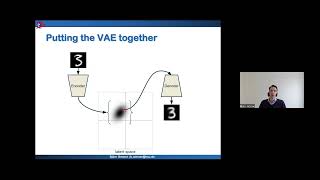
Deep Generative Models and Stable Diffusion: Revolution in Visual Synthesis - Lecture by Björn Ommer
Explore deep generative models, focusing on diffusion models and Stable Diffusion. Learn about visual synthesis advancements, efficiency improvements, and future developments in this cutting-edge field.
Toward Generalizable Embodied AI for Machine Autonomy
Explore recent advancements in machine autonomy, focusing on generalizable embodied AI through sequential decision-making, simulation environments, and human-AI collaboration.
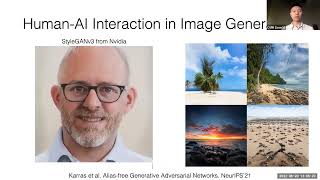
Human-AI Interaction for Computer Vision
Explore human-AI collaboration in computer vision, covering image classification, content editing, generative AI, and interactive learning for enhanced AI systems and applications.
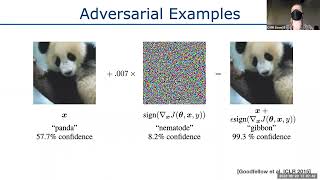
Responsible Computer Vision - Model Failures and Solutions
Explore visual recognition challenges, dataset biases, and domain adaptation techniques to improve model performance and address fairness issues in computer vision systems.
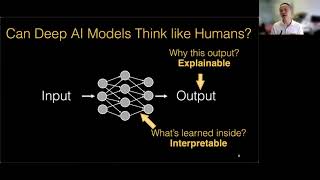
Human-Centric AI for Computer Vision and Machine Autonomy - ICCV'21 Tutorial
Explore human-centric AI in computer vision, covering explainable models, interpretable neural networks, and interactive machine learning for improved AI systems and autonomous machines.
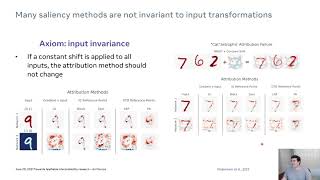
Towards Falsifiable Interpretability Research in Machine Learning - Lecture
Explore techniques for falsifiable interpretability in machine learning, focusing on saliency, individual neurons, and populations. Learn to build stronger hypotheses for more robust research.
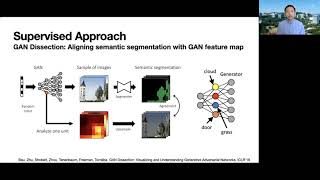
Interpreting Deep Generative Models for Interactive AI Content Creation
Explore deep generative models for AI content creation, covering image generation, latent space manipulation, and interactive techniques. Learn about challenges and applications in this cutting-edge field.
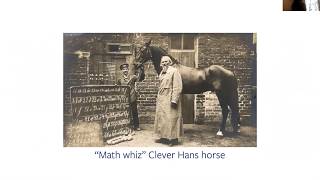
Understanding Deep Neural Networks - CVPR 2020 iMLCV Tutorial
Explore deep neural network interpretability through meaningful perturbations, extremal perturbations, and activation analysis. Learn techniques for understanding and improving model behavior in computer vision tasks.
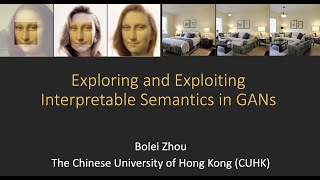
Exploring and Exploiting Interpretable Semantics in GANs - CVPR 2020 Tutorial
Explore interpretable semantics in GANs, covering deep generative representation, GAN dissection, latent space manipulation, and applications in face synthesis and image processing.

Modeling Conceptual Understanding in Image Reference Games - CVPR 2020 Tutorial
Explore image reference games, conceptual understanding modeling, and machine theory of mind in this tutorial on interpretable vision and multi-agent communication.
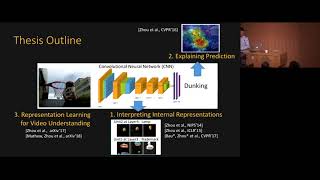
Interpretable Representation Learning for Visual Intelligence
Explore interpretable representation learning in deep neural networks for visual intelligence, covering object classification, scene recognition, and network visualization techniques.
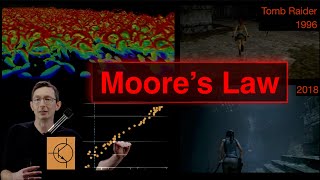
Moore's Law, Exponential Growth, and Extrapolation!
Explore Moore's Law, exponential growth in computing, and its impact on AI, scientific computing, and future technologies. Understand the implications for technological advancement.
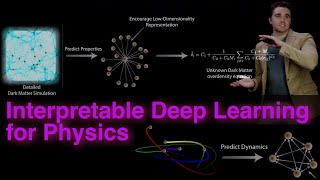
Interpretable Deep Learning for New Physics Discovery
Explore a novel method combining deep learning and symbolic regression to uncover physical laws from data, with applications in physics and cosmology.

Deep Reinforcement Learning - Neural Networks for Learning Control Laws
Explore neural networks in deep reinforcement learning for control systems, from game-playing AI to robotics. Learn about key algorithms and groundbreaking applications.
Machine Learning for Fluid Dynamics - Patterns
Explore machine learning applications in fluid dynamics, focusing on pattern extraction and coherent structure identification in high-dimensional systems.

Long Short-Term Memory with PyTorch + Lightning
Learn to implement and train LSTM networks using PyTorch and Lightning, covering custom LSTM coding, PyTorch's built-in LSTM, and advanced training techniques for deep learning projects.
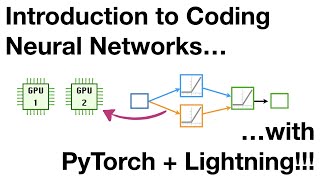
Introduction to Coding Neural Networks with PyTorch and Lightning
Aprenda a codificar redes neurais eficientemente com PyTorch e Lightning, simplificando o processo, melhorando a portabilidade e otimizando a taxa de aprendizagem automaticamente.

Introduction to PyTorch
Learn to create, visualize, and optimize a neural network using PyTorch in this step-by-step tutorial, covering network creation, output graphing, and parameter optimization through backpropagation.
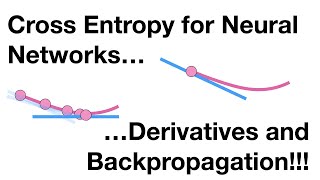
Neural Networks Part 7 - Cross Entropy Derivatives and Backpropagation
Detailed guide on calculating cross entropy derivatives and applying them in neural network backpropagation, with step-by-step explanations and practical examples.