
AI- From Algorithms to Ethics - ACM WomENcourage 2020
Explores gender fairness in AI, highlighting biases in data and algorithms. Emphasizes transparency and explainability for trustworthy AI development. Discusses case studies and proposes solutions for gender-neutral machine learning.
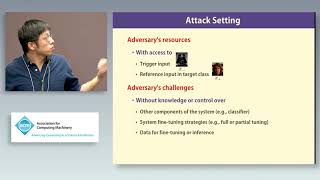
Model-Reuse Attacks on Deep Learning Systems
Explore the security risks of using pre-trained models in machine learning systems, focusing on model-reuse attacks and their implications for AI safety.
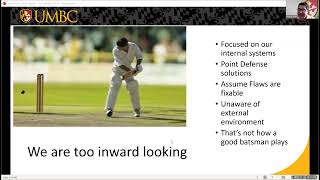
AI and Cybersecurity - The Twain Shall Meet
Explore AI's role in cybersecurity, focusing on advanced persistent threats, intrusion detection systems, and vulnerability analysis using ontologies and reasoning techniques.
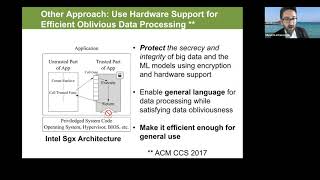
Securing Big Data in the Age of Artificial Intelligence
Explore challenges and solutions for securing big data in AI, including hardware support, federated learning, and privacy-preserving techniques for data science and machine learning.

How Morphological Computation Shapes Integrated Information in Embodied Agents
Exploring the relationship between morphological computation and integrated information in embodied agents, highlighting their antagonistic nature and impact on brain-body-environment interactions.

Autonomous Manipulator Solutions for Mobile Robotics
Explore autonomous manipulator solutions for mobile robotics, focusing on challenges in remote environments, machine perception, and object interaction. Learn about building blocks for advanced robotic control and human-robot collaboration.

AI and Cyber Security - Mark Menzies, Check Point
Explore AI's impact on cybersecurity, including advancements in threat detection, campaign hunting, and context-aware systems. Learn how AI is revolutionizing the field and enhancing accuracy.
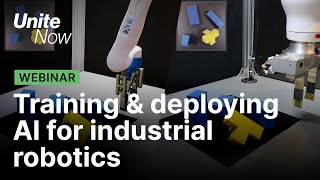
Training and Deploying AI for Industrial Robotics - Unite Now 2020
Explore AI training for industrial robotics using Unity, featuring domain randomization and insights on shaping the future of robotics from industry experts.
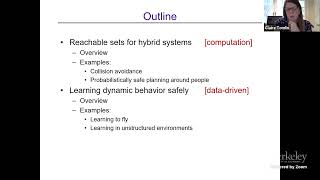
Safe Learning in Robotics
Explore safe learning in robotics, covering reachable sets, collision avoidance, fast planning, and human-robot interaction. Gain insights into cutting-edge techniques for autonomous systems.

Safety-Critical Autonomous Systems - What is Possible? What is Required?
Explore the design, challenges, and potential of safety-critical autonomous systems in aerospace, transportation, and consumer applications, focusing on verification and formal methods.

Computational Models of Cognition - Reverse-Engineering Common Sense in the Human Mind and Brain Pt 1
Explore cognitive modeling to reverse-engineer human common sense, examining AI progress, scientific context, and probabilistic programming techniques for capturing learning and constructing models.
Generative Adversarial Models for Privacy and Fairness
Explore generative adversarial models for enhancing privacy and fairness in machine learning, covering differential privacy, GANs, and real-world applications in data publishing and encoding.
Certifiable Outlier-Robust Geometric Perception - Robots that See through the Clutter with Confidence
Explore cutting-edge algorithms for robust geometric perception in robotics, enhancing safety and reliability in autonomous systems across various applications.
Towards Generalization of Precise Robot Skills - Accurate Pick-and-Place of Novel Objects
Explore precise robotic generalization for pick-and-place tasks using simulation-learned models. Discover how visuo-tactile sensing enables accurate object manipulation and placement with sub-millimeter precision for novel items.
Better Ways to Measure and Move - Joint Optimization of Agent's Physical Design and Computational Reasoning
Explore joint optimization of physical design and computational reasoning for intelligent agents, enhancing sensor networks, legged robots, and soft robotics through machine learning techniques.

Bio-Inspired Sensing
Explore bio-inspired sensing and its applications in robotics, focusing on how biological systems like the human eye inform edge detection, noise rejection, and data processing in artificial sensors.
sa.FIRE Cloud4Health Studio Demonstration
Explore sa.FIRE Studio's interface, ontology, policy creation, retrieval, and revocation in this Cloud4Health demonstration by Dr Lu Fan.
A Unifying Framework for Analyzing Complex Systems
Explore complex systems analysis through genetic algorithms, agent-based models, network analysis, and time series analysis. Learn quantitative methods for social sciences and economics research.

Microsoft Ignite Into Focus - Security
Industry experts discuss the current threat landscape and explore AI's potential in empowering security teams to protect organizations more effectively against growing cybercrime threats.

Multi-Dimensional Scanning Transmission Electron Microscopy to Solve 3D Nanostructures
Explore advanced electron microscopy techniques for 3D nanostructure analysis, including multi-dimensional imaging channels and computational methods to enhance resolution and information recovery.
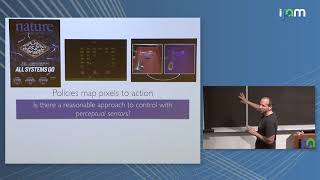
Trying to Make Sense of Control from Pixels
Explores challenges in merging machine learning with control systems, focusing on autonomous vehicles using vision. Discusses uncertainty quantification, robust controller design, and performance guarantees.