How to Create Inspiring Data
Explore the process of creating engaging data visualizations, from concept to execution, with insights on inspiring and captivating audiences through creative visual storytelling techniques.
Making Games with Python - Mission Impossible?
Explore Python's potential in game development, comparing frameworks like Pygame and OpenGL, and discussing its role in asset pipelines, data integration, and commercial game production.
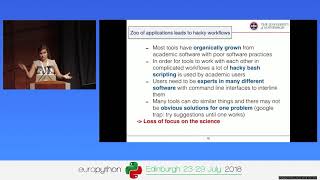
How is Python Used in Biomolecular Sciences?
Explore Python's role in computational molecular biology, including tools and workflows for protein simulations and drug discovery. Learn about BioSimSpace, an open-source library simplifying complex biomolecular problem-solving.
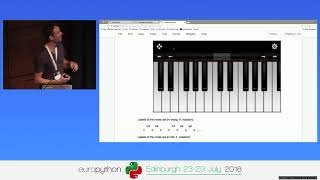
Change Music in Two Epochs
Explore deep learning applications in music: instrument detection, isolation, and generation. Learn to build synthesizers, create datasets, and adapt models for increasing complexity.
Extending HTTP for Fun and Non-Profit
Explore strategies for standardizing API guidelines through IETF, using real-world examples of HTTP header modifications and engaging with industry stakeholders.
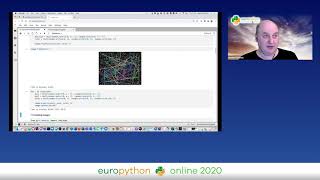
PyRT - Computer Graphics in Jupyter Notebooks for Fun and Teaching
Explore pyRT for raytracing in Jupyter notebooks, creating 2D animations, visualizing algorithms, rendering geodata, and generating 3D graphics with Python.
Live-Coding a Music Synthesizer
Live-coding session using NumPy and SoundDevice to create realistic instrument sounds with math. Gradually build a synthesizer from simple sine waves to playing classical music, while exploring music theory concepts.
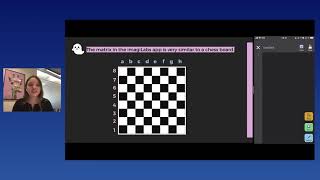
Creative Coding with imagiLabs
Explore Python basics through creative coding, making colorful animations using the imagiLabs app and programmable accessories. Ideal for young coders aged 8-16.
Driving 3D Printers with Python
Explore challenges and solutions in developing OctoPrint, an open-source web interface for 3D printers, focusing on end-user software maintenance and Python implementation insights.
Music and Code
Explore parallels between learning music and coding, discussing skill acquisition, cultural development, and expertise in both fields. Gain insights into the intersections of art and science in these disciplines.
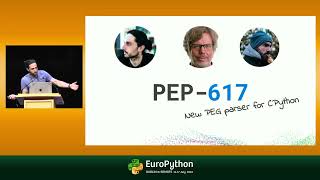
Making Python Better One Error Message at a Time
Explore Python 3.10's improved error messages and upcoming 3.11 enhancements. Learn about implementation challenges, user benefits, and how to contribute to future improvements.
Jupyter - Under the Hood
Explore Jupyter's architecture: from notebook server to IPython kernel. Dive into REST APIs, ZMQ sockets, and internal workings of Jupyter Notebook, JupyterLab, and JupyterHub.
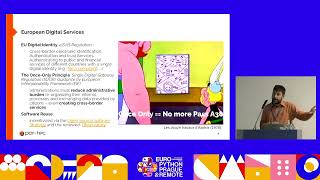
The Digital State of the European Union
Explore the challenges and current state of EU digital services, including identity, cross-border access, and open source support. Gain insights into normative and technical issues affecting UX, cybersecurity, and maintainability.
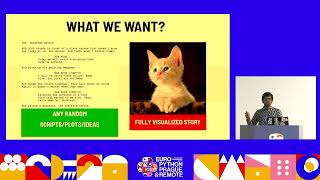
Story Generation Using Stable Diffusion in Python
Explore coherent visual story synthesis using AR-LDM, a latent diffusion model for story visualization and continuation tasks, leveraging history captions and generated images.
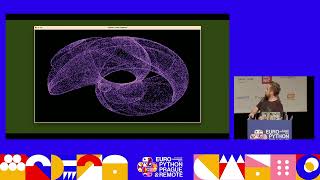
Games of Life - Generative Art in Python
Explore algorithms for creating unique, cohesive graphics using Python. Learn about Clifford attractors, slime mold simulation, and geometric primitives to generate impressive 2D and 3D visualizations.
Making Informed Decisions
Learn to create effective business analytics dashboards, focusing on data scope, strategic vs operational metrics, and best practices for informed decision-making.
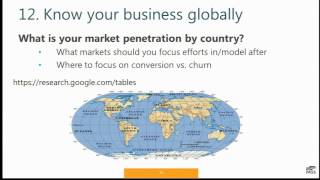
Growth Hacking Using Data
Learn data-driven growth strategies, including identifying key metrics, analyzing engagement, understanding funnels and cohorts, and effectively communicating insights to drive business decisions and success.
SQL Datawarehouse
Explora las ventajas, arquitectura y mejores prácticas de diseño de SQL Data Warehouse, optimizando el rendimiento y eficiencia de tus soluciones de almacenamiento de datos.
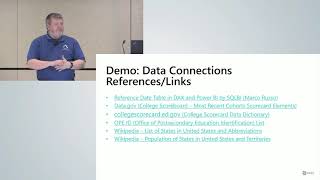
Data Modeling and Prototyping in Power BI Desktop
Explore rapid data modeling and prototyping using Power BI Desktop. Learn to connect, cleanse, and model data from various sources, creating quick reports for project approval without licensing costs.

An Introduction to Data Visualizations and Design Best Practices
Learn effective data visualization techniques, including chart selection, color theory, and design principles to enhance your data storytelling skills and create impactful Power BI reports.
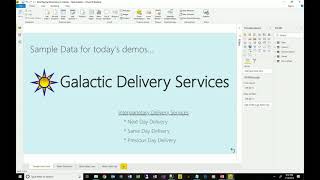
Handling Role Playing Dimensions in Tabular Models
Explore various methods for implementing role-playing dimensions in tabular models, including DAX expressions, with a focus on model maintainability and user experience in data analysis.