Dimension, Complexity and K Theory
Explore connections between dimension theory, complexity, and K-theory in mathematics, focusing on applications in topology and geometry. Gain insights into cutting-edge research in these interconnected fields.
Henrik Shahgholian - Free Boundaries on Lattice, and Their Scaling Limits
Explore lattice-based potential theory, examining harmonic functions and free boundary problems. Discover intriguing numerical results and their implications for facet formation in scaling limits.

The Lonely Runner Conjecture - Simulation and Explanation
Explore the intriguing Lonely Runner Conjecture through simulation, understanding its simplicity and the challenge of proving it conclusively.
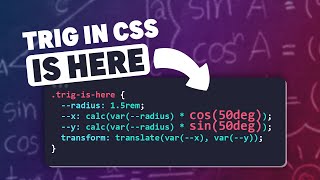
CSS Trigonometry
Explore CSS trigonometry functions sin() and cos() for creative layouts and animations. Learn practical applications and optimize with Sass loops and custom properties.

Discovery of the Aperiodic Monotile
Explore the groundbreaking discovery of the Aperiodic Monotile with co-discoverer Craig Kaplan. Learn about this revolutionary tiling concept and its implications in mathematics and design.

The Making of a Mile of Pi - Numberphile
Behind-the-scenes look at creating a mile-long printout of pi digits. Explores the challenges, technology, and teamwork involved in this unique mathematical endeavor.
Complex Analysis - Analytic Functions Solve Laplace's Equation
Explore how analytic complex functions' real and imaginary parts solve Laplace's equation, introducing harmonic functions in this in-depth mathematical analysis.

Sparks of AGI - Analyzing GPT-4 and the Latest GPT-LLM Models
Explore GPT-4's advancements, including multi-modal input, exam performance, spatial awareness, and potential AGI implications. Analyze capabilities, challenges, and societal impacts of cutting-edge language models.

Understanding Variable Fonts and Their Web Applications - Learn With Jason
Explore variable fonts with Jason Pamental: learn how they enhance web performance and art direction, with practical demos and implementation tips for immediate use in web projects.
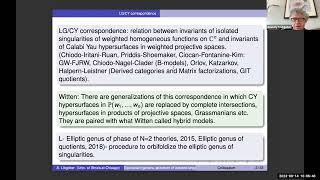
Equivariant Genera, Spectrum of Isolated Singularities & Hybrid Models
Explore equivariant genera, singularity spectra, and hybrid models in algebraic geometry. Delve into GIT quotients, McKay correspondence, and LG/CY correspondence for weighted projective spaces.

Markov Chains for Generative Music AI - Lecture 11
Explore Markov chains for generative music AI, covering intuition, formalization, music modeling, pros and cons, and practical applications in melody, rhythm, and dynamics generation.
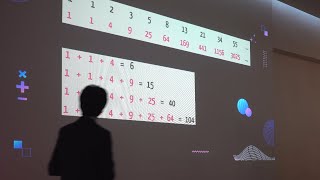
Mathematics in Nature - Exploring Fibonacci and the Golden Ratio
Explore the fascinating connections between mathematical sequences and nature, art, and architecture, revealing how mathematics shapes our perception of beauty and the world around us.
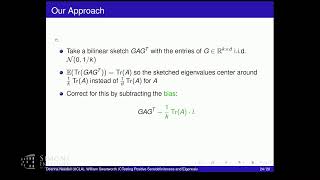
Testing Positive Semidefiniteness and Eigenvalue Approximation
Explore efficient algorithms for testing positive semidefiniteness and approximating eigenvalues in large matrices, with insights from David Woodruff of Carnegie Mellon University.
The Circle and Projective Homogeneous Coordinates - Universal Hyperbolic Geometry Lecture 7a
Introduction to projective geometry and its relation to universal hyperbolic geometry, exploring concepts like affine spaces, perspective, and one-dimensional projective geometry.
The Circle and Projective Homogeneous Coordinates in Universal Hyperbolic Geometry - Lecture 7b
Explores projective geometry as the foundation of universal hyperbolic geometry, focusing on the circle in projective homogeneous coordinates and its significance in mathematics and physics.
Clock Mathematics and the 12-Tone Chromatic Scale - Connecting Music Theory and Mod 12 Arithmetic
Explores the connection between mathematics and music through the 12-tone chromatic scale, clock geometry, and mod 12 arithmetic, offering a fresh perspective on music theory and mathematical notation.
The Impossibility of a Pythagorean Scale and Square Root of 2 in Music Theory
Explores the mathematical challenges in creating a perfect musical scale, linking the cycle of fifths, chromatic scale, and the irrational nature of sqrt(2) to reveal fundamental connections between music theory and arithmetic.
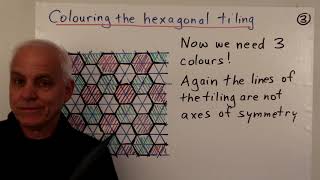
Regular Colourings of Regular Tilings - Elementary Mathematics K-6 Explained - Lecture 39
Explore symmetry and patterns through regular colourings of plane tilings. Learn about reflection, translation, and rotation while creating visually pleasing designs. Ideal for developing spatial awareness and creativity in young learners.
Perspective Image of a Square - More Projective Geometry - Lecture 18b
Explore advanced projective geometry concepts, including perspective images, vanishing points, and Desargues' theorem, with applications in 2D and 3D space.

Standard Staff Notation Issues in Music Theory
Explores issues in music notation, focusing on pitch and duration representation. Critiques current systems, hints at alternatives, and connects mathematics with musical theory.

Scale Adjacency, Sharps and Flats - Mathematics of Music
Explore the mathematical foundations of musical scales, key signatures, and notation systems, connecting music theory to geometry and the circle of fifths for a deeper understanding of harmonics.