Modeling a Flat and Spinning Solar System Using Python
Model a flat, spinning solar system with 100 masses using Web VPython and Python code. Explore advanced simulation techniques for celestial mechanics.
Modeling the Tri-Solar Syzygy with Python
Explore Python modeling of the Tri-Solar Syzygy from "The 3 Body Problem," simulating stable orbits and planetary positions in a three-star system.
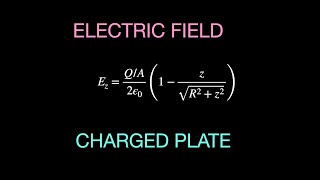
Electric Field due to a Charged Disk and Parallel Plate Capacitors
Derive the electric field of a uniformly charged plate using charged ring principles. Explore parallel plate capacitors and Monte Carlo calculations.
Modeling a Grappling Hook with a Bunch of Balls - Python Simulation Attempt
Explore the physics of grappling hooks through differential equations and Python modeling, inspired by a commercial. Dive into challenges and potential solutions for simulating rope dynamics.
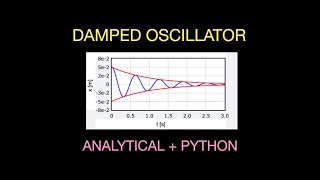
Solution for the Damped Harmonic Oscillator with Python Implementation
Explore the damped harmonic oscillator, including analytical and numerical solutions using Python, with practical examples and homework.
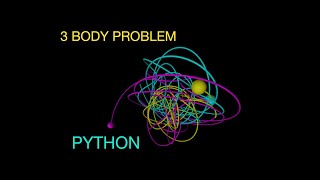
Calculate the Three-Body Problem Just Like the San-Ti
Explore the physics of the 3-body problem, its significance in "The Three-Body Problem" media, and learn computational methods to solve it.
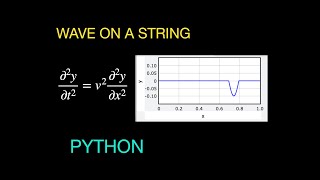
Modeling a Wave Pulse on a String with the Finite Difference Method and Python
Model wave pulses on strings using finite difference method and Python with Web VPython. Gain hands-on experience in computational physics and wave mechanics.
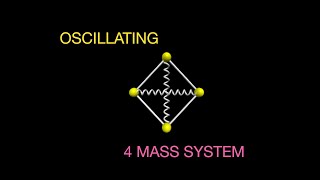
Three Ways to Solve a 4-Mass Oscillator: Energy, Python, and Lagrangian - Lecture
Explore three approaches to solving a complex 4-mass oscillator problem: energy analysis, Python simulation, and Lagrangian mechanics using SymPy.
PINNs for Inverse Problems in Scientific Computing
Explore Physics-Informed Neural Networks (PINNs) and their application in solving inverse problems in scientific computing and engineering.
Scan Statistics for the Detection of Anomalies in Random Fields
Explore scan statistics for detecting anomalies in random fields, focusing on applications in spatio-temporal data analysis and high-dimensional forecasting methods.
Lyapunov Exponents of the Navier-Stokes Equations
Explore Lyapunov exponents in Navier-Stokes equations through Alex Blumenthal's conference talk, delving into probabilistic techniques for random and time-dependent dynamical systems.
Non-convex SGD and Lojasiewicz-type Conditions for Deep Learning
Explore non-convex SGD and Lojasiewicz-type conditions for deep learning in this mathematical conference talk by Kevin Scaman at CIRM.
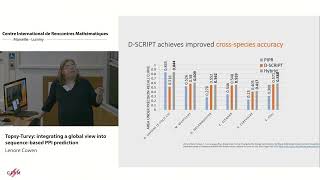
Topsy-Turvy: Integrating a Global View into Sequence-Based PPI Prediction
Explore innovative approaches to protein-protein interaction prediction by integrating global perspectives with sequence-based methods.
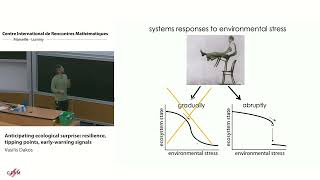
Anticipating Ecological Surprise: Resilience, Tipping Points, and Early-Warning Signals
Explore ecological surprises, resilience, tipping points, and early-warning signals in complex systems. Gain insights into anticipating and understanding sudden environmental changes.
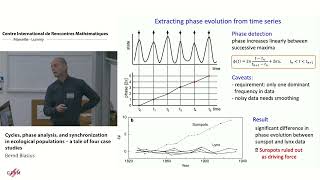
Cycles, Phase Analysis, and Synchronization in Ecological Populations - A Tale of Population Dynamics
Explore ecological population dynamics through cycles, phase analysis, and synchronization. Gain insights into predator-prey relationships, mathematical models, and data analysis techniques.
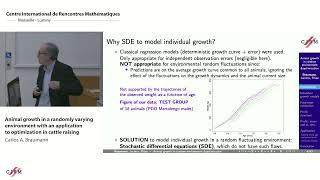
Animal Growth in a Randomly Varying Environment - An Application Study
Explore animal growth models in random environments, focusing on applications and mathematical analysis of population dynamics and ecology.
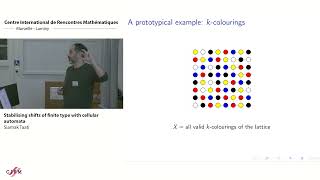
Stabilizing Shifts of Finite Type with Cellular Automata
Explore stabilization of finite type shifts using cellular automata in this mathematical conference talk on dynamic system complexity.
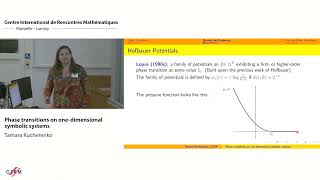
Phase Transitions on One-Dimensional Symbolic Systems
Explore phase transitions in one-dimensional symbolic systems with Tamara Kucherenko's insightful conference talk on mathematical dynamics and quasicrystals.
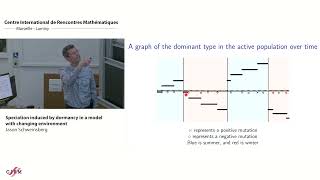
Speciation Induced by Dormancy in a Model with Changing Environment
Explore mathematical models of speciation in changing environments, focusing on dormancy's role in evolutionary biology.
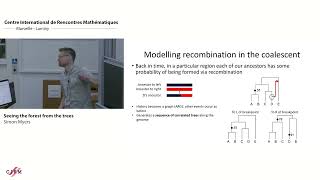
Seeing the Forest from the Trees
Explore stochastic processes in evolutionary biology through Simon Myers' insightful conference talk on seeing the forest from the trees.
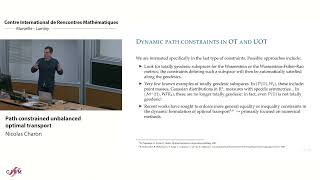
Path Constrained Unbalanced Optimal Transport
Explore path constrained unbalanced optimal transport with Nicolas Charon, delving into geometric statistics and shape analysis applications.