Post Processing and Mock Observations - Shane Davis, Philipp Moesta
Explore post-processing techniques and mock observations for binary systems, focusing on circumbinary gas evolution, observational signatures, and numerical modeling advancements.
Simulating Accretion in the Inner Cavity of Circumbinary Disks - Philipp Moesta
Explore simulation techniques for accretion in circumbinary disk inner cavities, focusing on modeling eccentricity, cavity dynamics, and potential shock emission in binary systems.
Stellar Mass Binaries in AGN - Hui Li - Barry Mc Kernan
Explore stellar mass binaries in AGN, their formation, evolution, and interactions with circumbinary gas. Gain insights into numerical modeling and observational signatures of these systems.
Exploring Autogenic and Allogenic Processes in Lobyte3D
Explore autogenic and allogenic processes in deep-water fan systems using Lobyte3D, a stratigraphic forward model, to investigate signal recording and extraction in sedimentary strata.
Pendulum Dynamics - Exploring Different Driving Functions
Explore pendulum behavior with different driving functions. Visualize and analyze changes in motion using Python simulations, including kick, sawtooth, and step functions.
Pendulum Simulation - Breaking Simple Harmonic Motion
Explore pendulum motion beyond simple harmonic approximations through coding, visualizing how small angle assumptions break down as amplitude increases.
Wave Function Evolver: Lennard-Jones Simulation Analysis - Episode 10
Explore Lennard-Jones simulation behavior by modifying potential energy minimum locations. Augment code to analyze changes and generate insights for physics enthusiasts and programmers.
Gravity Simulator - Sun and Earth Orbital Motion - Episode 1
Explore gravitational motion simulation using VPython, focusing on Sun-Earth dynamics. Learn about Euler-Cromer method, indices tracking, and Earth's scale in space.
Bouncy Balls Collision Math - Episode 3
Explore elastic collision math for bouncy balls, covering conservation of momentum, parallel axis, and unit vectors. Practical application in coding physics simulations.
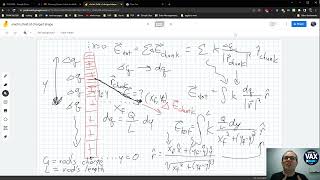
E-Field of Charged Shapes - Calculating Electric Fields for Complex Geometries
Learn to calculate the electric field of charged shapes by dividing them into small pieces. Explore techniques for various configurations, including dipoles, using Python code.
Dynamics of Waves and Vortices in the Ocean by Jim Thomas
Explore ocean fluid dynamics, focusing on wave-vortex interactions across scales. Learn about mathematical models and simulations used to understand complex oceanic processes.

Process of Model Building - Discrete-Time Population
Explore discrete-time population modeling with Vishwesha Guttal. Learn the process of building ecological models and gain insights into population dynamics.
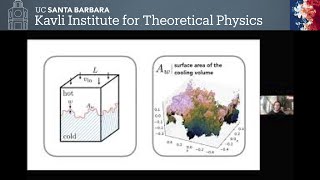
What Does It Mean to Resolve Multiphase Gas - Drummond Fielding
Explore multiphase gas resolution in astrophysics, covering numerical experiments, simulations, and turbulence. Gain insights into fluid dynamics across various cosmic environments and scales.
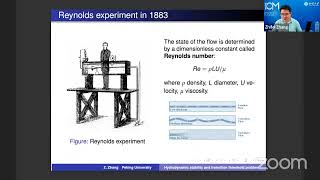
Hydrodynamic Stability at High Reynolds Number and Transition Threshold Problem
Explores hydrodynamic stability theory, focusing on laminar flow instability and turbulence transition at high Reynolds numbers. Discusses key physical effects and recent progress in linear inviscid damping and enhanced dissipation for shear flows.
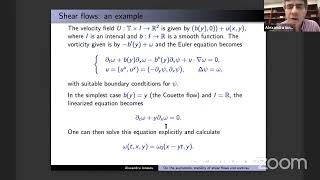
On the Global Stability of Shear Flows and Vortices
Explores recent findings on linear and nonlinear stability of shear flows and vortices in Euler equations, covering monotonic shear flows, point vortices, and smooth decreasing vortices.
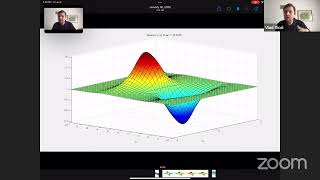
Formation and Development of Singularities for the Compressible Euler Equations
Explore the formation and evolution of singularities in compressible Euler equations, delving into mathematical intricacies and their implications for fluid dynamics.
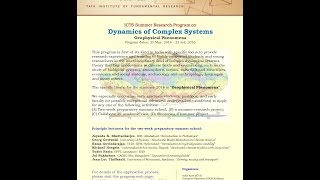
Introduction to Hydrodynamic Stability by Rama Govindarajan
Explore hydrodynamic stability principles and applications in geophysical phenomena through expert lectures and hands-on research projects. Gain insights into fluid dynamics and complex systems modeling.
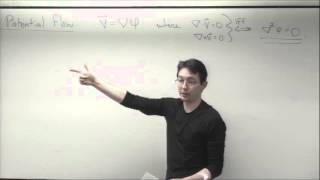
Potential Flow, Stream Functions, and Examples
Explore potential flow, stream functions, and Laplace's equation with practical examples in fluid dynamics. Gain insights into fundamental concepts and their applications.
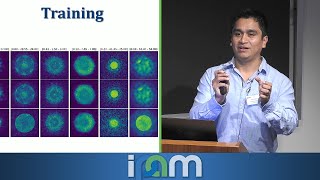
Application of Machine Learning to Electron Microscopy Data - IPAM at UCLA
Explore machine learning applications in electron microscopy, focusing on data modeling and neural networks for distortion compensation in experimental datasets.
Statistical Physics of Rare Events and Large Deviations - Lecture 1
Explore statistical physics of rare events and large deviations, covering mathematical foundations, equilibrium concepts, coin toss problems, blackbody radiation, and applications in physics and beyond.
Introduction to Resurgence, Trans-Series and Non-Perturbative Physics II by Gerald Dunne
Explore advanced concepts in quantum field theory, including resurgence, trans-series, and non-perturbative methods. Gain insights into connecting perturbative and non-perturbative physics across various areas.