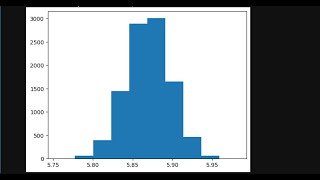
Integration by Monte Carlo Method Using Python in Jupyter Notebook
Explore Monte Carlo integration using Python in Jupyter Notebook. Learn to apply this powerful numerical technique for solving complex integrals.
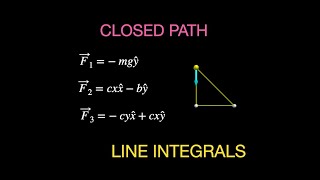
Vector Fields - Calculating the Line Integral Work Around Closed Paths
Explore vector fields and calculate line integral work around closed paths using analytical and numerical methods with Python.
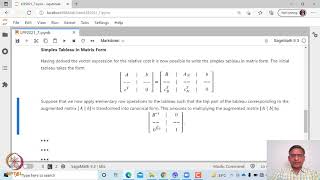
Simplex Methods in Matrix Form
Learn matrix-based simplex methods for efficient linear programming problem-solving, enhancing your optimization skills and mathematical understanding.
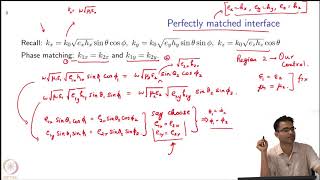
FDTD: Materials and Boundary Conditions - PML Theory Summary
Explore PML theory in FDTD simulations for materials and boundary conditions. Learn key concepts and applications in electromagnetic modeling.
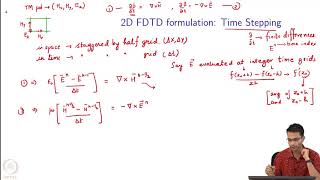
Finite Difference Time Domain Methods: 2D FDTD Formulation and Time Stepping
Explore 2D FDTD formulation and time stepping in finite difference time domain methods. Master advanced computational techniques for electromagnetic simulations.
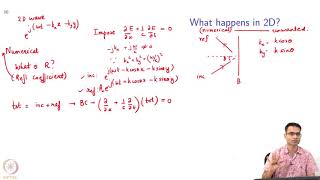
FDTD: Materials and Boundary Conditions - Absorbing Boundary Conditions in 2D
Explore absorbing boundary conditions in 2D for FDTD simulations of materials, enhancing understanding of electromagnetic wave propagation and computational techniques.
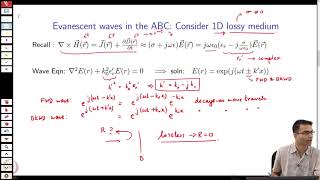
FDTD: Materials and Boundary Conditions - Failure of ABC
Explore FDTD simulation limitations in absorbing boundary conditions. Gain insights into material interactions and electromagnetic wave behavior in computational electromagnetics.
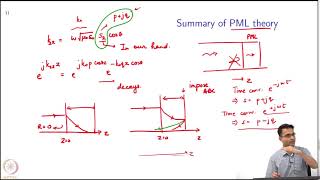
FDTD: Materials and Boundary Conditions - Implementing PML into FDTD - Part 2
Implement PML into FDTD with advanced techniques for materials and boundary conditions. Enhance electromagnetic simulation accuracy and efficiency.
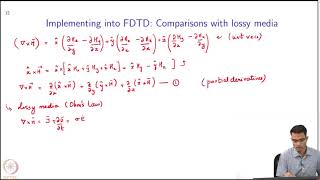
FDTD: Materials and Boundary Conditions - Implementing PML into FDTD - Part 1
Explore implementing Perfectly Matched Layer (PML) boundary conditions in Finite-Difference Time-Domain (FDTD) simulations for electromagnetic wave propagation modeling.

Introduction to Orthogonal Polynomials - Lecture 41
Explore orthogonal polynomials: definition, properties, examples, and mapping to standard intervals. Gain insights into this fundamental mathematical concept.
From Materials to Minds: Nonlocal Approaches to Damage and Degeneration
Explore nonlocal analysis for modeling damage in materials, drawing parallels to neural networks and potential applications in cognitive degeneration research.
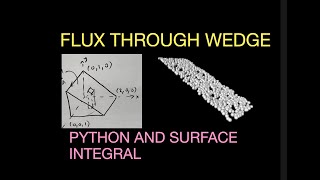
Calculate the Flux Through the Surface of a Wedge - Two Methods
Learn to calculate flux through a wedge surface using traditional integration and Python-based random number methods, enhancing your vector calculus and computational skills.

Chimera States for Coupled Pendula
Explore chimera states in coupled pendula systems with Prof. Tomasz Kapitaniak's insightful seminar on complex synchronization phenomena.
Finite Volume Method for Diffusion Equation - Problem Solving Using TDMA
Solve diffusion equation problems using Finite Volume Method and TDMA. Learn source term linearization and tackle example problems.
Finite Volume Method for Convection and Diffusion: Discretization of Steady and Unsteady Convection Equations
Explore numerical methods for convection-diffusion equations, focusing on finite volume discretization, dispersion, and modified equation analysis.
Finite Volume Method for Convection and Diffusion - Discretization of Unsteady Convection Equation
Explore discretization techniques for unsteady convection equations, including CDS, UDS, Lax-Wendroff, and higher-order schemes like QUICK and Fromm.
Overview of Numerical Methods: Finite Volume Method
Explore the finite volume method, a crucial numerical technique for solving partial differential equations in engineering and scientific applications.
Finite Volume Method for Diffusion Equation - Discretization of 2D Steady Diffusion Equation
Explore discretization techniques for 2D steady diffusion equations using the Finite Volume Method, enhancing your understanding of numerical methods in computational fluid dynamics.
Finite Volume Method for Diffusion Equation - Discretization of 1D Diffusion Equation
Explore discretization of 1D steady diffusion equation and solve heat conduction problems using the Finite Volume Method.
Finite Volume Method for Diffusion Equation - Boundary Conditions for 2D Diffusion Equation
Explore boundary conditions for 2D diffusion equations, including Dirichlet, Neumann, and mixed conditions in finite volume methods.
Discretization of 3D Diffusion Equation with Mixed Boundary Conditions
Explore 3D diffusion equation discretization and mixed boundary conditions using the Finite Volume Method. Learn to calculate diffusion coefficients on cell faces.