
Graphs in the Modern World: Analyzing Infectious Disease Dynamics
Explore graph-based models for analyzing infectious diseases, from deterministic compartmental models to agent-based simulations in modern epidemiology.
Tame Your Data - Constrained Spline Regression in the Wolfram System
Explore disciplined convex programming for optimized cubic spline functions with constraints, applying advanced techniques to solve multi-objective optimization problems.
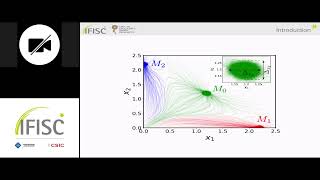
Generation of Stochastic Trajectories - Applications to Complex Systems
Explore stochastic trajectory generation and its applications in complex systems, focusing on interdisciplinary physics concepts and advanced modeling techniques.
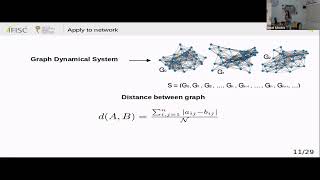
Maximum Lyapunov Exponent for Temporal Networks
Explore the Maximum Lyapunov Exponent concept in temporal networks, delving into complex systems analysis and network dynamics.
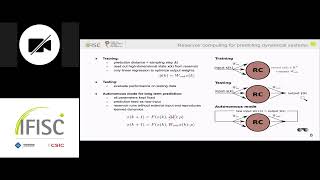
Learn One Size to Infer All: Exploiting Symmetries in Dynamical Systems Using Scalable Neural Networks
Explore symmetries in dynamical systems using scalable neural networks to infer patterns across various sizes and complexities.
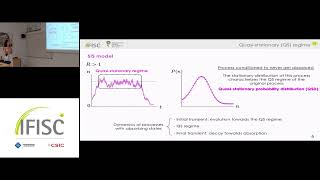
Numerical Methods for Quasi-Stationary Distributions
Explore numerical techniques for calculating quasi-stationary distributions in complex systems, enhancing understanding of long-term behavior in stochastic processes.
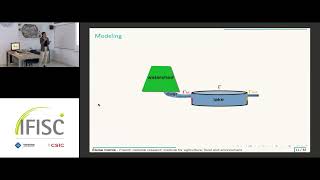
Optimal Control of Lake Eutrophication
Explore strategies for managing lake ecosystems, focusing on controlling eutrophication through mathematical modeling and optimal control theory techniques.
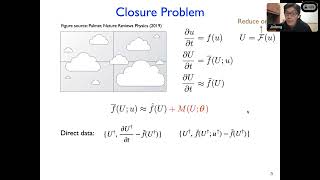
Data-Driven Closure Modeling Using Derivative-free Kalman Methods
Explore data-driven closure modeling for complex dynamical systems using derivative-free Kalman methods. Learn to improve predictions in turbulence and cloud dynamics with advanced machine learning techniques.
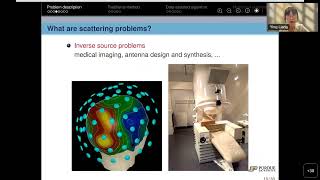
Data-assisted Algorithms for Inverse Random Source Scattering Problems - DDPS
Explore data-assisted algorithms for inverse random source scattering problems, enhancing reconstruction accuracy with fewer realizations and comparing performance of various data-driven methods.

Progress in Graphs and Networks
Explore advancements in graph theory and network analysis, uncovering applications in various fields and enhancing problem-solving skills.
Topological Perspectives on Networks
Explore algebraic topology tools for network analysis, focusing on their application in neuroscience to understand structure-function relationships.
Topological Perspectives on Networks
Explore algebraic topology tools for network analysis, focusing on their application in neuroscience to understand structure-function relationships.

Computational Mathematics: Dynamics, Geometry, and Algebra in Numerical Integration
Explore computational mathematics at the intersection of dynamics, geometry, and algebra, focusing on geometric numerical integration and structure-preserving discretization of differential equations.
Modeling X with Partial Differential Equations
Explore advanced PDE modeling techniques using NDSolve and finite element methods for engineering applications, including axisymmetric regions and hyperelastic solid mechanics.

Statistical Methods for Data Analysis in Particle Physics - Lecture 2
Explore advanced statistical techniques for particle physics data analysis, focusing on hypothesis testing, confidence intervals, and likelihood methods in experimental research.

New Developments in BifurcationKit.jl - JuliaCon 2024
Explore advancements in BifurcationKit.jl for analyzing periodic and homoclinic orbits, including new methods for bifurcation analysis and integration with other Julia packages.
Dynamical Spectral Transition for Optimization in Very High Dimensions
Explore dynamical spectral transitions in high-dimensional optimization, examining mathematical concepts and their applications in complex systems and data analysis.
Mathematical Analysis of Models for Living Tissues and Free Boundary Problems - Tutorial Part 1
Explore mathematical models for living tissues and free boundary problems with Professor Perthame, delving into advanced analysis techniques and applications in biological systems.
Mathematical Analysis of Models for Living Tissues and Free Boundary Problems - Tutorial Part 2
Explore mathematical models for living tissues and free boundary problems with Professor Benoît Perthame. Gain insights into advanced analytical techniques for biological systems.
PDEs for Neural Assemblies - Analysis, Simulations, and Behavior
Explore PDEs for neural assemblies, analyzing their behavior through simulations and mathematical techniques with Professor Benoît Perthame from Sorbonne University.
Optimization in Theory and Practice
Explore optimization techniques and their real-world applications with insights from Stephen Wright of University of Wisconsin-Madison, blending theoretical foundations and practical implementations.