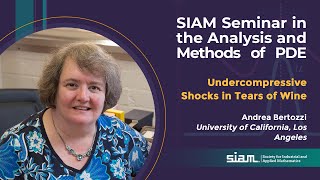
Seminar in the Analysis and Methods of PDE - Andrea Bertozzi
Explore the physics behind "tears of wine" phenomenon, examining undercompressive shocks in thin films and their role in the formation of wine tears using mathematical modeling and analysis.
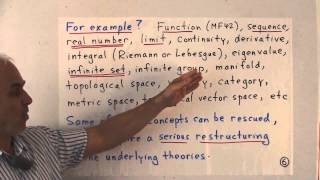
Logical Weaknesses in Modern Pure Mathematics - Real Numbers and Limits - Math Foundations 87
Explores logical weaknesses in modern pure mathematics, focusing on inconsistent rigor and problematic definitions. Challenges conventional views and invites discussion on foundational issues in mathematics.
The Most Fundamental Problem in Mathematics - Famous Math Problems 19a
Explore the fundamental problem of modeling the continuum in mathematics, examining its historical significance, practical applications, and implications for various mathematical areas.

Geometry in Everyday Life - Past, Present, and Future
Explore the past, present, and future of geometry with Yang-Hui He and Madeleine Hall. Discover how geometric principles shape our world, from ancient postulates to modern applications in nature and science.
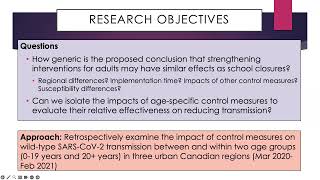
Retrospective Modelling Analysis on the Effects of Control Measures on COVID Transmission in Canada
Explore the impact of COVID-19 control measures in Canada through retrospective modeling analysis, examining transmission patterns and effectiveness of interventions.
Understanding Tumour Responses to Radiotherapy Using Mathematical Models - Lecture 2
Explores mathematical modeling of tumor responses to radiotherapy, focusing on theoretical approaches to understand and predict treatment outcomes in cancer progression.
Mathematical and Computational Modelling to Explore Various Potential Cancer Treatments
Explore mathematical and computational modeling approaches for cancer research, covering topics from age-structured populations to machine learning techniques for understanding disease progression and treatment.
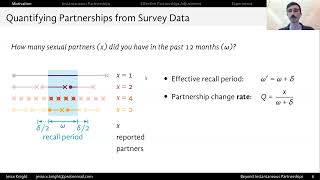
Re-examining the Force of Infection Equation in Compartmental HIV Transmission Models
Explore innovative approaches to HIV transmission modeling, focusing on the force of infection equation and its implications for public health strategies and interventions.
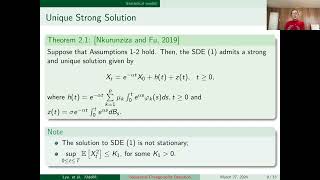
Sequential Change-point Detection in Stochastic Differential Equations
Explore advanced techniques for detecting change-points in stochastic differential equations, focusing on sequential methods and their applications in statistical analysis.
Well Posedness for Hamilton-Jacobi Equations for Linearly Controlled Gradient Flows
Explore well-posedness of Hamilton-Jacobi equations for linearly controlled gradient flows, examining mathematical foundations and applications in optimization and control theory.
Decoding Plasma Turbulence Dynamics with Irene Gamba
Explore quasilinear diffusion models for plasma systems, focusing on their emergence from equilibrium states and the validity of ergodic approximations. Gain insights into instabilities and analytical solutions.
Chance to See Life - Expressing the World Through Probability
Exploring mathematical models and probability to interpret the world, blending quantitative analysis with human nature insights for a unique perspective on life and investment.
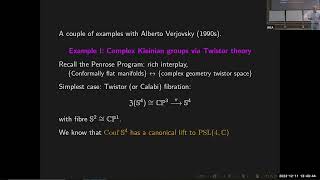
Discrete Group Actions on the Complex Projective Plane CP^2
Explore discrete group actions on CP^2, extending classical Kleinian group theory to higher dimensions. Gain insights into complex geometry and holomorphic dynamics.
The Random Friend Tree by Serte Donderwinkel
Explore the Random Friend Tree model in network science, examining its structural properties, dynamics, and applications in social networks and complex systems.
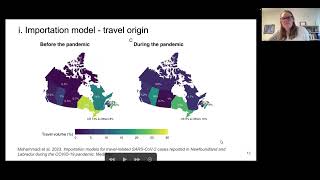
Modelling to Support Regions Implementing an Elimination Strategy
Explore mathematical modeling techniques for regional disease elimination strategies, focusing on public health applications and policy support.
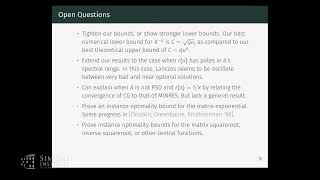
Instance Optimal Iterative Methods for Matrix Function Approximation
Explores instance-optimality of Lanczos method for matrix function approximation, extending conjugate gradient analysis to rational and other function classes. Discusses recent progress and open questions.

Logarithms: Applications in Mobile Technology, Pandemic Modeling, and Social Networks
Explore logarithms' relevance in modern life, from pandemic modeling to information theory and social networks. Discover their history and applications in this insightful lecture by Professor Oliver Johnson.
Path-Dependent PDEs and Mean Field Control - SIAM FME Virtual Talk Series
Explore advanced mathematical concepts in finance: path-dependent PDEs, rough volatility, and mean field control. Gain insights from experts on convergence rates and numerical analysis in financial modeling.
Numerical Approach to Polylogarithms on Higher-Genus Riemann Surfaces
Explore numerical evaluation of polylogarithms on genus-two Riemann surfaces using Schottky parametrization and averaging over genus-one differential forms, advancing particle physics research.
Structural and Stochastic Modeling to Study the Dynamics of Tumor-Immune Interactions
Explore structural and stochastic modeling techniques to analyze tumor-immune interactions, enhancing understanding of cancer dynamics and potential treatment strategies.
Using Mathematical Approaches to Describe and Understand Cancer
Explore mathematical modeling in cancer research, covering population dynamics, systems biology, and machine learning to enhance understanding and treatment of this complex disease.