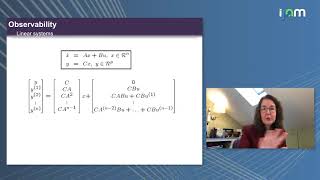
Analytical and Empirical Tools for Nonlinear Network Observability in Autonomous Systems
Explore nonlinear network observability in autonomous systems, covering analytical and empirical tools for sensor selection, network analysis, and applications in engineering and biology.

What the Numbers Say - Endemicity - What’s Next?
Experts discuss COVID-19 endemicity, examining data-driven approaches to future outbreaks. Topics include variants, immunity, global perspectives, and policy challenges in transitioning to an endemic state.
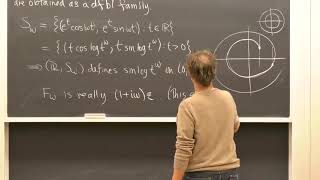
Tame Phenomena Over the Real Field - Lecture 6
Explore control theory concepts including flows, log spirals, limit cycles, and restricted analytic functions in this advanced graduate-level lecture on tame phenomena.

Modelling COVID-19 Vaccination and Immunity Panel Discussion
Expert panel explores COVID-19 vaccination strategies, immunity dynamics, and challenges in modeling the pandemic's long-term effects, offering insights for public health decision-making.
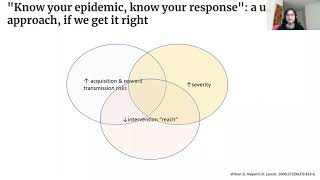
Do No Harm - Terminology, Assumptions, and Interpretation of Epidemic Models in Communities Most Affected
Exploring ethical considerations in epidemic modeling, focusing on terminology, assumptions, and interpretation to avoid stigmatization and promote equitable public health responses.
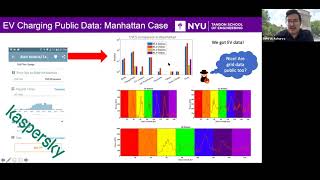
Demand Side Cybersecurity of Smart Grids
Explore smart grid cybersecurity, focusing on demand-side challenges, EV charging, and innovative solutions like cyber insurance for power grids and microgrids.
Generalised Integrated Information Theories
Exploring generalizations of Integrated Information Theory to address technical issues and extend applicability beyond classical systems, using category theory and process theories.
Predicting Intersection Signal Timing
Explore signal control parameters, queueing theory, and dynamic programming for optimizing intersection traffic flow and reducing fuel consumption.
PID Controllers
Learn about PID controllers: their components, applications, and how they achieve stable control systems. Explore mathematical models and live simulations to understand this powerful algorithm.
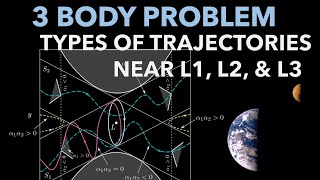
Trajectory Types Near L1, L2, and L3 in the Three Body Problem - Theory and MATLAB Examples
Explore trajectory types near Lagrange points in the three-body problem. Learn analytical solutions, MATLAB simulations, and applications to Earth-Moon and Sun-Jupiter systems. Gain insights into orbital dynamics and space mission design.
Two-Scale FEMs for Non-Variational Elliptic PDEs
Explore advanced finite element methods for non-variational elliptic PDEs, focusing on two-scale approaches, monotonicity enforcement, and novel error estimation techniques for complex mathematical problems.
A Family of Crouzeix-Raviart Non-Conforming Finite Elements in Two- and Three Spatial Dimensions
Explore non-conforming finite elements in 2D and 3D, focusing on Crouzeix-Raviart type. Learn about optimal a priori estimates, jump conditions, and explicit representations of local basis functions.
Simultaneous Control of Ensembles of Dynamical Systems
Control strategies for managing multiple dynamic systems simultaneously, focusing on mathematical approaches and applications in various fields.
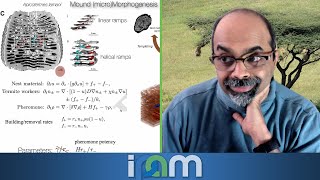
Physical Intelligence in Insect and Robot Societies - IPAM at UCLA
Exploring collective problem-solving in insect societies and robotic systems, linking physics and behavior across scales to understand embodied physical intelligence in nature and technology.

What the Numbers Say - How Can We Get to a Safer Summer?
Experts discuss COVID-19 modelling, public health measures, and strategies for controlling the pandemic in Ontario, offering insights on how to achieve a safer summer through data-driven approaches.
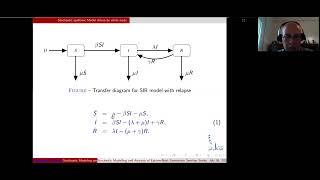
Stochastic Modeling and Analysis for Epidemic Models With Loss of Immunity
Explore stochastic modeling techniques for epidemic analysis, focusing on scenarios involving loss of immunity. Gain insights into advanced mathematical approaches for disease spread prediction.
Tame Control Theory - Lecture 5
Explore advanced concepts in tame control theory, focusing on phenomena over real fields. Delve into graduate-level mathematical analysis and applications.
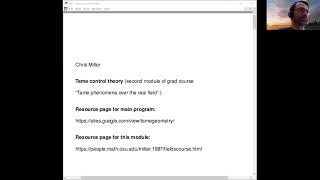
Tame Phenomena Over the Real Field - Graduate Course Lecture 1
Explore fundamental concepts of tame control theory, focusing on real field applications and advanced mathematical principles in this graduate-level lecture.
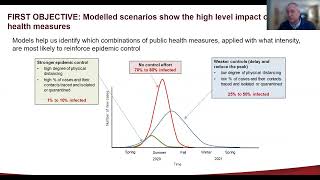
Predicting What Comes Next: Modelling the COVID-19 Epidemic
Explore mathematical modeling techniques for predicting COVID-19 epidemic trends and future scenarios, with insights from public health experts.
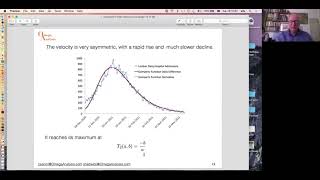
Predicting the Course of Covid-19
Explore mathematical models for predicting COVID-19 trends, analyzing data patterns, and discussing implications for public health strategies and decision-making.
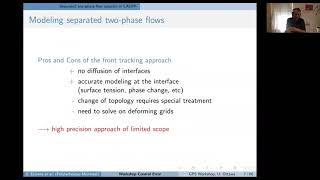
Combined Arbitrary Lagrangian-Eulerian Approach and Adaptive Remeshing Technique for the Finite
Explore advanced numerical methods combining ALE approach and adaptive remeshing for finite element simulations, enhancing accuracy and efficiency in complex engineering problems.