Changing Physics Education with Julia
Revolutionizing physics education by integrating Julia programming, focusing on nonlinear dynamics. Demonstrates how coding enhances understanding, introduces interactive applications, and discusses benefits of real-world exercises.
Discrete and Continuous Mathematics - MIT Computational Thinking Spring 2021 - Lecture 14
Explore discrete and continuous mathematics, bridging concepts through indexing, function evaluation, area calculation, and random walks in computational thinking.
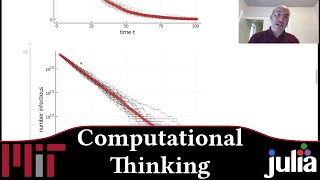
Macroscopic Models of Epidemic Dynamics - Week 6
Explore macroscopic epidemic models, transitioning from stochastic to deterministic approaches. Learn about SIR models, continuous-time dynamics, and differential equations in epidemiology.

Adventures in Computing - From Punch Cards to Differential Equations
Prof Linda Petzold explores her journey in computational science, from punch cards to modern differential equations, highlighting key developments in numerical methods, stochastic simulations, and their applications in various fields.
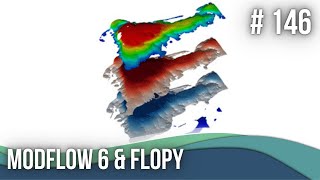
MODFLOW 6 and FloPy
Learn to create and analyze groundwater models using MODFLOW 6 and FloPy in Python. Covers model setup, visualization, water balance, pathlines, and transient simulations.
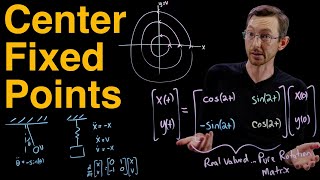
Systems of ODEs: Imaginary Eigenvalues and Center Fixed Points
Explore imaginary eigenvalues and center fixed points in 2D ODE systems. Learn to compute eigenvectors, write solutions, and understand geometric intuition behind rotational dynamics.
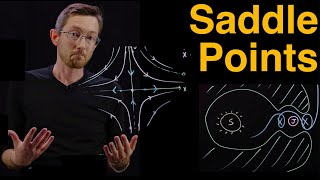
Systems of ODEs - Saddle Points and Instability
Explore unstable saddle points in 2D linear ODEs, their applications in energy-efficient transport, and analysis using eigenvalues, eigenvectors, and phase portraits.
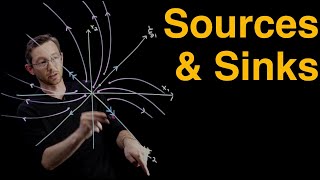
Systems of ODEs - Sources and Sinks
Explore 2D linear ODEs with real eigenvalues, analyzing unstable sources and stable sinks through eigenvalues, eigenvectors, and phase portraits. Gain insights into solution methods and visualizations.
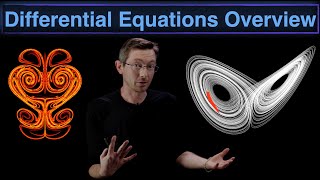
Differential Equations and Dynamical Systems - Overview
Explore dynamical systems and their applications in various fields. Learn classic and modern techniques for modeling real-world phenomena, from fluid dynamics to epidemiology.
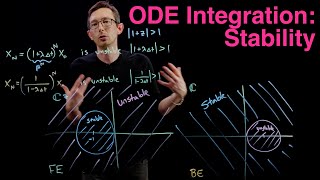
Stability of Forward Euler and Backward Euler Integration Schemes for Differential Equations
Explore stability of Forward and Backward Euler integration schemes for differential equations through eigenvalue analysis, covering continuous and discrete dynamics, scalar and matrix systems.
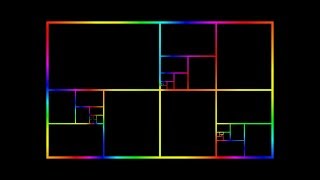
Winding Numbers and Domain Coloring
Explore winding numbers and domain coloring to solve 2D equations numerically. Learn about graphing techniques, color mapping, and applications in complex analysis.
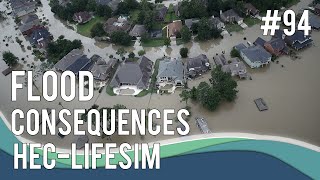
Advances in Flood Consequence Assessments
Explore advanced flood consequence assessment tools for predicting damage, optimizing evacuation, and estimating loss of life. Learn from experts about numerical methods aiding proactive flood management decisions.
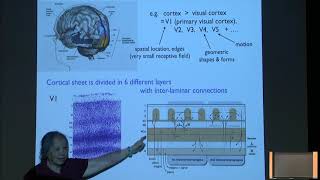
Towards a Mathematical Model of the Brain - Lai-Sang Young
Explore mathematical approaches to modeling brain dynamics, from local neural populations to complex cognitive functions, with insights on synchronization, memory, and visual processing.
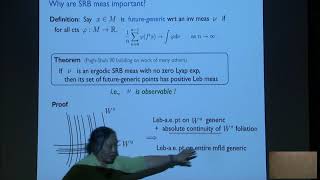
Observable Events and Typical Trajectories in Dynamical Systems - Lai-Sang Young
Explore observable events and typical trajectories in dynamical systems with Lai-Sang Young, covering SRB measures, attractors, and infinite dimensional center manifolds.
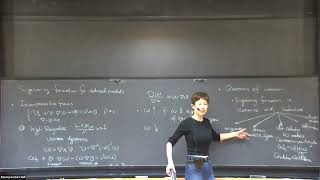
Singularity Formation for Reduced Models of Fluid Equations - Mimi Dai
Explore singularity formation in reduced fluid equation models, focusing on electron magnetohydrodynamics and its connection to Euler equations. Gain insights into nonlinear dynamics and finite-time singularities.
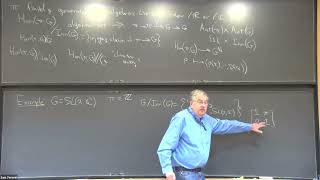
Dynamics on Character Varieties - William Goldman
Exploration of dynamical systems arising from locally homogeneous geometric structures and flat connections on manifolds, with focus on character varieties and their complex topology.
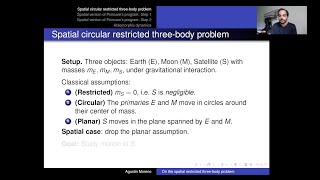
On the Spatial Restricted Three-Body Problem - Agustin Moreno
Explore the spatial restricted three-body problem, global hypersurfaces, and Hamiltonian return maps. Learn about a higher-dimensional Poincaré-Birkhoff theorem and its applications to orbital dynamics.
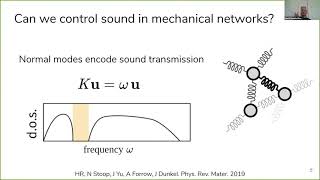
Physics of Functional Networks - Henrik Ronellenfitsch
Explore the physics of functional networks, from sound control in mechanical systems to resilient power grids and leaf venation. Discover optimization principles and their applications in engineering and biology.
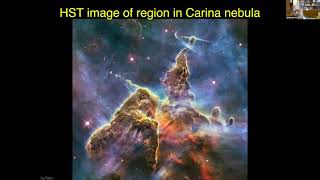
Astrophysical Fluid Dynamics - James Stone
Explore astrophysical fluid dynamics with Prof. James Stone, covering mathematical models, numerical methods, and future research in this fascinating field of study.
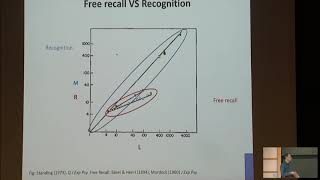
Mathematical Models of Human Memory - Michail Tsodyks
Explore mathematical models of human memory, covering simplification, recall capacity, experiments, and recognition tests, with insights on memory dynamics and cognitive processes.
The Primacy of Experiment - Kyle Cranmer
Explore the interplay between physics and mathematics, focusing on experimental validation and the potential for unifying theories in understanding the universe's fundamental laws.