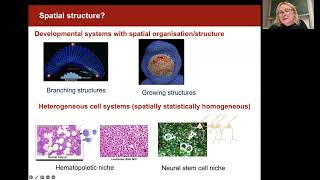
Introduction to Mathematical Modeling of Leukemia - Part 1
Explore the mathematical foundations of leukemia research through expert analysis of oncological models and their applications in understanding disease progression and treatment strategies.
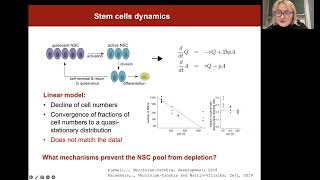
Mathematical Models of Leukemia - Part 2
Delve into advanced mathematical modeling of leukemia dynamics, exploring theoretical frameworks and analytical approaches for understanding cancer progression and treatment strategies.
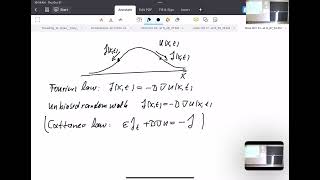
Stochastic Processes and Tumor Control Probability
Explore mathematical modeling of cancer treatment through stochastic processes and probability theory, focusing on tumor control analysis and therapeutic outcomes.
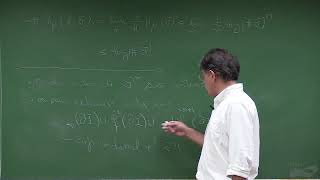
Teoria Ergódica Diferenciável - Aula 22
Explore advanced concepts in Differentiable Ergodic Theory, including invariant measures, Poincaré and Birkhoff recurrence theorems, ergodic decomposition, and topological entropy in mathematical dynamics.
Fractal Geometry of the Markov and Lagrange Spectra and Their Set Difference
Delve into the fractal geometry of Markov and Lagrange spectra, exploring their set differences and mathematical properties through advanced number theory and geometric analysis.
Mixing Times in Ising Dynamics
Delve into the mathematical analysis of mixing times in Ising dynamics, exploring quantum algorithms and their applications to open quantum systems through advanced theoretical frameworks.
Teoria Ergódica Diferenciável - Aula 21
Explore advanced concepts in Differentiable Ergodic Theory, including invariant measures, Poincaré and Birkhoff recurrence theorems, ergodic decomposition, and topological entropy in mathematical dynamics.
Modeling Genotype to Phenotype: A Search for Natural Objects of Selection
Explore evolutionary dynamics through metabolism as a genotype-phenotype map, examining how collective modes in phenotype space serve as natural selection objects rather than individual genes.
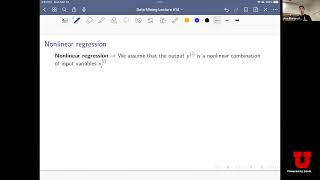
Data Mining: Introduction to Linear Regression - Spring 2023
Master linear regression fundamentals, from basic concepts to least squares method, while learning how to apply these techniques for effective data analysis and predictive modeling.
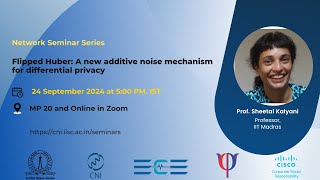
Flipped Huber - A New Additive Noise Mechanism for Differential Privacy
Discover a novel additive noise mechanism for differential privacy that combines Laplace and Gaussian distributions, offering enhanced privacy protection while maintaining data accuracy in query responses.
Wolfram Alpha Notebook Edition for Education - Adding No-Code Computational Power to Classrooms
Explore Wolfram|Alpha Notebook Edition's no-code computational power for interactive classroom lessons and tools across all grade levels.
Mathematical Computation in Wolfram Language Version 14.1
Explore the latest mathematical advancements in Wolfram 14.1, including symbolic-dimensional arrays, stability analysis of dynamical systems, and PDE modeling improvements.
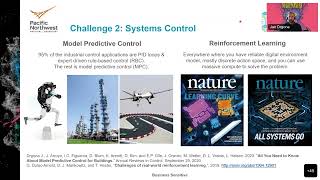
Differentiable Programming for Modeling and Control of Dynamical Systems
Explore differentiable programming for optimal control of dynamical systems, focusing on differentiable predictive control and its applications in building control and power systems optimization.
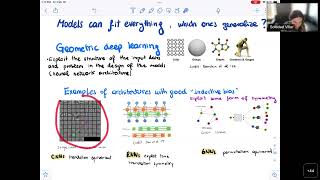
The Passive Symmetries of Machine Learning
Explore passive symmetries in machine learning, their implications, and implementation as group equivariances. Gain insights on generalization and links to causal modeling.
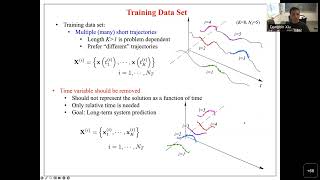
Data-Driven Modeling of Unknown Systems with Deep Neural Networks
Explore data-driven modeling of unknown systems using deep neural networks. Learn to discover and approximate evolution operators for predictive analysis across various problem domains.
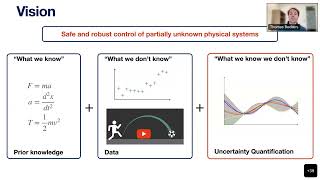
Physics-Enhanced Gaussian Processes for Learning of Electromechanical Systems
Explore physics-enhanced Gaussian processes for modeling electromechanical systems. Learn about GP-PHS and physics-enhanced variational autoencoders to improve data efficiency and ensure physical correctness.
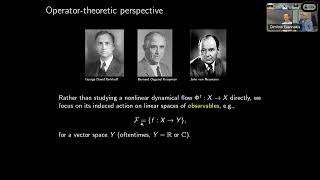
Quantum Information and Data Science for Modeling Classical Dynamics
Explore quantum information and data science approaches for modeling classical dynamics, focusing on operator-theoretic techniques and their applications in dynamical systems and climate modeling.
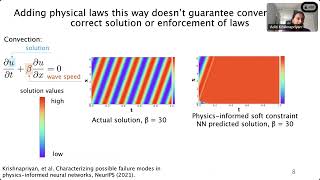
Bridging Numerical Methods and Deep Learning with Physics-Constrained Differentiable Solvers
Explore machine learning strategies for neural PDE solvers, focusing on self-supervised learning and simulation-in-the-loop approaches to enhance spatiotemporal modeling across various systems.
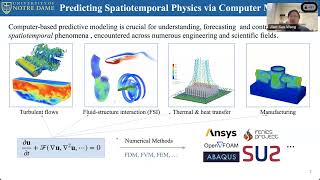
Neural Differentiable Physics: Unifying Numerical PDEs and Deep Learning for Data-Augmented Computational Physics
Explore Neural Differentiable Physics, unifying numerical PDEs and deep learning for enhanced computational modeling of complex physical systems. Learn innovative SciML approaches integrating physics principles with AI.
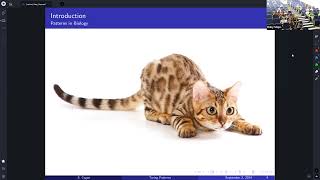
Turing Patterns in Mathematical Biology
Explore Turing patterns in mathematical biology, examining their formation and applications in biological systems. Gain insights into this fascinating intersection of mathematics and biology.
Koopman Operator Theory Based Machine Learning of Dynamical Systems
Explore Koopman Operator Theory for machine learning of dynamical systems, covering applications in fluid dynamics, power grids, network security, and more.