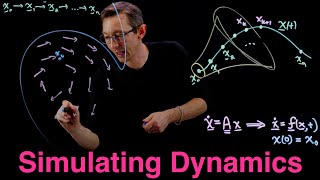
Numerical Simulation of Ordinary Differential Equations - Integrating ODEs
Explore numerical integration of ODEs to analyze nonlinear systems and generate trajectories. Learn techniques for solving complex dynamics where analytic methods fall short.
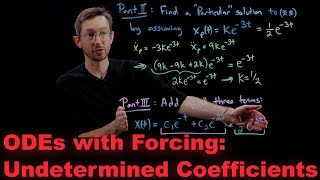
Differential Equations with Forcing: Method of Undetermined Coefficients
Learn to solve linear differential equations with external forcing using the method of undetermined coefficients. Understand homogeneous solutions, particular solutions, and how to combine them for a complete solution.

Partial Differential Equations Overview
Explore the mathematical language of physical phenomena with an overview of partial differential equations, covering canonical PDEs, linear superposition, and nonlinear PDEs like Burgers Equation.
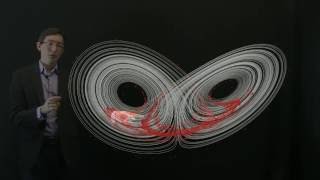
Hankel Alternative View of Koopman - HAVOK Analysis
Decompose chaos into linear systems with intermittent forcing using HAVOK analysis. Learn to build linear regression models on eigen-time-delay coordinates for complex dynamical systems.
Numerical Integration and Numerical Solutions to ODEs
Explore numerical methods for integration and solving ordinary differential equations, enhancing your computational skills in engineering mathematics.

Eigenvalues, Eigenvectors, and Dynamical Systems
Explore eigenvalues, eigenvectors, and dynamical systems in engineering mathematics, focusing on their applications and significance in solving complex problems.
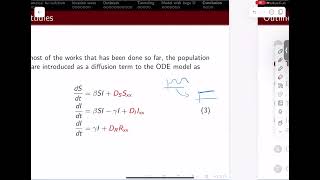
Modelling of Spatial Infection Spread Through Heterogeneous Population
Explore spatial infection spread modeling in heterogeneous populations, examining key factors and methodologies for understanding disease transmission dynamics.
On the Existence, or Lack, of Non-Commutative Factors of a Dynamical System
Explore non-commutative factors in dynamical systems with Tattwamasi Amrutam, delving into advanced mathematical concepts and their implications in operator algebra.
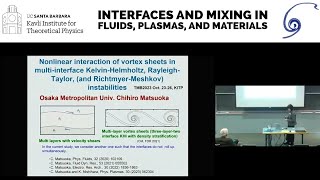
Nonlinear Interaction of Vortex Sheets in Multi-Interface
Explores nonlinear vortex sheet interactions in multi-interface fluid instabilities, focusing on Kelvin-Helmholtz, Rayleigh-Taylor, and Richtmyer-Meshkov phenomena. Presents advanced research in fluid dynamics and instability mechanisms.

Finite Differences and Successive Over Relaxation - Jupyter Notebook Assignment Development
Explore finite differences and successive over-relaxation methods in computational physics through a guided Jupyter notebook project, enhancing problem-solving skills in numerical analysis.

Jupyter Notebook Assignment - Runge-Kutta Method Development - Vlog 3
Explore the Runge-Kutta Method in computational physics, comparing it with Euler-Cromer. Develop skills in numerical analysis and scientific computing using Jupyter Notebooks.
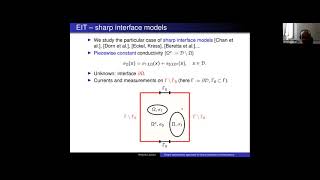
Shape Optimization Approach for Sharp-Interface Reconstructions in Inverse Problems
Shape optimization techniques for inverse problems: analyzing piecewise constant models, shape derivatives, and Lagrangian approaches. Applications in electrical impedance tomography and full waveform inversion.
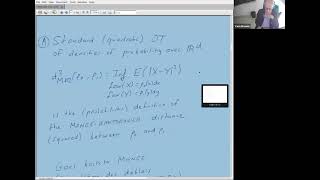
Optimal Transport of Matrix-Valued Measures - SIAM PDE Seminar
Explore optimal transport of matrix-valued measures, inspired by incompressible Euler equations. Discover a matricial analogue of Hellinger-Kantorovich metric spaces in this advanced mathematical seminar.
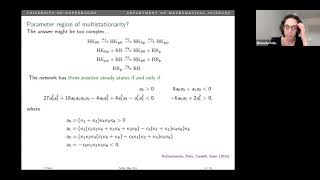
Parametric Polynomial Systems and Biochemical Reaction Networks
Explore parametric polynomial systems in biochemical reaction networks, focusing on multistationarity and the dual futile cycle. Gain insights into steady state analysis and parameter region determination.
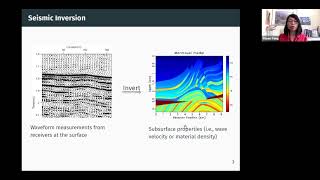
Optimal Transport for Inverse Problems and Implicit Regularization
Exploring optimal transport theory for inverse problems, addressing nonconvexity and noise sensitivity in least-squares methods, with applications in industry and broader data-fitting challenges.
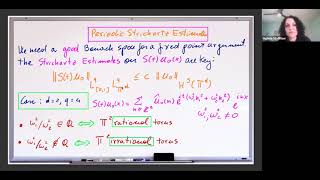
How Much Math Do You Need to Know to Solve an Initial Value Problem - SIAM PDE Seminar
Explore mathematical techniques for solving nonlinear Schrödinger equations, from harmonic analysis to dynamical systems, focusing on long-time dynamics and energy transfer in initial value problems.
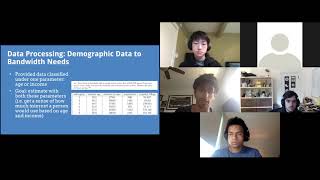
MathWorks Math Modeling Challenge 2021 - Nueva School Winning Presentation
Winning presentation by Nueva School on their solution for the MathWorks Math Modeling Challenge 2021, showcasing innovative approaches to technical computing and problem-solving.
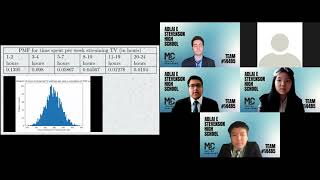
MathWorks Math Modeling Challenge 2021 - Adlai E Stevenson High School Finalist Presentation
Finalist team from Adlai E Stevenson High School presents their solution to the MathWorks Math Modeling Challenge 2021, showcasing innovative problem-solving skills in applied mathematics.

MathWorks Math Modeling Challenge 2021 - Julia R Masterman Middle High School Finalist Presentation
High school team presents innovative mathematical modeling solutions for the MathWorks Math Modeling Challenge, showcasing problem-solving skills and analytical thinking in a competitive environment.
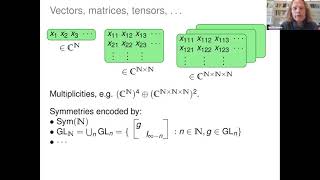
Infinite-Dimensional Geometry with Symmetry - SIAM SAGA Seminar
Explore infinite-dimensional geometry with symmetry, focusing on algebraic models and their applications in statistics, tensor decomposition, and combinatorics.
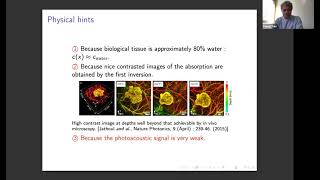
Hölder Stability in Quantitative Photoacoustic Tomography - Imaging and Inverse Problems Seminar
Explore Hölder stability in quantitative photoacoustic tomography, focusing on reconstructing diffusion and absorption coefficients from partial internal data near boundaries.