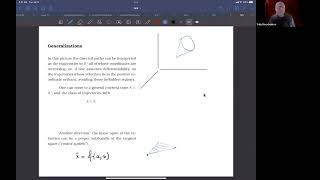
Linear Obstacles in Linear Systems and Ways to Avoid Them
Explore topology in control theory, focusing on obstacle-avoiding paths and cohomology rings using homotopy limits. Gain insights into theoretical computer science applications.
Robert Adler Interviewed by Omer Bobrowski
Insightful interview exploring Robert Adler's contributions to applied algebraic topology, offering valuable perspectives on the field's development and future directions.
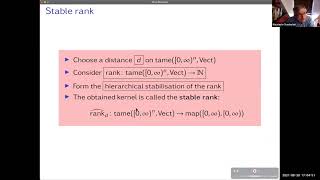
Enabling a Machine to Sense Geometry
Explore how to construct a reach space of kernels on persistent modules, enabling machine intelligence to sense geometry, with applications in synthetic and real scenarios.
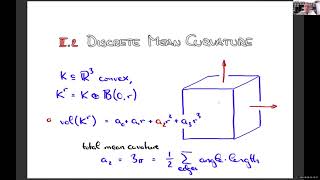
The Intrinsic Volumes of a Space Filling Diagram and Their Derivatives
Explore intrinsic volumes in molecular dynamics, focusing on space-filling diagrams and their derivatives. Learn formulas for weighted volumes and curvatures in Alpha shape representations.
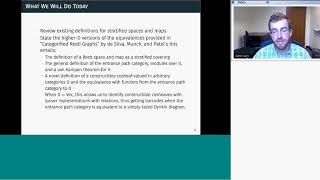
Stratified Covering Maps and Interleavings
Explore stratified covering maps and interleavings in algebraic topology, examining their applications and theoretical foundations.
Descriptive Geometry of Function Spaces
Explore the intricate world of function spaces and their descriptive geometry in this advanced mathematical lecture by Shmuel Weinberger, part of the Hausdorff Trimester Program.
Natural Homology Computability and Eilenberg Steenrod Axioms
Explore natural homology computability and Eilenberg Steenrod axioms in this advanced mathematics lecture, delving into applied and computational algebraic topology concepts.
Poisson U Statistics Subgraph and Component Counts in Random Geometric Graphs
Explore Poisson U statistics, subgraph counts, and component analysis in random geometric graphs, advancing knowledge in applied algebraic topology.
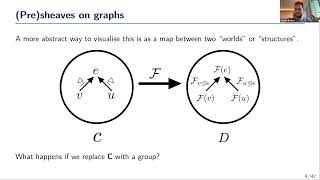
A Sheaf-based Approach to Graph Neural Networks
Explore sheaf theory's application to Graph Neural Networks, offering a novel perspective on Geometric Deep Learning beyond traditional geometric structures.
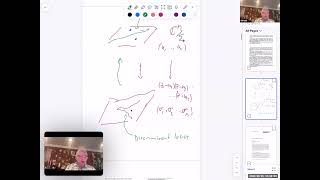
Analog and Universal Complexity in Robotics and Manifolds
Explore analog complexity in robotics, comparing digital and analog approaches. Discover surprising properties of analog category and its implications for finite groups and parametrized complexity.
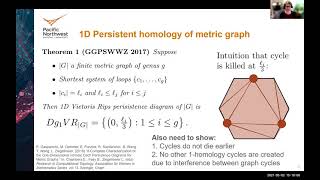
Homology of Graphs and Hypergraphs
Explore topological structures of graphs and hypergraphs, including recent findings on homology and persistent homology, with applications in combinatorial and metric space analysis.
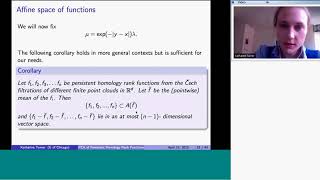
Katharine Turner - PCA of Persistent Homology Rank Functions with Case Studies
Explore persistent homology rank functions through PCA, featuring case studies and insights into topological data analysis techniques.
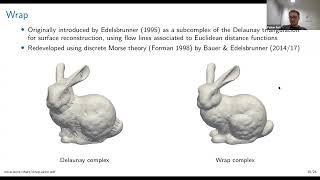
Bridging Persistent Homology and Discrete Morse Theory with Applications to Shape Reconstruction
Explore the connection between persistent homology and discrete Morse theory, unifying key concepts and applying insights to shape reconstruction in computational topology.
On Clustering scRNA-seq Data
Explore challenges and strategies in clustering single-cell RNA sequencing data, focusing on the k-cluster method's effectiveness for analyzing neuronal datasets in fruit flies.