The Landscape of Formal Verification in APL - A Review with a Case Study in Quantum Computing
Explore formal verification in APL, focusing on its potential for building dependable software. Examine a case study in quantum computing and discuss future implications for software development.
Apple Array Allocation - Static Memory Management for Flat, Immutable Arrays
Explore statically determined memory allocation for flat, immutable arrays in Apple array system, extending liveness analysis for JIT compilers in functional languages.

Orthotope - APL-Inspired Arrays for Haskell - Lambda Days 2022
Explore Orthotope, a Haskell library for multi-dimensional arrays inspired by APL. Learn efficient structural operations, clever array representation, and various implementations for different storage and typing needs.
New Tatin Packages: Overview of NuGet, APLProcess, and OpenAI Integration
Discover new Tatin packages for Dyalog APL, including NuGet integration, APLProcess for workload distribution, and OpenAI API implementation for AI capabilities in APL applications.
Filling the Core Language Gaps - Proposed New Primitives in APL
Explore three proposed APL primitives enhancing function composition, generalization, and indexing, completing the language's core functionality.

The Power of Function Composition
Explore function composition strategies and combinators across multiple programming languages, enhancing your coding skills and problem-solving abilities.
Data Parallel Proof Verification in APL - Using Metamath for Mathematical Databases
Discover how APL enables data-parallel verification of mathematical proofs using Metamath, exploring formal verification methods, proof structures, and efficient processing of large mathematical databases.
Static Analysis of APL in APL - Development Tools and Verification
Explore static analysis techniques for APL programming, focusing on code verification, bug detection, and security enforcement through practical implementation strategies and architectural considerations.
Co-dfns Compiler Roadmap and Updates - Implementation and Integration Features
Discover the latest developments in Co-dfns compiler for APL, exploring GPU integration, scalar optimization, static analysis, and traditional APL support through practical use cases and performance insights.
Telemetry and Protocol Buffers: Implementation in Dyalog APL
Discover how to implement OpenTelemetry in Dyalog APL and leverage Protobuf for efficient data serialization, with practical demonstrations of performance monitoring and cross-language data exchange.
Developing in Dyalog with Modern Tools - Using Git, GitHub, and Development Utilities
Discover modern development workflows in Dyalog APL using Git, GitHub, Cider, and Tatin through a practical bug-fixing demonstration and learn best practices for version control and package management.
Migrating to Dyalog from APL+Win - Workspace Transformation
Discover the process of migrating APL+Win workspaces to Dyalog, covering workspace restructuring, code modernization, and enhanced functionality through Link framework implementation and improved error handling.
Deployment of the Dyalog Interpreter as an OLE Server
Discover how to integrate the Dyalog interpreter as an OLEServer object, enabling seamless development and debugging in heterogeneous applications with full access to development tools and environments.
Migrating APL+Win Applications to Dyalog - Tools and Techniques
Discover tools and techniques for migrating APL+Win applications to Dyalog, including source code management, automated conversion, GUI emulation, and component file handling for seamless transition.
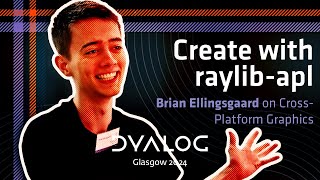
Raylib-APL: A Cross-Platform Library for Graphics and Game Programming
Discover how raylib-apl enables cross-platform game development and graphics programming in APL, featuring practical demos of 2D/3D graphics, VR capabilities, and integration techniques.
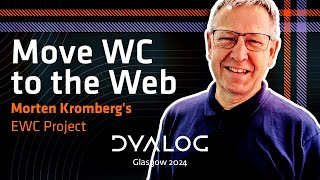
Everywhere WC: Cross-Platform GUI Development with HTMLRenderer
Discover how to migrate Windows desktop applications to web platforms using Everywhere WC, exploring features like HTMLRenderer, JavaScript objects, and cross-platform compatibility for minimal code modification.
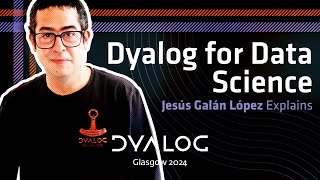
Dyalog APL for Data Science: From Basic Analysis to Materials Science Applications
Discover how APL primitives and Dyalog features excel in data science through practical examples, from analyzing Berkeley admissions to metal microstructure analysis, comparing implementations with Python.
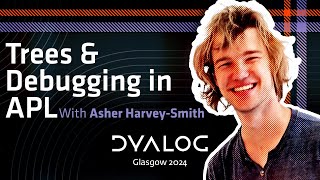
Climbing Trees and Catching Bugs - Working with Tree Data Structures in APL
Explore tree data structures in APL through parent vector representation, with animated illustrations and practical examples for array-oriented manipulation and workspace management.
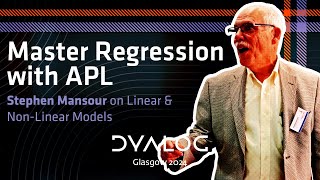
Taming Regression Using APL - From Basic Linear Models to Advanced Applications
Master statistical regression techniques using APL through practical examples, from basic linear models to advanced non-linear and logistic regression, with hands-on demonstrations using TamStat software.
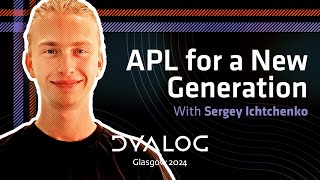
APL MOOC: Introduction to APL Programming for University Students
Discover how the University of Helsinki is revolutionizing APL programming education through an innovative online learning platform designed to inspire and educate the next generation of developers.
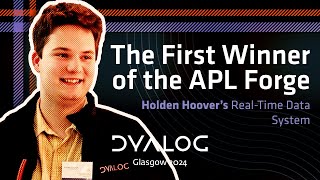
Radar Ingest System: Building an ADS-B Aircraft Tracking Application in APL
Discover how to build a real-time aircraft tracking system using APL, exploring ADS-B technology implementation, database integration, and multi-antenna data processing for aviation surveillance.