
Standardizing the Data Distribution Service API for Modern C++
Explore modern C++ standardization for DDS API, covering data-centric publish-subscribe architecture, exception safety, and forward compatibility in distributed real-time systems.

Designing XML API for Modern C++
Explore modern C++ techniques for designing efficient and user-friendly XML APIs, focusing on performance, usability, and leveraging latest language features.

Back to the Future
Exploring advanced C++ abstractions for multi-core and parallel computing, focusing on a heterogeneous, extensible future implementation that outperforms existing models like OpenMP and MPI.
C++11's Quiet Little Gem - System Error
Explore C++11's <system_error> header, focusing on std::error_code and std::error_condition. Learn their design, intended use, and potential for extensibility in error handling and reporting across platforms.
Words of Wisdom
Explore coding wisdom from various sources, covering value semantics, strong types, and API design. Gain insights on naming, consistency, and best practices in C++ programming.
Property-Based Declarative Containers in C++
Explore declarative containers in C++, offering simplified APIs for complex systems while maintaining efficiency. Learn to design opaque, property-based containers and domain-specific algorithms.
Identifying Monoids - Exploiting Compositional Structure in Code
Explore monoids as a powerful compositional pattern in code architecture. Learn to identify, exploit, and apply monoids to improve API design, incremental computation, and work distribution.
Creating Extensible Workflows with Off-Label Use of Python
Discover how to create flexible yet constrained workflow systems using Python's type annotations, coroutines, and dataclasses for extensible APIs in data processing, ETL, CI/CD, and more.
Orcha - Procesamiento Masivo Paralelo - MPP y Diseño de APIs
Explora Orcha, una herramienta de orquestación para paralelizar pruebas de forma masiva, optimizando recursos y reduciendo tiempos de ejecución en entornos de desarrollo complejos.
API Design - Lessons Learned
Learn valuable lessons and best practices for effective API design from an experienced developer's insights and real-world examples.
Good API Design
Learn principles and best practices for creating effective, user-friendly APIs. Explore key concepts, common pitfalls, and strategies to enhance API usability and developer experience.
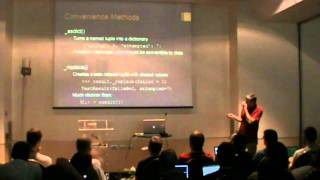
Fun with Python's Newer Tools
Explore Python's latest tools, including Counter, namedtuple, and defaultdict. Learn advanced techniques for API design, dynamic programming, and efficient data handling.
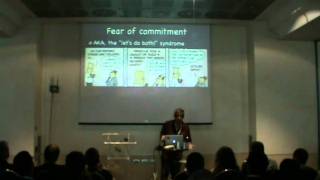
Good API Design
Learn principles for creating effective APIs, avoiding common pitfalls, and designing interfaces that are intuitive, consistent, and developer-friendly.

Lessons Learned from Building Elasticsearch Client
Lessons learned in building a distributed system client, focusing on API mapping, graceful degradation, and flexibility. Insights on language differences, architecture, and integration challenges.

Gamers Do REST
Explore how Demonware builds scalable RESTful APIs using Python and Django to serve millions of gamers for popular franchises like Call of Duty and Skylanders.

Cutting-Edge APIs Using Hypermedia at BSkyB
Explore hypermedia-enabled APIs, their implementation using Flask and HAL, and the scalability benefits for expanding businesses. Compare with traditional APIs and learn practical advantages.
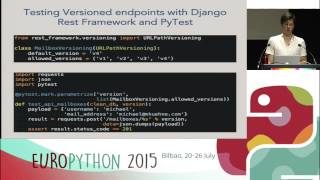
TDD for APIs
Explore test-driven development for APIs, focusing on validation, design improvement, and practical implementation in Django. Learn key principles and lessons from real-world projects.

Just Because You Can, Doesn't Mean You Should
Explores antipatterns in Python library design, discussing type checking, API design, resource management, and networking. Emphasizes balancing convenience with flexibility, readability, and predictability.

Designing a Pythonic Interface
Explore Pythonic interface design principles for complex systems, focusing on creating user-friendly abstractions while maintaining full functionality and familiarity with Python conventions.
Creating Solid APIs
Discover best practices for creating developer-friendly APIs, covering documentation, standardization, authentication, versioning, and real-world examples from major platforms.
Extending HTTP for Fun and Non-Profit
Explore strategies for standardizing API guidelines through IETF, using real-world examples of HTTP header modifications and engaging with industry stakeholders.