Efficiently Computing Data Independent Memory Hard Functions
Explore efficient computation of data-independent memory hard functions, covering complexity, attacks, and practical applications in cryptography and security.
Optimization of LPN Solving Algorithms
Explore optimization techniques for LPN solving algorithms, including sparse secret, claw reduce, drop reduce, and code reduce methods. Learn about their applications and effectiveness.
Faster Algorithms for Isogeny Problems Using Torsion Point Images
Explore advanced cryptographic techniques using torsion point images to accelerate algorithms for isogeny problems, enhancing efficiency in post-quantum cryptography.

Bridging the Gap between QoE and QoS in Congestion Control - A Large-scale Mobile Web Service Perspective
Explore a novel approach to enhance mobile web services by bridging Quality of Experience and Quality of Service in congestion control, improving user experience through adaptive algorithms.
Small Lie in Big O
Explore algorithmic complexity, Big O notation, and common misconceptions in performance analysis. Gain insights to improve code efficiency and optimize algorithms.
How It's Done - Sorting Algorithms
Explore various sorting algorithms, their implementations in C and C++, and optimization techniques. Gain insights into the evolution of sorting methods from basic to highly efficient approaches used in modern libraries.
Practical SIMD Acceleration with Boost.SIMD
Explore SIMD acceleration techniques using Boost.SIMD library. Learn to optimize algorithms, abstract hardware, and leverage SIMD registers for efficient parallel computing across various platforms.
Metaprogramming for the Brave
Explore advanced C++ metaprogramming techniques for library writers, including creative uses of generalized constant expressions and compiler optimization strategies.
Pulling Visitors
Explore Boost.Coroutine to invert visitor-based control flows, combining it with Boost.Graph for improved algorithm stepping and resumption. Learn a more readable and maintainable approach to visitor-based programming.
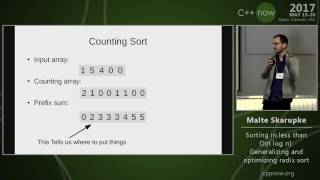
Sorting in Less Than O(n log n) - Generalizing and Optimizing Radix Sort
Explore advanced sorting techniques beyond O(n log n), focusing on generalizing and optimizing radix sort for various data types in C++. Learn to implement faster sorting algorithms for improved performance.
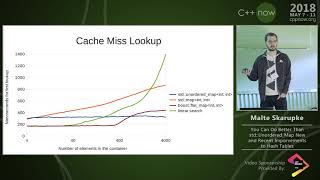
You Can Do Better than std - unordered_map - New Improvements to Hash Table Performance
Explore advanced hash table implementations and optimizations beyond std::unordered_map, including Robin Hood Hashing, SIMD instructions, and node-based container improvements for enhanced performance and memory efficiency.

Implementing Fast Calendar Algorithms - Speeding Date
Optimizing calendar algorithms for modern CPUs: strength reduction, data dependency breaking, and historical insights. Faster implementations for leap year checks and last day of month calculations.
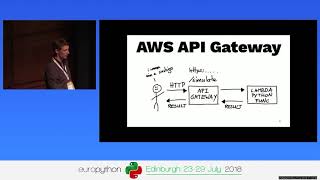
Winning Card Games with 1000+ CPUs
Explore how AWS Lambda and Python concurrency can optimize a genetic algorithm for winning the SushiGo card game, discussing implementation, challenges, and results.

Supercharge Your Deep Learning Algorithms with Optimized Software
Optimize deep learning algorithms on Intel architecture using Intel® MKL for training and Intel® nGraph and OpenVINO™ for inferencing, enhancing runtime performance.
Fastware
Explore optimization techniques for modern computing, from silicon-oriented methods to algorithm adjustments, enhancing performance in speech recognition, self-driving cars, and AI.
The One Pass (OP) Compactor - An Intellectual Abstract
Explore a novel compaction algorithm that reduces heap fragmentation with a single pass, improving efficiency in memory management and garbage collection.

Little Red Riding Hood & the K-D Tree Forest
Explore k-d tree implementation through a fairy tale analogy, delving into C++ intricacies, optimization challenges, and data structure design principles in this engaging programming journey.

How Modern SQL Databases Come up with Algorithms that You Would Have Never Dreamed Of
Explore how modern SQL databases use advanced optimization techniques to outperform hand-written algorithms, making SQL the ideal language for complex data retrieval and business logic.
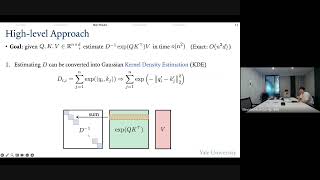
Accelerating Transformers via Kernel Density Estimation - Google TechTalk
Explore efficient Transformer acceleration using kernel density estimation. Learn innovative techniques for handling long sequences and improving performance in deep learning models.
Optimizing Binary Search - Advanced Techniques and Performance Improvements
Explore advanced techniques to optimize binary search, including branchless programming, memory layout optimization, and SIMD instructions, achieving up to 15x speedup over std::lower_bound.
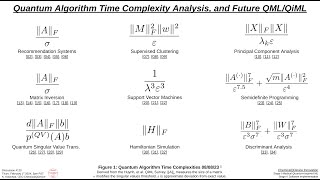
Quantum Algorithm Time Complexity Analysis and Future QML/QiML
Analyze quantum algorithm time complexity and explore future developments in quantum machine learning, with insights from leading researchers.