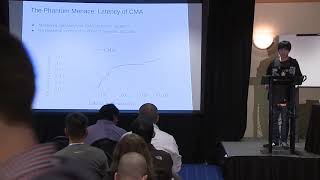
GCMA - Guaranteed Contiguous Memory Allocator
Explore the Guaranteed Contiguous Memory Allocator (GCMA) for Linux, its design principles, implementation challenges, and potential performance benefits for memory-intensive applications.
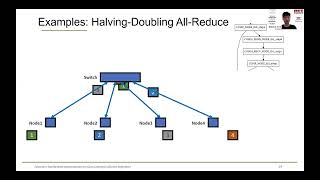
Towards a Standardized Representation for Deep Learning Collective Algorithms
Explore standardized approaches for representing collective algorithms in deep learning, focusing on optimization techniques and implementation strategies for enhanced performance.
A Graphical #SAT Algorithm for Formulae with Small Clause Density
Explore a novel graphical approach to solving #SAT problems using ZH-calculus, focusing on Boolean satisfiability with small clause density and its applications in quantum circuit analysis.

Regular Expression Matching using Bit Vector Automata
Explore a new algorithm for efficient regex matching with bounded repetition using nondeterministic bit vector automata, offering improved performance for challenging patterns in practice.

Efficient Matching of Regular Expressions with Lookaround Assertions
Explore efficient matching of regular expressions with lookaround assertions, including formal semantics, simplification properties, and a new O(m·n) algorithm using oracle-NFAs for improved performance.
Incremental Computation: What Is the Essence? - Lecture 24
Explore incremental computation's essence through incrementalization, a systematic method for efficient algorithm and program design. Gain insights into high-level abstractions for developing optimized solutions.
Finding the Value of Pi from a Random Walk Using Python
Explore Python coding to calculate pi using random walks, from 1D to 3D simulations. Enhance mathematical understanding through practical programming.

Finding "L" from the Clues - Quantum Computer Programming - Lesson 87
Efficient classical algorithm for determining cycle length "L" using random clues from Rotation Estimation, illustrated in quantum computing lesson.

SynFlow - Pruning Neural Networks Without Any Data by Iteratively Conserving Synaptic Flow
Explores SynFlow, a novel data-agnostic algorithm for pruning neural networks at initialization, avoiding layer collapse and achieving maximum compression capacity without training or data.
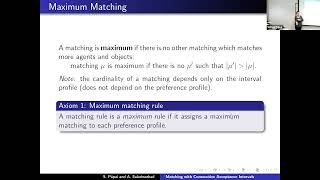
Maximum Matching with Consecutive Acceptance Intervals
Explore maximum matchings in one-to-one markets with consecutive acceptance intervals. Learn about algorithms, characterizations, and serial dictatorships for optimal matchings.
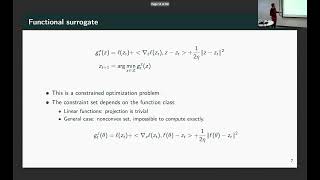
Recent Advances in Functional Optimization
Explore cutting-edge functional optimization techniques for reinforcement and supervised learning, with theoretical insights and practical algorithms.
Tensor Reconstruction Beyond Constant Rank
Explorez les algorithmes efficaces pour calculer le rang tensoriel et reconstruire des circuits algébriques restreints, améliorant les résultats existants pour les tenseurs de rang faible mais non constant.

Multidimensional Approach to AI Development: Beyond Technical Feasibility
Explore multidimensional considerations in AI development beyond technical feasibility. Learn to integrate cultural, social, political, and legal aspects throughout the product lifecycle for more purposeful and impactful AI tools.
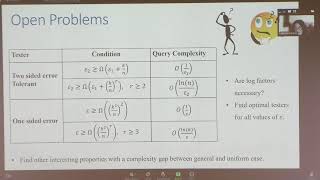
Testing Intersectingness of Uniform Families - How Dana and I Intersected
Explore efficient algorithms for testing intersecting k-uniform set families, including tolerant and one-sided error non-adaptive methods. Compare results to non-uniform families and discover optimal query complexities.
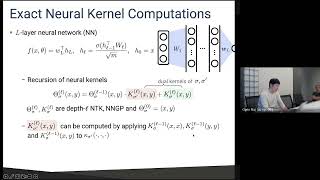
Fast Neural Kernel Embeddings for General Activations
Explore fast sketching methods for approximating multi-layered NNGP and NTK matrices with various activation functions, overcoming limitations of prior works and achieving significant speedups.
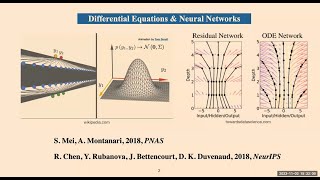
Continuous-in-time Limit for Bandits
Explore the connection between Hamilton-Jacobi-Bellman equations and multi-armed bandit problems, and discover an efficient algorithm for solving MAB challenges.
Strassen's Matrix Multiplication Algorithm - Concept and Time Complexity
Explore Strassen's Matrix Multiplication algorithm, its concept, and time complexity in the context of Divide & Conquer strategies for efficient matrix operations.

Keynote - Six Impossible Things
Explore software development limits, from integer representation to task estimation, and learn to create solutions within these constraints for more effective development.

To See or Not to See - Is AI at Its Best When People Know It's There?
Explore the ethical implications of AI transparency in online services, examining strategies from Reddit's open-source approach to Google's partial disclosure and their impact on user trust and engagement.

Shuffling-based Stochastic Optimization Methods: Bridging the Theory-practice Gap
Explore shuffling-based stochastic optimization methods and their practical applications in bridging theoretical concepts with real-world implementation.
Template Task Graphs: An Introduction to Parallel Programming for Irregular Data Sets
Explore the Template Task Graph programming paradigm for expressing task parallelism in algorithms with irregular data sets. Learn installation and integration techniques.