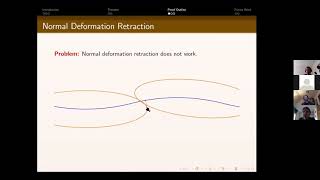
Sampling Smooth Manifolds Using Ellipsoids
Explore sampling smooth manifolds using ellipsoids, a novel approach requiring lower sample density than traditional ball-based methods, with potential applications in data science and topology.
Alexander Wagner - Nonembeddability of Persistence Diagrams into Hilbert Spaces
Explore nonembeddability of persistence diagrams in Hilbert spaces, examining stability, metrics, and implications for machine learning applications in topological data analysis.
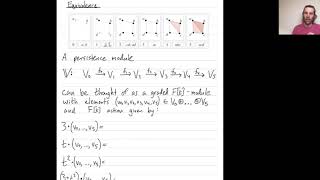
Computing Persistent Homology - Introduction
Explore the fundamentals of persistent homology computation, covering key concepts, intuition, and practical applications in topological data analysis.
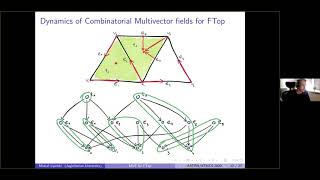
Conley-Morse-Forman Theory for Generalized Combinatorial Multivector Fields
Generalized combinatorial multivector fields on finite topological spaces: extending Conley-Morse-Forman theory for data science applications, including isolated invariant sets, Conley index, and Morse decompositions.
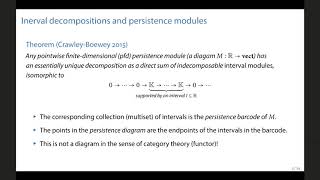
Ulrich Bauer - Persistence Diagrams as Diagrams
Explore persistence diagrams as categorical functors, examining their structure, stability, and relationships to matchings. Learn about new constructions and theorems in this advanced algebraic topology lecture.
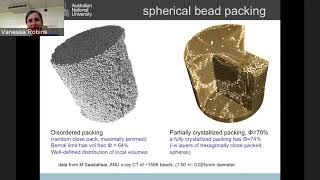
Vanessa Robins - Persistence Diagrams of Bead Packings
Exploring grain-scale mechanisms in granular crystallization using X-ray tomography and persistent homology, revealing key formation processes of tetrahedral and octahedral pores in spherical bead packings.
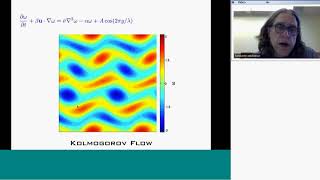
Nonlinear Dynamics, High Dimensional Data, and Persistent Homology
Explore nonlinear dynamics, high-dimensional data analysis, and persistent homology with Konstantin Mischaikow. Learn about algebraic topology applications, persistence diagrams, and recent advancements in data science.
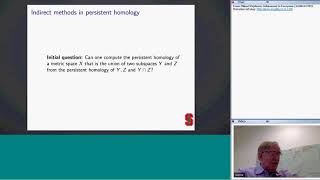
Gunnar Carlsson - Local to Global Principles in Persistent Homology
Explore persistent homology's local-to-global principles, computational methods, and applications in topology and data analysis with expert Gunnar Carlsson.
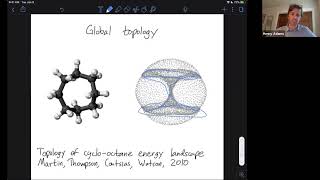
From Persistent Homology to Machine Learning
Overview of persistent homology's applications in machine learning, exploring its use in analyzing global topology and local geometry of datasets, with examples from various fields and discussions on stability and interpretability.
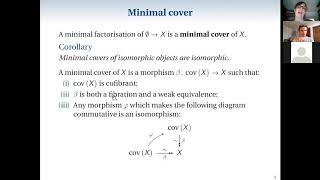
Invariants for Tame Parametrised Chain Complexes
Explore invariants for tame parametrised chain complexes in applied algebraic topology, focusing on explicit constructions, comprehensive frameworks, and discriminative power in topological data analysis.
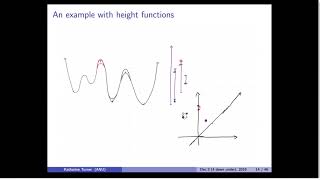
Why Should Q=P in the Wasserstein Distance Between Persistence Diagrams?
Explore Wasserstein distance in persistence diagrams, focusing on q=p choice. Covers geometric implications, stability results, algebraic versions, and computational advantages for central tendencies.
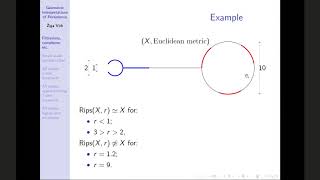
Geometric Interpretation of Persistence
Explore geometric interpretations of persistence in algebraic topology, covering space reconstruction, one-dimensional persistent homology classification, and detection of contractible geodesics using higher-dimensional features.
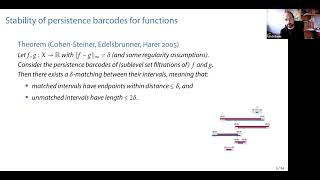
Persistence in Functional Topology
Explore functional topology's evolution, connecting persistent homology to critical point theory and calculus of variations. Gain insights into Morse's theory and its application to minimal surfaces.

Conversation on the Paper "Persistent Extension and Analogous Bars" by Yoon, Ghrist, Giusti
Explore persistent homology extensions and analogous bars in topological data analysis, discussing novel methods for comparing persistence barcodes and their applications in data science.
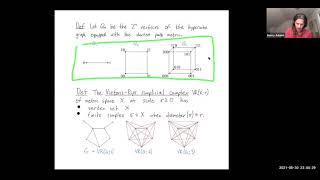
Henry Adams - Vietoris-Rips Complexes of Hypercube Graphs
Explore Vietoris-Rips complexes of hypercube graphs, their homotopy types, and applications in genetic recombination and persistent homology. Discover formulas, open questions, and conjectures in this fascinating area of applied algebraic topology.
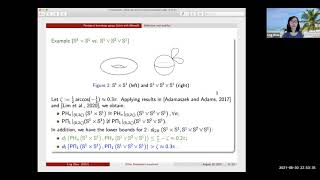
Other Persistence Invariants - Homotopy and the Cohomology Ring
Explore persistent homotopy groups and cohomology rings, focusing on fundamental groups, rational homotopy, and cup-length diagrams. Learn about new tools complementing persistent homology in topological data analysis.
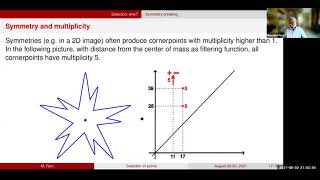
Massimo Ferri - Selection of Points in Persistence Diagrams
Explore point selection in persistence diagrams, including Kurlin's criterion and the Ziqqurat method, for noise reduction and improved data analysis in topological data analysis.
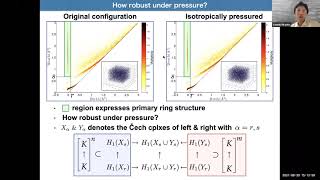
On Characterizing Rare Events in Persistent Homology
Explore rare events in persistent homology, focusing on indecomposables in multi-parameter settings. Learn about large deviation principles and laws of large numbers in topological data analysis.
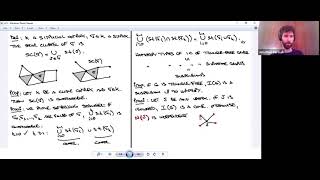
Star Clusters in Clique Complexes and the Vietoris-Rips Complex of Planar Sets
Explore star clusters in simplicial complexes and their applications to independence complexes and Vietoris-Rips complexes of planar sets, with insights on homotopy information and related conjectures.
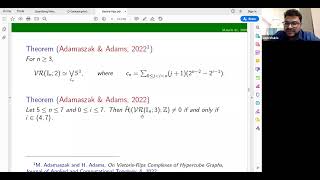
Vietoris-Rips Complexes of Hypercube Graphs
Explore Vietoris-Rips complexes of hypercube graphs, their collapsibility, and applications in genetic trees and persistent homology. Gain insights into simplicial complexes and topological data analysis.

Approximation of Compact Metric Spaces by Finite Samples
Explore topological data analysis through finite approximations of compact metric spaces, connecting Shape Theory and Persistence for robust feature extraction from noisy datasets.