Numbers, Polynumbers, and Arithmetic with Vexels - Part 2
Explore vexels, polynumbers, and Hindu-Arabic arithmetic, transitioning to base-2 for simplified understanding of number systems and their arithmetic operations.
Numbers, Polynumbers and Arithmetic with Vexels - Data Structures Math Foundations 190
Exploring Hindu Arabic numerals through multiset orientation, polynumbers, and vexels. Connects algebra and arithmetic concepts for a deeper understanding of number systems.
Logical Difficulties with Cyclotomic Fields - Famous Math Problems 20
Explores logical issues in cyclotomic fields, focusing on the challenges of embedding roots of unity into complex numbers and the limitations of purely algebraic approaches.
The Perspective Image of a Square - Number Theoretic Approach - Lecture 18d
Explores the number theoretic aspects of perspective images of squares, including algebraic solutions, quadratic equations, and harmonic ranges, with applications to spheres and algebraic theorems.
The Perspective Image of a Square - Famous Math Problems 18a
Explore projective geometry concepts like quadrilaterals, quadrangles, duality, and cross ratios in relation to perspective images of squares. Novel approach using planar vector cross products.
Extending Archimedes' Parabolic Area Formula to Cubics - Algebraic Calculus
Extending Archimedes' parabolic area formula to cubics using Algebraic Calculus and projective geometry. Explores unique aspects of cubic functions and their areas without relying on infinite processes.
The Algebra of Boole and Boolean Algebra - Key Differences - Part 1
Introduction to the Algebra of Boole, focusing on the bifield of two elements and n-tuples. Explores its role in circuit analysis and contrasts it with Boolean algebra, highlighting implications for 20th-century mathematics.
Central Polynumber Algebra and Baby Weyl Character Formula - Math Foundations 236
Explores central polynumber algebra and Weyl character formula, focusing on SU(2) and SU(3) representations. Connects to particle physics and quaternions, emphasizing polynumbers over complex exponentials.
Central Polynumbers and SL(2)/SU(2) Characters - Math Foundations 235
Explore a novel algebraic approach to SL(2) and SU(2) representation theory, emphasizing central polynumbers and mset arithmetic, with implications for Lie theory and modern physics.
Alternating and Symmetric Polynumbers - A Missing Chapter of Algebra - Math Foundations 234
Explore symmetric, alternating, and central polynumbers in algebra. Discover their relationships, product formulas, and significance in mathematics and physics.
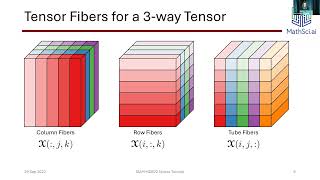
Tensor Decompositions - A Quick Tour of Illustrative Applications
Explore tensor decompositions for data analysis and dimensionality reduction. Learn fundamentals, applications in various fields, and hands-on examples using real-world datasets.

How to Solve Multi-Step Equations - A Mini Course
Comprehensive guide to solving multi-step equations, covering various types from basic two-step to complex problems involving distributive property and like terms. Ideal for beginners and those needing a refresher.
Solving Equations - A Step-by-Step Guide
Comprehensive guide to solving equations, from basic one-step problems to complex multi-step equations. Covers various techniques including distributive property and combining like terms.
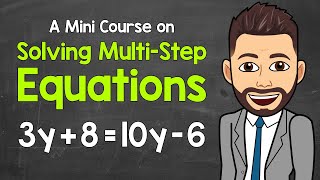
How to Solve Multi-Step Equations - A Mini Course
Comprehensive guide to solving multi-step equations, covering various types from basic two-step to complex problems involving distributive property and like terms. Includes step-by-step explanations and examples.
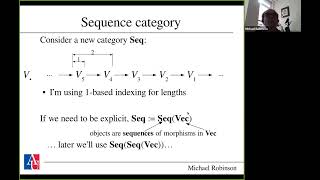
The Snake Lemma and Indecomposable Chain Maps
Explore the snake lemma's connecting homomorphism through vector space chain complexes, using Escolar and Hiraoka's representation to simplify proofs and reveal key indecomposable chain maps.
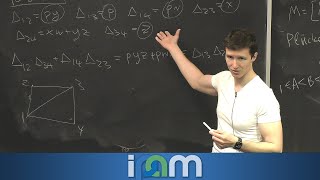
Introduction to Cluster Algebras - Part 1
Explore cluster algebras, quivers, and mutation through examples, with a focus on the Grassmannian. Gain insights into this fundamental algebraic structure and its applications.
Fiber Symmetrization in the Space of Matrices
Explore fiber symmetrization in matrix spaces, its properties, and applications to isoperimetric inequalities for convex bodies, generalizing Steiner symmetrization to higher dimensions.
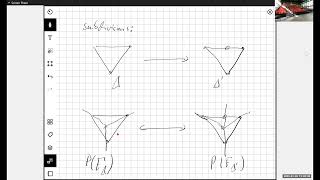
Basics in Commutative Algebra - January 29, 2024
Explore fundamental concepts of commutative algebra, focusing on face rings and the Ishida complex, with insights into their algebraic properties and applications.
Two-Sided Estimates for Operator ℓp to ℓq Norms of Random Matrices with IID Entries
Explore two-sided estimates for operator norms of random matrices, discussing proofs, examples, and open problems in this mathematical analysis of iid entries and their implications.
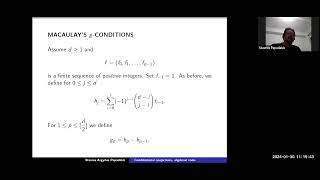
Combinatorial Conjectures and Algebraic Tools - January 30, 2024
Explore combinatorial conjectures like Grünbaum and g-conjectures, and their connections to deeper algebraic properties in this insightful overview.
The Grothendieck-Teichmüller Lie Algebra Injects Into The Double Shuffle Lie Algebra by Leila Schnep
Explore the injection of Grothendieck-Teichmüller Lie algebra into double shuffle Lie algebra, advancing understanding in algebraic geometry and number theory.