
Graphing Lines by Solving for Y and Plotting Points
Learn efficient techniques for graphing lines by solving for y and plotting points, building on previous concepts to develop more elegant graphing methods.
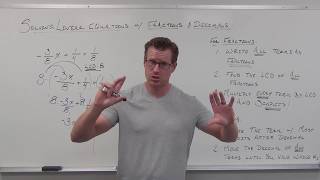
Solving Linear Equations with Fractions and Decimals
Learn techniques to simplify and solve linear equations containing fractions and decimals, focusing on efficient methods to eliminate complex terms and find solutions.

Solving Equations Using Multiplication and Division
Learn to solve basic linear equations using multiplication and division, focusing on inverse operations and maintaining equality on both sides.

Solving Equations Using Addition and Subtraction
Learn to solve linear equations using inverse operations of addition and subtraction. Explore primary goals, common mistakes, and effective problem-solving techniques.
Learning-Based Low-Rank Approximations - IPAM at UCLA
Explores learning-based algorithms for low-rank matrix approximation, focusing on optimizing sketching matrices using training data to significantly reduce approximation errors in efficient computational methods.
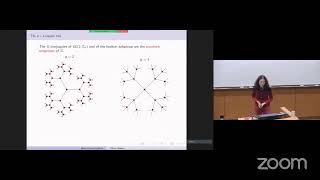
Marie-France Vignéras- Modular Representations of P-Adic Groups
Explore modular representations of p-adic groups in the Langlands program, examining their connections to number theory and geometry using various vector spaces and modules.
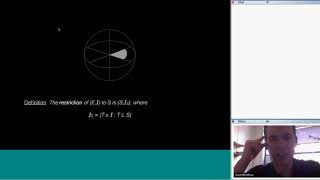
Greg Henselman - Matroids & Canonical Forms Theory and Applications
Explore matroids and canonical forms, their theoretical foundations, and practical applications in algebraic topology and related fields.
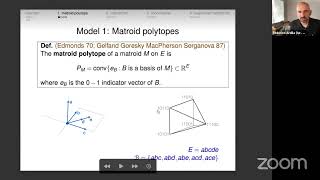
The Geometry of Geometries - Matroid Theory, Old and New
Explore matroid theory's origins, connections, and recent geometric advances in combinatorial mathematics, highlighting matroid polytope, Bergman fan, and conormal fan models.
The Module Structure of a Group Action on a Ring
Explore finite group actions on graded algebras, examining module multiplicities and their connections to homological algebra and geometric group actions.
An Introduction to Chromatic Homotopy Theory
Explore Morava K-theories, E-theories, and their role in chromatic homotopy theory. Delve into K(n)-local categories and the connection between E-theory and group cohomology.
Tensor Triangular Geometry - Lecture 1
Explore symmetric monoidal triangulated categories, their spectra, and analogies to algebraic geometry. Delve into challenges in compactly generated settings and tensor triangulated fields.

Marina Iliopoulou- Three Polynomial Methods for Point Counting, Lecture III
Explore advanced polynomial techniques for solving geometric problems, including Dvir's method, polynomial partitioning, and slice rank method in finite-field settings.
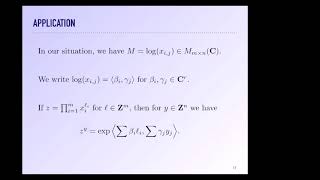
An Introduction to Auxiliary Polynomials in Transcendence Theory - Lecture III
Explore transcendence theory, Baker's Theorem, and the structural rank conjecture. Learn complex analysis and commutative algebra techniques for proving lower bounds on logarithmic matrices.
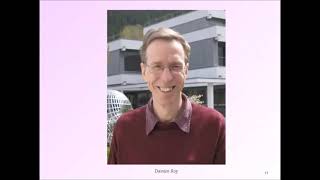
An Introduction to Auxiliary Polynomials in Transcendence Theory - Lecture II
Explore advanced transcendence theory concepts, focusing on auxiliary polynomials and their applications in proving Baker's Theorem and the Masser-Waldschmidt theorem on logarithmic matrices.
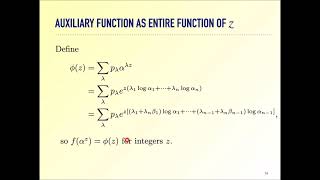
An Introduction to Auxiliary Polynomials in Transcendence Theory
Explore transcendence theory, focusing on Baker's Theorem and the structural rank conjecture. Learn complex analysis and commutative algebra techniques for proving key results in number theory.
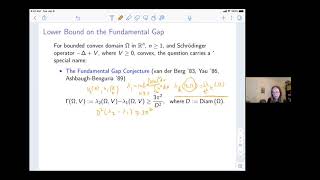
Some Comments on the Fundamental Gap of the Dirichlet Laplacian in Hyperbolic Space
Explore the fundamental gap of convex domains in hyperbolic space, comparing it with Euclidean space and examining different types of convexity in this advanced mathematical analysis.
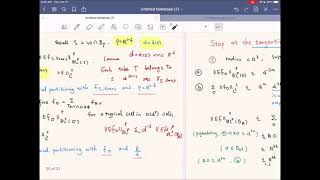
The Restriction Problem and the Polynomial Method - Lecture IV
Explore Stein's restriction conjecture, Kakeya conjecture, and the polynomial method in restriction theory. Understand wave packet decomposition and intersection of tubes in hypersurfaces.
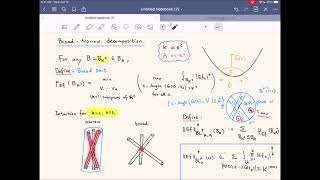
The Restriction Problem and the Polynomial Method - Lecture III
Explore Stein's restriction conjecture, Kakeya conjecture, and the polynomial method in restriction theory. Understand wave packet decomposition and intersection of tubes in hypersurfaces.
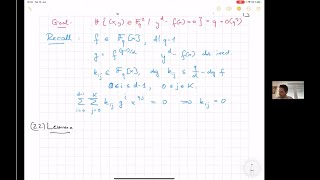
Valentin Blomer: The Polynomial Method for Point Counting and Exponential Sums
Explore advanced techniques for counting points on curves over finite fields and estimating exponential sums using families of auxiliary polynomials.
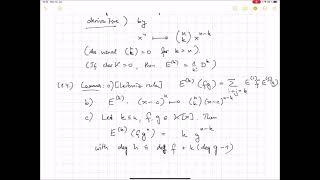
The Polynomial Method for Point Counting and Exponential Sums
Explore how auxiliary polynomials aid in counting points on curves over finite fields and estimating exponential and character sums.
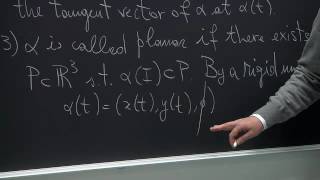
Differential Geometry - Lecture 1
Explore fundamental concepts and principles of differential geometry in this comprehensive lecture by mathematician Claudio Arezzo.