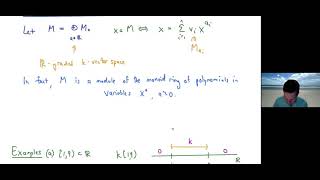
Homological Algebra for Persistence Modules
Introduction to persistence modules in algebraic topology, exploring tensor products, Hom operations, and their role in homological algebra. Insights into preserving exact sequences and advanced concepts.
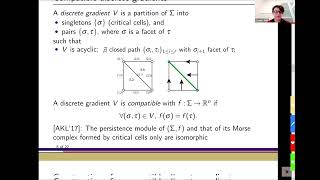
Claudia Landi - Multi-parameter Persistence from the Viewpoint of Discrete Morse Theory
Explore multi-parameter persistence through discrete Morse theory, connecting combinatorial properties of critical cells to algebraic properties of persistence modules in topological data analysis.
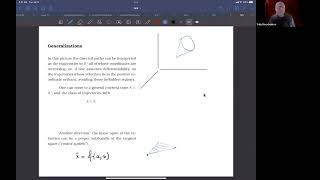
Linear Obstacles in Linear Systems and Ways to Avoid Them
Explore topology in control theory, focusing on obstacle-avoiding paths and cohomology rings using homotopy limits. Gain insights into theoretical computer science applications.
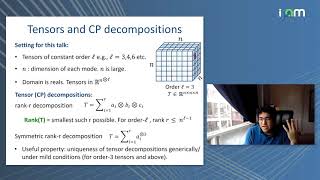
Smoothed Analysis for Tensor Decompositions and Unsupervised Learning
Explore smoothed analysis for tensor decompositions and unsupervised learning, focusing on polynomial time guarantees and robust decompositions of symmetric overcomplete tensors.
Classifying Small Fusion Categories
Explore the classification of small fusion categories, including recent results on odd-dimensional modular and fusion categories. Learn about different interpretations of "small" in this context.
Positivity for Symmetric Functions and Vertex Models
Explore connections between symmetric function homomorphisms and stochastic six-vertex model positivity, linking to RSK correspondence in algebraic combinatorics.
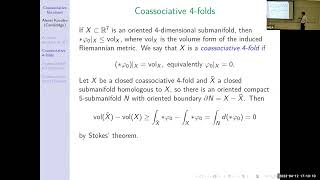
Coassociative Fibrations in G2 Geometry
Explore G2 geometry in 7D spaces, focusing on coassociative submanifolds. Learn about their properties, deformation theory, and constructions forming fibrations with singular fibers in 7-manifolds.
Operations on Cyclic Complexes, Getzler-Gauss-Manin Connection, Noncommutative Crystalline Cohomology
Explore advanced algebraic concepts including cyclic complexes, Getzler-Gauss-Manin connection, and noncommutative crystalline cohomology in this in-depth mathematical lecture by Boris Tsygan.
Divergence in Coxeter Groups
Explores divergence in Coxeter groups, introducing the 'hypergraph index' to characterize linear, quadratic, and exponential divergence in these mathematical structures.
Braids and Line Arrangements - Old and New
Explore the interplay between braid groups, configuration spaces, and hyperplane arrangements, focusing on recent advances in understanding fundamental groups of complex line arrangement complements.
Polynomials for Quivers and Topological Recursion
Explore A-polynomials for quivers and their connection to topological recursion in this advanced mathematics lecture by Piotr Sułkowski from the University of Warsaw.
Prequels and Possible Sequels to Topological Recursion
Exploration of topological recursion's origins, connections to Hopf algebras, and potential future developments, bridging discrete data and moduli spaces through cubical complexes.
Topological Recursion, Virasoro-W-Algebra Constraints, and Kontsevich-Soibelman
Explore Virasoro and W-algebra constraints in topological recursion, Kontsevich-Soibelman operators, and their connection to Conformal Field Theory in this advanced mathematics lecture.
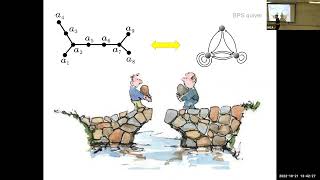
Quivers, Curve Counting, and Fermionic Sums in Topology
Explore connections between quantum groups, vertex algebras, and quiver representations in topology. Discover how fermionic forms link these areas, shedding new light on enumerative geometry and curve counting.
Algebraic Definition of Braids and the Braid Group
Explore the algebraic foundations of braids and the braid group, delving into their mathematical properties and applications in topology and geometry.
Alexander Polynomials of Algebraic Links
Explore Alexander polynomials of algebraic links, their definitions, examples, and connections to algebraic geometry. Discover the relationship between plane curve singularity spectra and link polynomials.
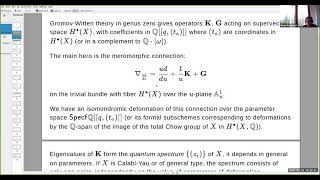
Blow Up Formulae and Invariants II - Dimension Theory
Explore numerical invariants in meromorphic connections, their relation to singularity theory, and applications to non-rationality criteria for Fano varieties.
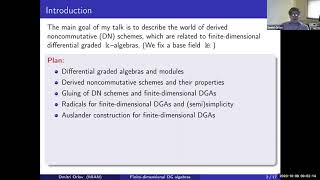
Finite-Dimensional DG Algebras and Their Properties
Explore finite-dimensional DG algebras, perfect complexes, and their role in noncommutative schemes. Discover connections to DG categories with (semi)exceptional collections.

Intermediate Algebra - A Study of Conic Sections: Ellipse and Hyperbola
Explore ellipses and hyperbolas in conic sections, learning their properties, equations, and applications in this comprehensive algebra lecture.

Intermediate Algebra - A Study of Conic Sections - Parabola and Circle
Explore conic sections, focusing on parabolas and circles. Learn key properties, equations, and applications of these fundamental geometric shapes in algebra and real-world scenarios.
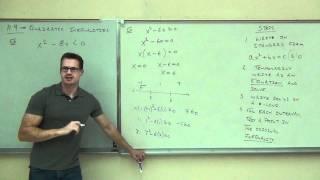
Intermediate Algebra - Solving Non-Linear and Quadratic Inequalities
Learn to solve non-linear and quadratic inequalities with step-by-step guidance, enhancing your problem-solving skills in intermediate algebra.