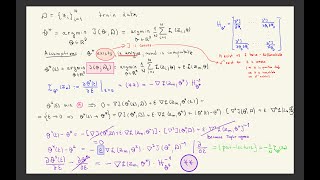
Data Influence: Understanding Influence Functions and Efficiency in Machine Learning
Delve into advanced mathematical concepts of data influence, exploring influence functions, efficiency, and convexity through theoretical frameworks and practical applications in data science.
Chiral and Factorization Algebra - Lecture 25
Delve into advanced mathematical concepts exploring chiral and factorization algebras, their equivalence, and the relationship with Lie-* algebras, culminating in the Eckmann-Hilton commutativity theorem.
E_n Algebras and Their Applications to Verdier and Non-abelian Poincare Duality
Delve into E_n-algebras, exploring their fundamental properties, infinity-operads, and connections to Verdier duality and non-abelian Poincare duality in advanced mathematics.
Chiral Koszul Duality in Holomorphic Factorization Algebras - Talk 31
Delve into holomorphic factorization algebras, exploring their relationship with topological counterparts and the connections between definitions through (co)operads theory.
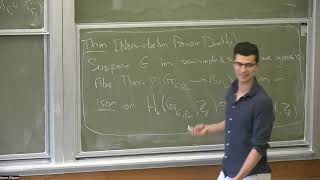
Non-Abelian Poincaré Duality - Talk 33
Delve into non-abelian Poincaré duality, exploring its relationship between l-adic homology of BunG and Beilinson-Drinfeld Grassmannian, featuring Drinfeld's simplified proof approach.
Compile-Time Sparse Matrices - Optimizing Memory and Performance
Explore compile-time sparse matrices for efficient memory use and performance in C++ linear algebra. Learn to incorporate sparseness information, reduce storage, and optimize operations automatically.
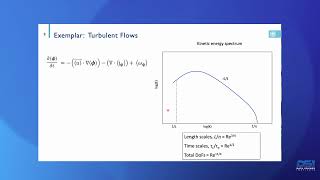
Higher-Order Multi-Variate Statistics for Scientific Data Analysis
Explore advanced multi-variate statistical techniques for scientific data analysis, focusing on higher-order methods like coskewness and cokurtosis for rare event detection and dimensionality reduction in complex systems.
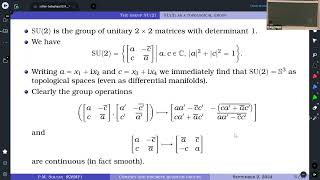
Compact and Discrete Quantum Groups
Explore compact and discrete quantum groups, delving into advanced mathematical concepts with expert Piotr M. Sołtan from the University of Warsaw.
Generalizations of Matrix Multiplication for Solving the Light Bulb Problem
Explore a novel approach to solving the Light Bulb Problem using tensor-based algorithms, potentially outperforming traditional matrix multiplication methods for faster data analysis and pattern recognition.
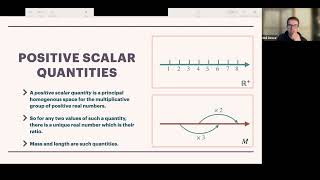
Intrinsic Quantum Mechanics - Extending Classical Physics to Quantum Structures
Explore intrinsic quantum mechanics, focusing on characterizing physical quantities' intrinsic structure and extending classical physics concepts to quantum realm. Gain insights into complex scalar quantities and intrinsic product spaces.
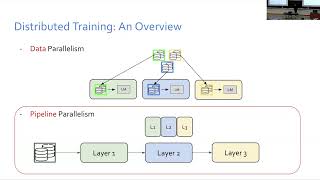
Efficient Language Models - Tutorial
Explore efficient language model techniques with JHU researcher Tianjian Li, covering optimization strategies and cutting-edge approaches for improved NLP performance.
Twistor Theory and Vertex Algebras
Explore the intersection of twistor theory and vertex algebras, delving into advanced mathematical concepts and their applications in geometry and physics.
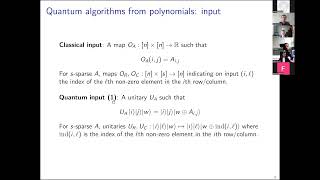
Quantum Algorithms from Polynomials: Solving Linear Systems Faster - Lecture
Explore quantum algorithms for solving linear systems using polynomial approximations. Learn about LCU and QSVT techniques, and discover constant factor improvements in quantum linear algebra.
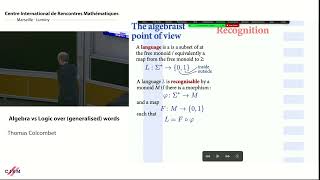
Algebra vs Logic over Generalized Words
Explore algebraic and logical perspectives on generalized words, comparing approaches and examining key concepts in discrete mathematics and theoretical computer science.
Affine BPS Algebras and W Algebras - Lecture on Quiver Potentials and Cohomological Hall Algebras
Explore affine BPS algebras, W algebras, and their connections to quiver representations, cohomological Hall algebras, and Yangians in this advanced mathematical seminar.

An Overview of the E11 Program in String Theory and Supergravity
Explore E11 Kac-Moody symmetry in string theory, its relation to supergravity, and implications for extended spacetime. Delve into recent applications in four-dimensional gravity and open questions.
Stochastic Partial Differential Equations and Regularity Structures - Award Lecture
Explore groundbreaking work on stochastic partial differential equations, revolutionizing mathematical modeling of random physical systems with the theory of regularity structures.
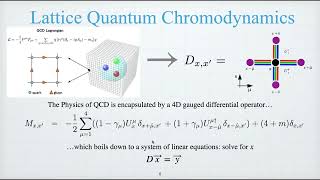
GPU Computing and Krylov Solvers
Explore GPU computing and Krylov solvers for advanced numerical computations, enhancing problem-solving skills in high-performance computing environments.
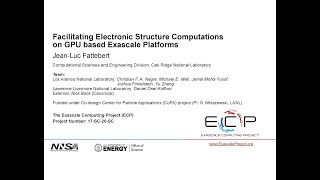
Facilitating Electronic Structure Computations on GPU-based Exascale Platforms
Explore GPU-based electronic structure computations for exascale platforms using PROGRESS and BML libraries. Learn implementation strategies, performance optimization, and scaling techniques.
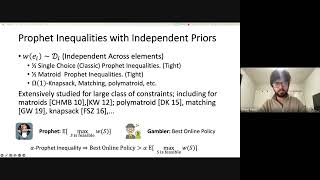
Limitations of Stochastic Selection with Pairwise Independent Priors
Explore stochastic selection problems with pairwise-independent priors and matroid constraints, examining limitations and optimal bounds for contention resolution and prophet inequalities.

Algorithms and Hardness for Attention and Kernel Density Estimation
Explore algorithmic techniques for Attention and Kernel Density Estimation, examining fast algorithms and hardness results to optimize computational efficiency in machine learning and statistical tasks.