
Orthotope - APL-Inspired Arrays for Haskell - Lambda Days 2022
Explore Orthotope, a Haskell library for multi-dimensional arrays inspired by APL. Learn efficient structural operations, clever array representation, and various implementations for different storage and typing needs.
Towards a Formulation of the Birch and Swinnerton-Dyer Conjecture for Abelian Schemes Over Varieties Over Finite Fields
Delve into advanced number theory concepts exploring the Birch and Swinnerton-Dyer conjecture's formulation for abelian schemes over finite field varieties, presented by mathematician Amilcar Pacheco.
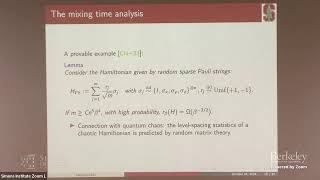
Mathematical Challenges of Quantum Algorithms for Open Quantum Systems
Explore mathematical challenges in quantum algorithms for open quantum systems, examining advanced computational approaches and theoretical frameworks for quantum system analysis.
Técnicas Espectrais para Detecção de Comunidades
Explore técnicas espectrais para detecção de comunidades em redes complexas, abordando decomposição de autovalores, otimização de modularidade e agrupamento espectral para análise eficiente de padrões.
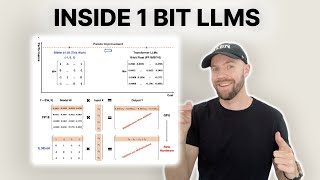
Understanding 1-Bit Large Language Models - From Theory to Implementation
Dive into the revolutionary concept of 1-bit Large Language Models, exploring how weights can be represented with simple integers (0, 1, -1) instead of complex floating-point numbers.
Double Affine Hecke Algebras Beyond Genus Zero
Delve into advanced mathematical concepts of Double Affine Hecke Algebras and their applications beyond genus zero, presented by mathematics expert Dr. Arthamonov.
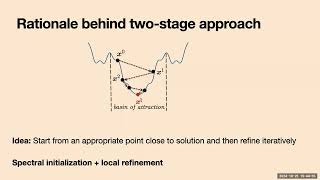
Non-convex Matrix Sensing: Breaking the Quadratic Rank Barrier in Sample Complexity
Explore groundbreaking research on non-convex matrix sensing, focusing on improved algorithms for reconstructing low-rank matrices using fewer samples through innovative probabilistic decoupling methods.
Derived Categories of the Permutahedral Varieties
Delve into the geometric and combinatorial analysis of derived categories in toric varieties, exploring permutahedron's role in matroid theory through convex-geometric approaches.
Tropical Quiver Representations and Their Geometric Applications
Delve into advanced algebraic geometry concepts through tropical quiver representations, exploring Grassmannians, flag varieties, and their matroidal analogues as fundamental moduli spaces.
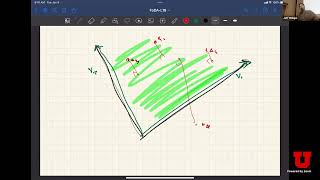
Dimensionality Reduction: Data Matrices and Projection Methods - Lecture 18
Explore dimensionality reduction techniques through matrix operations, focusing on dot product projections and orthogonal basis sets for effective data transformation.
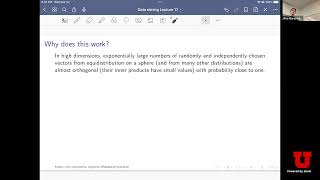
Random Projection in Data Mining - Spring 2023
Explore random projection techniques in data mining, from PCA and SVD fundamentals to Johnson-Lindenstrauss lemma, with practical algorithms and theoretical foundations.
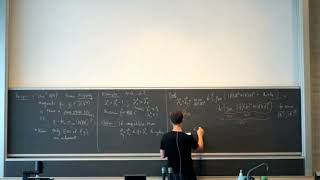
Quantum Marginal Problem in Advanced Topics in Quantum Information Theory - Lecture 22
Delve into the quantum marginal problem through rigorous mathematical proofs and theoretical foundations in advanced quantum information theory.
All Projective Measurements Can Be Self-Tested in Quantum Computing
Delve into groundbreaking research demonstrating how real-valued projective measurements in quantum systems can be self-tested through correlation analysis and post-hoc testing techniques.
Classical Shadows in Quantum Information Theory
Explore classical shadows in quantum computation through an expert presentation on theoretical aspects, measurement protocols, and applications in quantum information science.
Building Decision-Making Assistants: Introduction to Recommendation Systems
Explore recommendation systems from basic classification to advanced Netflix-style matrix factorization, covering content filtering, collaboration models, SVD, and PCA techniques.
Formalizing Giles Gardam's Disproof of Kaplansky's Unit Conjecture
Explore the formalization of Giles Gardam's disproof of Kaplansky's Unit Conjecture using Lean 4, combining deductive proving and verified computation.

Uncomputable Functions - Exploring the Limits of Computation
Explore the fascinating world of uncomputable functions, their implications for lambda calculus, and the limits of computation in this thought-provoking presentation.
Performance Matters: New Tricks for Old Dogs - Lecture 1
Explore performance-oriented C++ techniques, including faster erasure methods, cache-friendly linked lists, and efficient random-access containers. Suitable for both newcomers and experienced developers.
Matrix Computation in Wolfram Language
Explore advanced linear algebra capabilities in Mathematica and Wolfram Language, including recent additions and future developments.
On the Spectrum of the Poincaré Operator in Ellipsoids
Explore the Poincaré operator's spectrum in ellipsoids, examining fluid motion, wave operators, and eigenvalue asymptotics in rotating incompressible fluids.
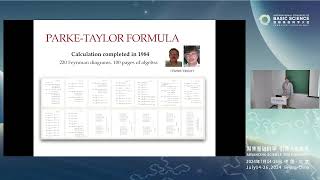
The Amplituhedron - Connecting Scattering Amplitudes and Quantum Field Theory
Explore the connection between scattering amplitudes and the Amplituhedron, a novel mathematical concept generalizing convex polytopes into Grassmannians.