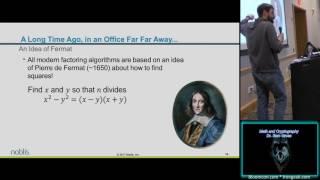
Math and Cryptography
Explore modern factoring, complexity analysis, and cryptography concepts, including Cohen's Criterion and Internet of Things security implications.
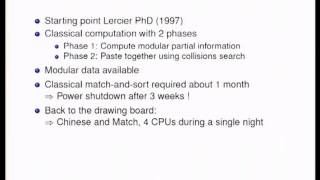
A Tutorial on High Performance Computing Applied to Cryptanalysis
Learn high-performance computing techniques for cryptanalysis, covering key steps from concept to implementation, with insights on scaling computations and optimizing algorithms for cryptographic challenges.
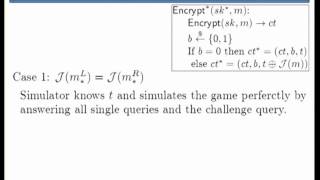
Property Preserving Symmetric Encryption
Explore property preserving symmetric encryption, its security definitions, and constructions using pairings in composite order groups. Learn about new directions in this cryptographic field.
Rate 1 - Linear Time and Additively Homomorphic UC Commitments
Explore universal composability, homomorphism, and rate in commitment schemes. Learn about theoretical results, building blocks, and practical applications in cryptography.
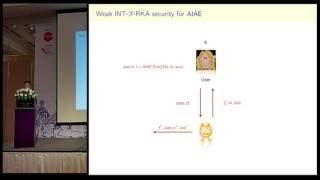
Efficient KDM CCA Secure Public Key Encryption for Polynomial Functions
Explore advanced cryptographic techniques for secure public key encryption, focusing on efficient KDM CCA security for polynomial functions.
One Shot Verifiable Encryption from Lattices
Explore lattice-based cryptography with a focus on one-shot verifiable encryption, covering zero-knowledge proofs, Ring-LWE encryption, and practical applications in this cutting-edge research presentation.
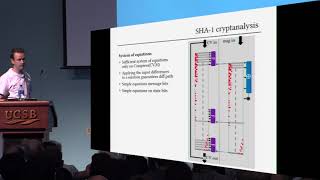
The First Collision for Full SHA-1
Explore the groundbreaking research on SHA-1 collisions, including compression techniques, GPU acceleration, and reusable collision methods for cryptographic security.
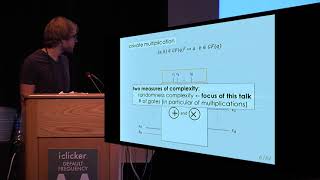
Private Multiplication over Finite Fields
Explore secure multiparty computation techniques for private multiplication in finite fields, focusing on cryptographic protocols and their applications.
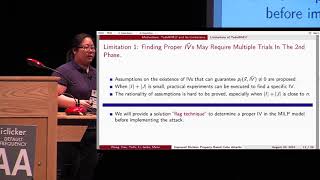
Improved Division Property Based Cube Attacks Exploiting Algebraic Properties of Superpoly
Explores advanced cryptanalysis techniques, focusing on enhanced division property-based cube attacks and leveraging algebraic properties of superpoly to improve cryptographic analysis.
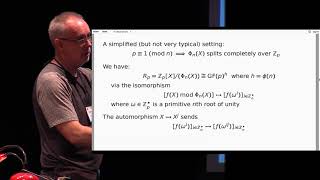
Faster Homomorphic Linear Transformations in HElib
Explore advanced techniques for optimizing homomorphic linear transformations in HElib, enhancing efficiency in encrypted computations.
The Emergence of Geometric Worldviews in Qualia Space
Explores how cognitive capabilities, subjective experience, and macroscopic perception lead to geometric worldviews in organisms, using qualia-based measurement spaces and topological concepts.
C++ and Linear Algebra
Explore the proposal for adding linear algebra support to C++'s standard library, discussing its importance, requirements, and potential applications in geometry and color manipulation.
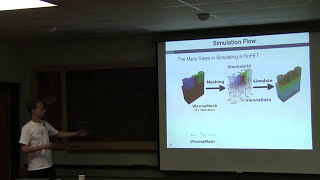
A Discussion of Selected Vienna-Libraries for Computational Science
Explore Vienna-Libraries for computational science: ViennaCL, ViennaGrid, ViennaData, ViennaMath, and ViennaFEM. Learn how C++ can better meet scientific computing needs.
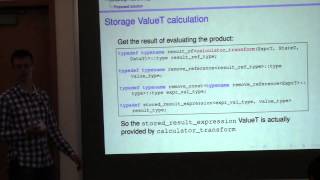
Building Finite-Element Matrix Expressions with Boost Proto and the Eigen Library
Learn to integrate Eigen with Boost Proto for finite-element matrix expressions, including user-defined functions and external libraries in domain-specific languages.

Monoids, Monads, and Applicative Functors - Repeated Software Patterns
Explore abstract mathematical structures in software development, focusing on monoids, monads, and applicative functors. Learn to recognize these patterns and apply them to improve code design and problem-solving skills.
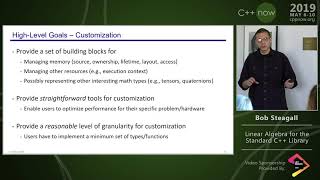
Linear Algebra for the Standard C++ Library
Exploring a proposal to add linear algebra components to the C++ standard library, covering design, rationale, and implementation details for matrices, vectors, and related operations.
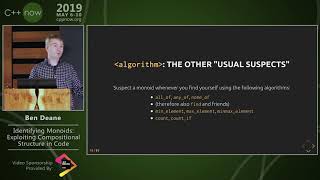
Identifying Monoids - Exploiting Compositional Structure in Code
Explore monoids as a powerful compositional pattern in code architecture. Learn to identify, exploit, and apply monoids to improve API design, incremental computation, and work distribution.
STL Algorithms as Expressions
Explore advanced C++ techniques using Expression Templates for flexible algorithm customization, enhancing STL range algorithms and generic programming beyond traditional approaches.
Taking Static Type-safety to the Next Level - Physical Units for Matrices
Explore advanced C++ techniques for implementing physical unit types in matrix operations, enhancing type safety and error prevention in robotics, graphics, and automated driving applications.

C++ Compile-Time Sparse Matrices for Linear Algebra and Tracking Applications
Explore compile-time sparse matrices in C++ for efficient linear algebra and tracking applications, optimizing memory usage and performance through advanced type system techniques.
Vectorize Using Linear Algebra and NumPy to Make Your Python Code Fast
Learn to optimize Python code using linear algebra and NumPy vectorization techniques. Discover how to replace inefficient loops with fast NumPy operations, significantly improving performance while maintaining readability.