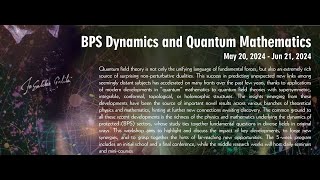
Gauge Origami and Quiver W-algebras
Explore gauge origami and quiver W-algebras with Taro Kimura, delving into advanced mathematical concepts and their applications in theoretical physics.
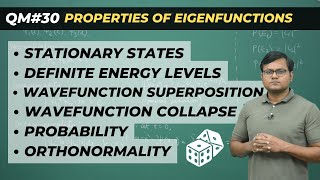
Stationary States, Energy Levels, Superposition and Wavefunction Collapse in Quantum Mechanics
Explore quantum mechanics concepts: stationary states, energy levels, superposition, and wavefunction collapse. Gain insights into fundamental principles shaping quantum systems.
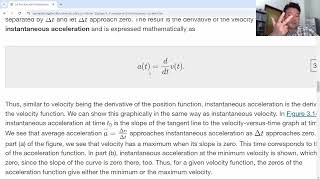
Physics 4A - Chapter 3 Overview
Explore fundamental concepts of motion, including velocity, acceleration, and displacement, in this comprehensive overview of Chapter 3 in classical mechanics.
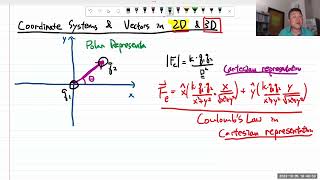
Physics 4B - Coordinate Systems and Vectors in 2D - Cartesian and Polar
Explore 2D coordinate systems and vectors in Cartesian and polar forms, enhancing your understanding of fundamental physics concepts.
Significant Figures and Scientific Notation in General Physics - Lesson 1.2
Master significant figures and scientific notation for precise calculations in physics and beyond.
Vectors in General Physics - Lesson 1.4
Explore vectors in physics: from trigonometry review to vector components, addition, and resultant vector calculations. Master essential concepts for understanding vector operations in physics.
Kirchhoff's Rules and Complex DC Circuits - General Physics
Master Kirchhoff's Rules for complex DC circuits. Learn to apply junction and loop rules, solve equations, and use matrix algebra for efficient problem-solving in electrical systems.
A Closed-Form Mathematical Framework for Modeling Turbulent Fluids
Explore a groundbreaking mathematical framework for turbulent fluid motion, covering energy spectra, instability mechanisms, and analytical solutions for turbulence in confined spaces.
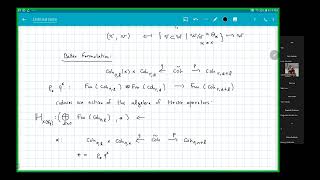
Cohomological Hall Algebras of Zero-Dimensional Sheaves on Surfaces and the P=W Conjecture
Explore cohomological Hall algebras of 2CY categories, focusing on zero-dimensional sheaves on surfaces and their role in proving the P=W conjecture for character varieties.
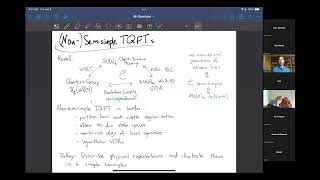
Non-semisimple TQFTs from 3D N=4 Quantum Field Theories - Part 1
Explore non-semisimple TQFTs from 3D supersymmetric field theories, examining their connections to quantum groups and vertex operator algebras in topological quantum field theory.
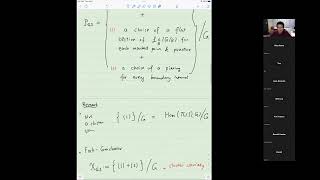
Cluster Nature of Quantum Groups
Explore quantum groups through a rigid cluster model, discovering natural Hopf algebra isomorphisms and a cluster canonical basis with unique invariance properties.
Mathematics of Quantum Entanglement - Part 1
Explore quantum entanglement's mathematical foundations, including its role in communication, Bell inequalities, and quantum capacities.

Coalgebra Symmetry and Discrete Time Integrable Systems - Lecture 2023
Explore coalgebra symmetry and discrete time invariant systems through advanced mathematical concepts and their applications in physics and engineering.
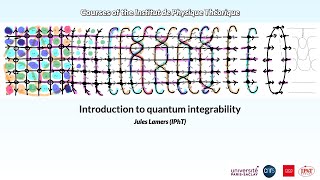
Introduction to Quantum Integrability - Lecture 1
Explore quantum integrability fundamentals, focusing on key concepts and applications in theoretical physics.
Modular Tensor Categories, Quantum Groups and Vertex Algebras - Lecture 4
Explore connections between modular tensor categories, quantum groups, and vertex algebras. Delve into the logarithmic Kazhdan–Lusztig conjecture linking quantum groups and vertex algebras.
Modular Tensor Categories, Quantum Groups and Vertex Algebras - Lecture 1
Explore modular tensor categories, focusing on nonsemisimple theory. Gain insights into these mathematical structures and their connections to quantum symmetries and algebraic concepts.
Braided Fusion Categories - Lecture 5: Witt Equivalence and Categorical Witt Group
Explore advanced concepts in braided fusion categories, including gauging, Picard groups, Witt equivalence, and categorical Witt groups. Suitable for graduate-level mathematics students.
Braided Fusion Categories - Lecture 4
Explore algebraic theory of semisimple braided tensor categories, covering properties, examples, centralizers, equivariantizations, gauging, and Witt equivalence. Suitable for graduate students.
Braided Fusion Categories - Lecture 2
Explore algebraic theory of semisimple braided tensor categories, covering structure, classification, and applications in quantum symmetries and topological quantum field theories.
W-algebras and Lax Operators - Lecture 1
Explore finite W-algebras, twisted Yangians, and Lax operators. Investigate relationships between these mathematical structures using advanced algebraic techniques.
Braided Fusion Categories - Lecture 1
Explore semisimple braided tensor categories, their structure, and classification. Learn about centralizers, non-degeneracy, equivariantizations, gauging, and Witt equivalence in fusion categories.