Symmetries and Quantum Mechanics - The Regular Representation - Lecture 6
Delve into representation theory of groups in quantum mechanics, focusing on regular representation and its fundamental principles in symmetry analysis.
Symmetries and Quantum Mechanics - Orthogonality Relations for Characters - Lecture 5
Explore the fundamental principles of group representation theory in quantum mechanics, focusing on character orthogonality relations and their applications in quantum states.
Symmetries and Quantum Mechanics: Consequences of Schur's Lemma - Lecture 4
Delve into the fundamental principles of group representation theory and its applications in quantum mechanics, with a focus on exploring Schur's lemma and its implications.
Symmetries and Quantum Mechanics - Linear Representations
Explore the fundamental principles of group representation theory and its applications in quantum mechanics, focusing on linear representations and their mathematical foundations.
Vertex Operator Algebras and Integrable Systems - Lecture 2
Delve into advanced mathematical concepts of vertex operator algebras, screening methods, W-algebras, and their applications in geometric Langlands theory and integrable systems with Boris Feigin.
Predicting New Physics for Gravitational Wave Astronomy - William East
Exploring new physics in gravitational wave astronomy, focusing on precision modeling, theoretical challenges, and emerging techniques for interpreting signals and searching for novel phenomena.
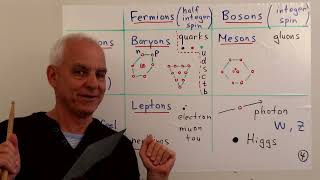
Rethinking Standard Model Numerology
Explore particle physics' Standard Model, focusing on quantum numbers, particle classifications, and novel representations of Baryon and Meson families. Gain insights into the eight-fold way and quark theory.
College Physics 1 - Describing Motion
Explore fundamental physics concepts like position, speed, and velocity, and learn to model motion using diagrams and vectors.
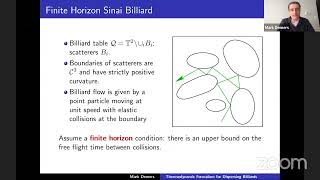
Thermodynamic Formalism for Dispersing Billiards
Explores mathematical billiards in statistical mechanics, focusing on dispersing billiards. Discusses equilibrium states, geometric potentials, and spectral analysis, with insights into SRB measures and maximal entropy.
Spectral Decomposition of Atomic Structures in Heterogeneous Cryo-EM
Innovative approach to recover 3D atomic structures of flexible macromolecules from cryo-EM data, combining biological knowledge with spectral analysis to estimate conformational variations.
Modular Theory and Quantum Field Theory - Lecture 1
Explore modular theory in quantum field theory, covering observables, operators, and superselection sectors. Gain insights into correlation functions and state sewing in QFT.
Invariants of Manifolds From 6 Dimensions
Explore invariants of 6-dimensional manifolds, covering vector spaces, complex numbers, and vertex operator algebras. Delve into state field correspondence and multi-dimensional environments.

The No Cloning Theorem in Quantum Mechanics - Full Proof Explained
Explore the No Cloning Theorem in quantum mechanics through an accessible proof, replacing qubits with Schrödinger's cat to demonstrate why perfect quantum cloning is impossible.
An Algebra for String Theory - The Virasoro Algebra
Explore the Virasoro algebra, a fundamental concept in string theory, and its applications in theoretical physics and mathematics.

Randomized Methods for Quantum Many-Body Problems - A Mathematical Primer
Explore randomized methods for quantum many-body problems, focusing on Monte Carlo techniques to approximate ground and excited states in large systems. Learn about VMC and FCIQMC algorithms.
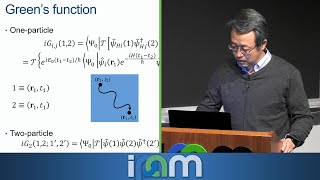
Low Rank Approximation in Electron Excitation Calculations - IPAM at UCLA
Explore low rank approximation techniques for efficient electron excitation calculations, focusing on the Interpolative Separable Density Fitting method and its applications in quantum mechanics.
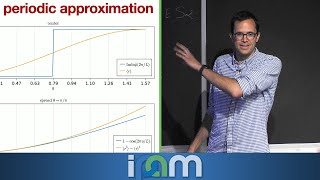
Localization Methods - Perspectives on Initialization and Optimization - IPAM at UCLA
Explore Wannier localization in quantum mechanics, its mathematical formulation, challenges, and new approaches for efficient orbital localization in condensed matter systems.
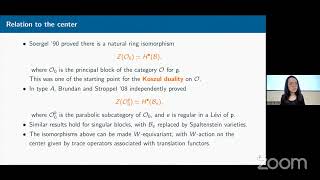
Peng Shan- On Geometrical Realization of Centers
Explore connections between algebra centers and geometric cohomology, focusing on quantum groups and affine Springer fibers in Lie theory.

Introduction to Quantum Mechanics and Light Polarization
Explore the math of superposition and quantum states, focusing on polarized light and its relation to classical electromagnetic waves. Gain insights into quantum mechanics fundamentals.
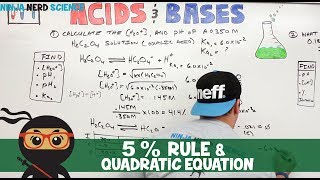
General Chemistry - 5% Rule & Quadratic Equation
Learn to apply the 5% rule with the quadratic equation through discussion and practice problems, enhancing your problem-solving skills in general chemistry.
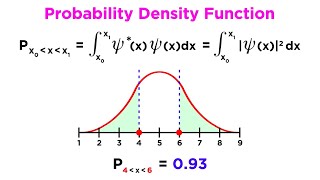
Wavefunction Properties, Normalization, and Expectation Values
Explore quantum mechanics through wavefunctions, normalization, and expectation values. Learn about Hilbert spaces, bra-ket notation, and the superposition principle to gain a deeper understanding of quantum systems.