Главная
Study mode:
on
1
Intro
2
Initially motivated by study of state spill • State spill: the state of a software component undergoes a lasting change a result of interacting with another component Future correctness depends on th…
3
Establishes OS structure of many tiny components All components must have runtime-persistent bounds 2. Adopt intralingual OS design to empower Rust compiler Leverage language strengths to go beyond s…
4
Maximally leverage/empower compiler • Take advantage of Rust's powerful abilities Rust compiler checks many built-in safety invariants
5
Matching compiler's execution model 1. Single address space environment
6
Intralingual OS implementation in brief (0) Use & prioritize safe code as much as possible 1. Identify invariants to prevent unsafe, incorrect resource usage Express semantics using existing language…
7
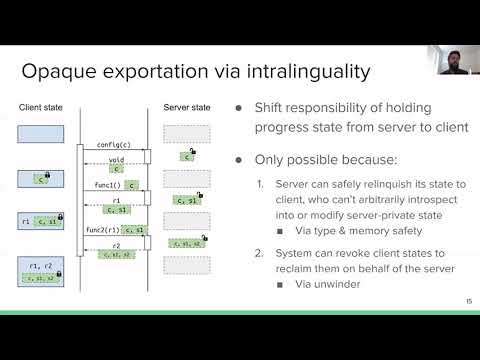
Addressing state spill • Key technique: opaque exportation
8
Compiler-checked Task invariants 1. Spawning a new task must not violate safety 2. Accessing task states must always be safe and deadlock-free 3. Task states must be fully released in all execution p…
9
Theseus facilitates evolutionary mechanisms • Runtime-persistent bounds simplify cell swapping o Dynamic loader ensures non-overlapping memory bounds
10
Realizing availability via fault recovery • Many classes of faults prevented by Rust safety & intralinguality Focus on transient hardware-induced faults beneath the language level
11
Brief evaluation overview • Live evolution case studies • Fault recovery experiments Injecting faults into Theseus Comparison with MINIX 3 microkernel • Cost of intralingual and spill-free design • M…
12
Live Evolution: sync + async "IPC" Theseus advances evolution beyond monolithic/microkernel OSes Safe, joint evolution of user-kernel interfaces and functionality Evolution of core components that mu…
13
Cost of intralinguality & state spill freedom Mapped Pages performs better Safe heap: up to 22% overhead due to allocation bookkeeping
14
Limitations at a glance • Unsafety is a necessary evil + detect infectious unsafe code • Reliance on safe language Must trust Rust compiler and core/alloe libraries • Intralinguality not always possi…
Description:
Explore an experimental operating system called Theseus, designed to improve OS modularity and leverage the Rust programming language for enhanced safety and compiler-enforced invariants. Learn about its unique structure of tiny components with runtime-persistent bounds, intralingual approach, and state management techniques that enable live evolution and fault recovery for core OS components. Discover how Theseus addresses state spill, implements compiler-checked task invariants, and facilitates evolutionary mechanisms. Examine the system's performance, limitations, and comparisons with other operating systems like MINIX 3 and Linux. Gain insights into the challenges and benefits of designing an OS that prioritizes safety, modularity, and compiler-driven resource management.
Theseus - An Experiment in Operating System Structure and State Management

USENIX
Add to list